
 Home
Home
MW vs MWh: Why Storage Power and Storage Capacity Are Two Different Things
If you have ever opened a storage datasheet, a supplier quotation, or a system sizing sheet here in the Philippines and felt that two numbers were quietly contradicting each other — you are not alone. The most common confusion in our industry is also the simplest to fix.
It comes down to two letters: MW and MWh.
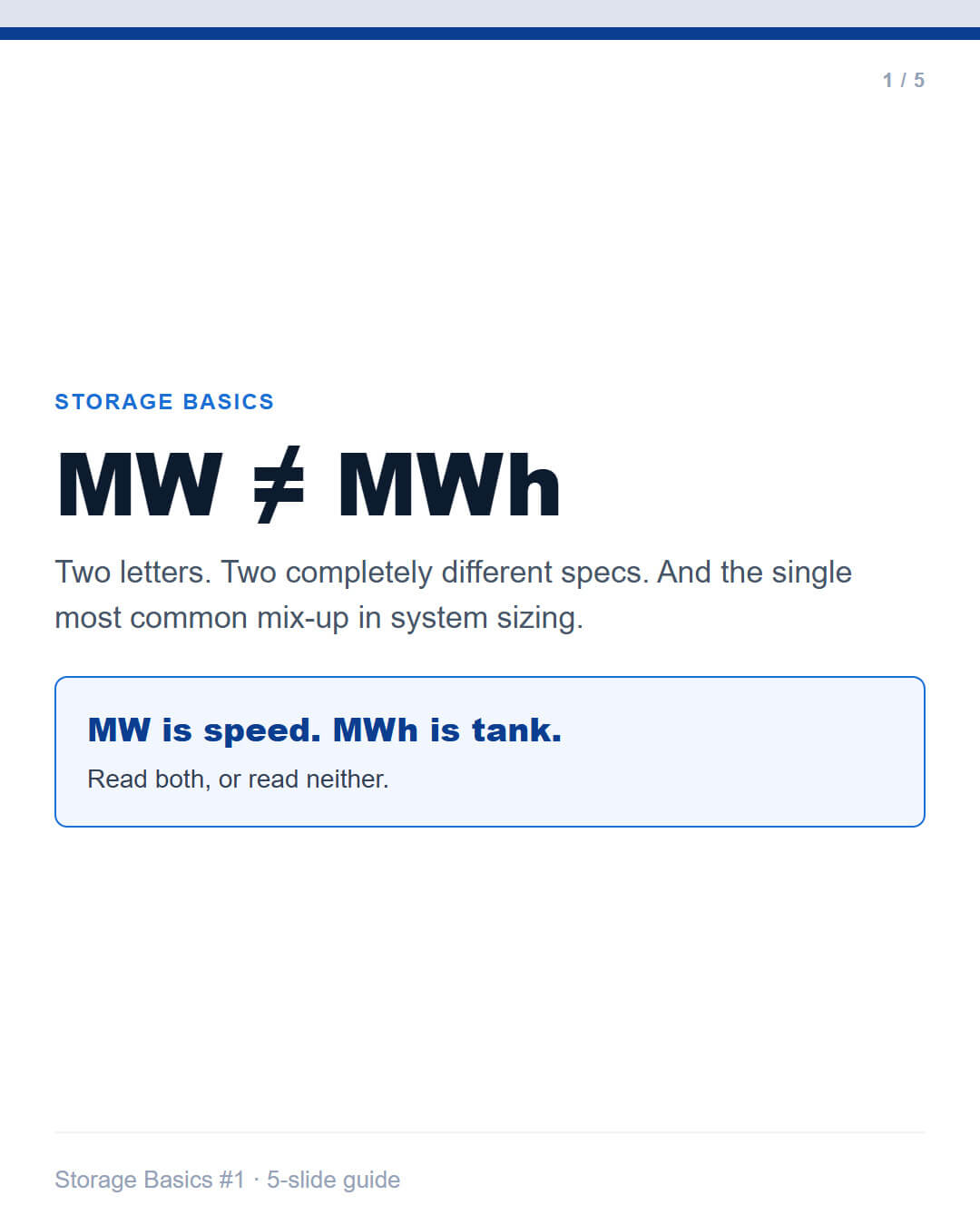
Get this distinction right, and most of the sizing conversations that follow become far easier. Get it wrong, and you can specify a system that looks correct on paper and fails on site.
The short version
|
MW |
MWh |
|
| What it measures |
Power |
Energy |
| The question it answers |
How fast? |
How much? |
| Everyday analogy |
The width of a pipe |
The size of a tank |
| Typical use |
Maximum output, response speed |
speedTotal storage, duration |
1 MW describes an instantaneous rate of energy flow. 1 MWh describes a volume of energy — specifically, 1 MW sustained for one hour, which equals 1,000 kWh
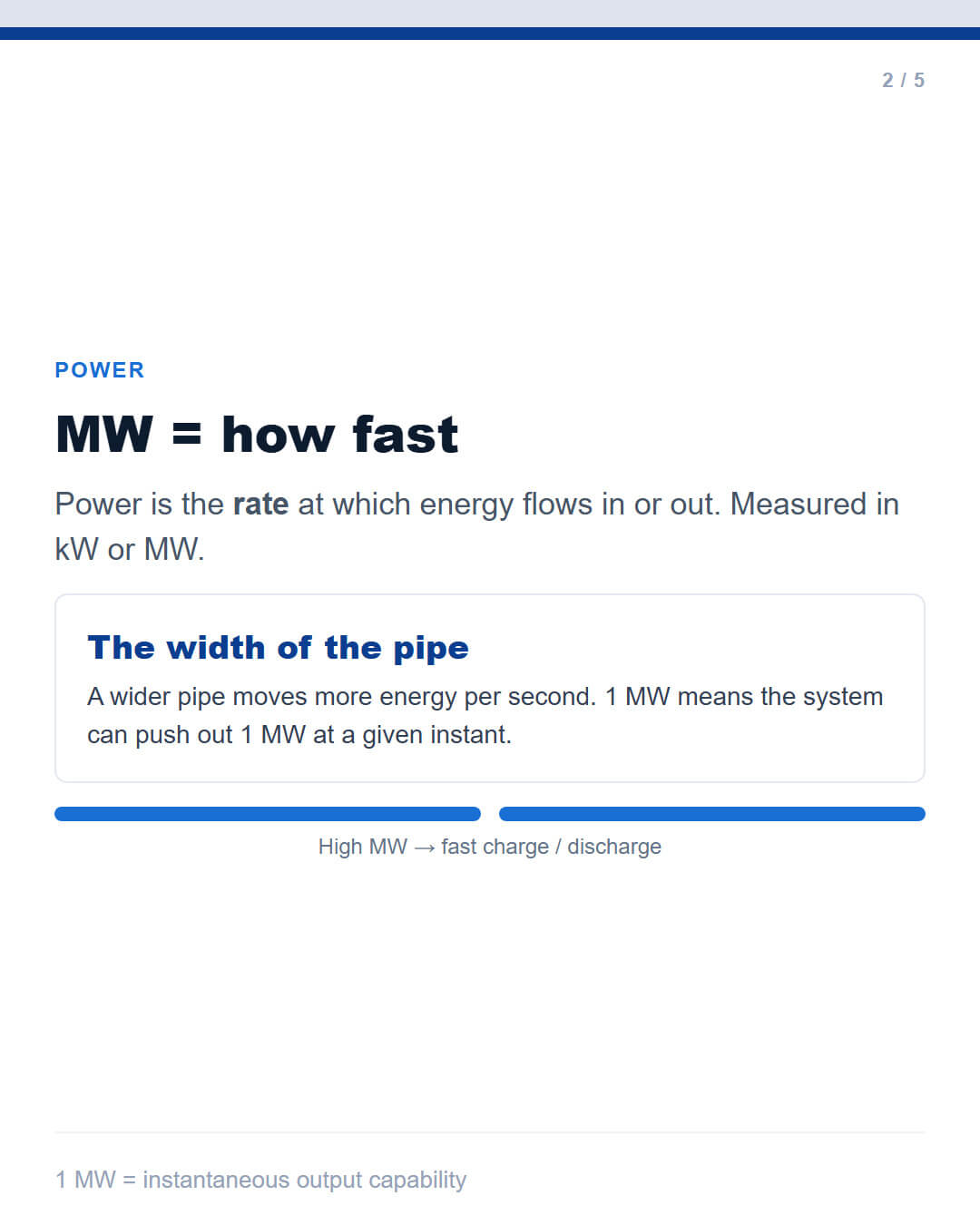
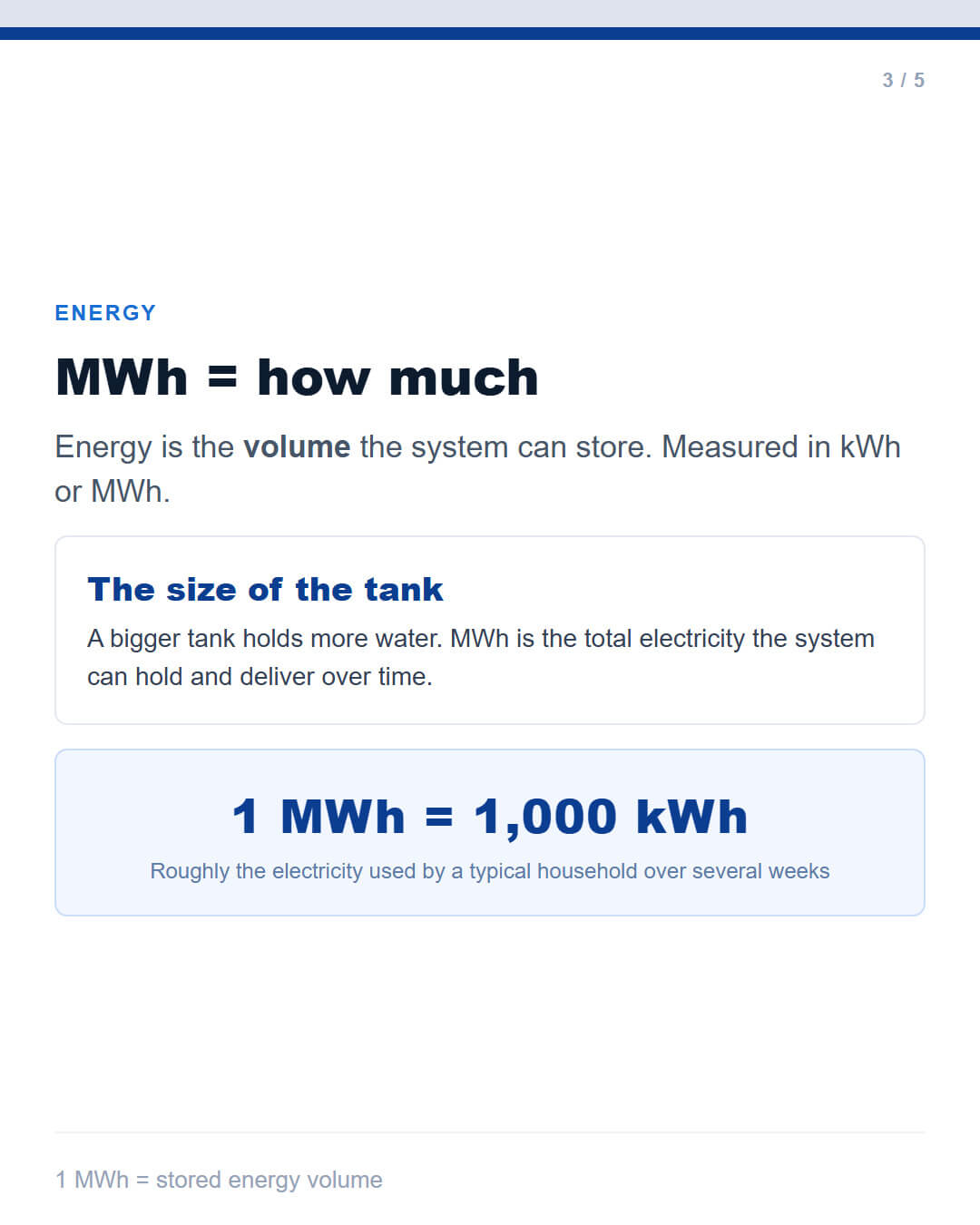
They are not interchangeable. They are not proportional. And they are not two ways of saying the same thing.
Why this matters more than it seems
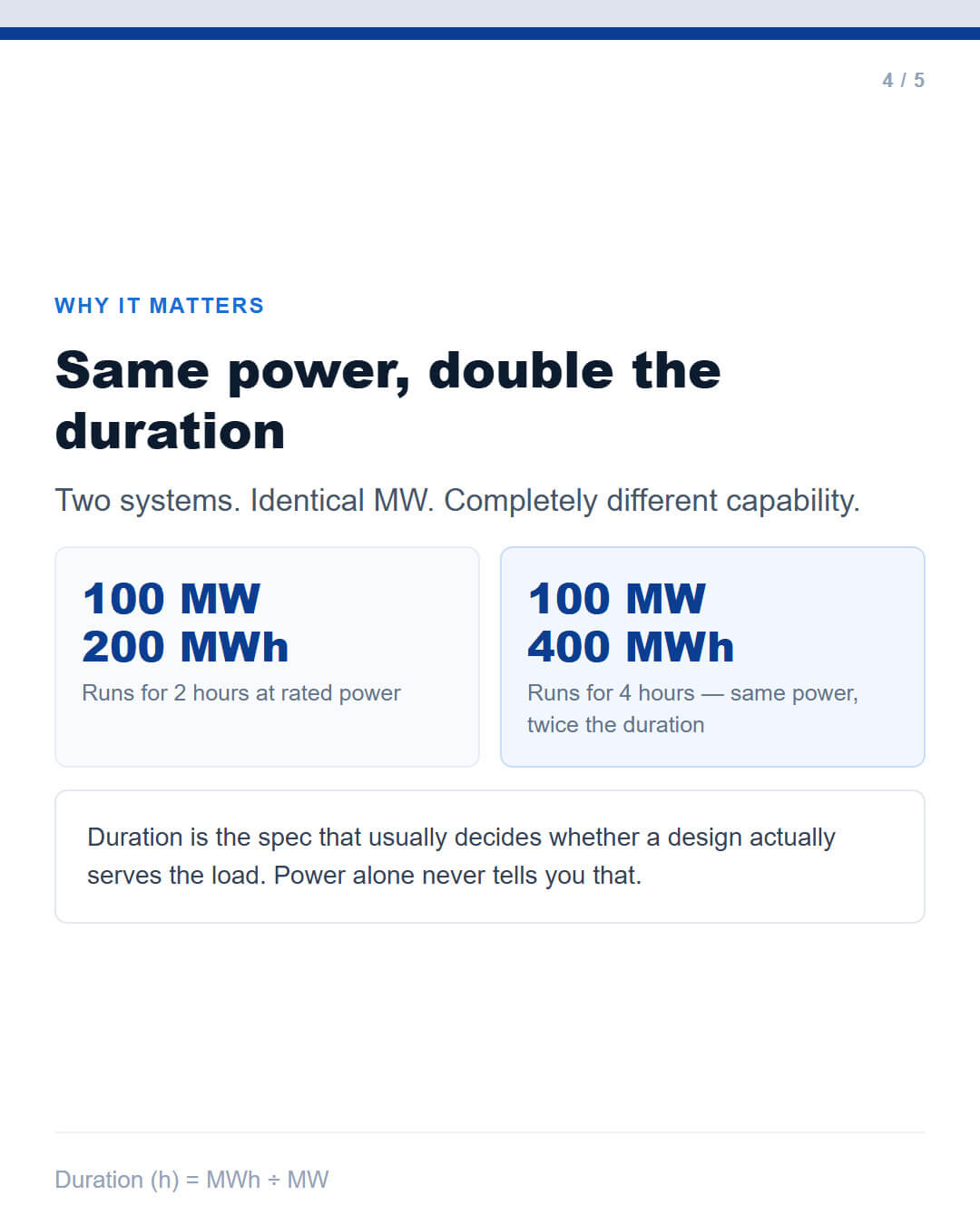
Here is the scenario that catches people out. Two storage systems are quoted to you:
System A: 100 MW / 200 MWh
System B: 100 MW / 400 MWh
System B is not "more powerful." Both systems can deliver 100 MW at any instant — and neither one MW more. What System B has is twice the duration: it can hold that output for twice as long before it runs out of energy.
That difference is usually the number that decides whether your design actually serves the load. A system with impressive MW can still fail a site — because the load needed to run for hours, not seconds.
The duration formula
Duration (h) = Energy (MWh) ÷ Power (MW)
Applied to the example above:
|
System |
Calculation |
Duration at rated power |
| A |
200 ÷ 100 |
2 hours |
| B |
400 ÷ 100 |
4 hours |
Same power. Same instant capability. Completely different service window.
A practical way to remember it
Think about water.
MW is the width of the pipe. A wider pipe moves more water per second. That is power — the rate at which energy flows in or out.
MWh is the size of the tank. A bigger tank holds more water. That is energy — the total stored volume available to deliver over time.
A wide pipe connected to a small tank will empty it fast. A narrow pipe connected to a big tank will take a long time to fill and discharge, but it will sustain the flow for much longer.
Neither is "better." They answer different questions. But you need to know which question your project is actually asking.
The mistake we see most often
Common mistake: "Bigger MW means it stores more energy."
This is the single most frequent misreading, and it usually traces back to a quotation that lists only one of the two numbers.
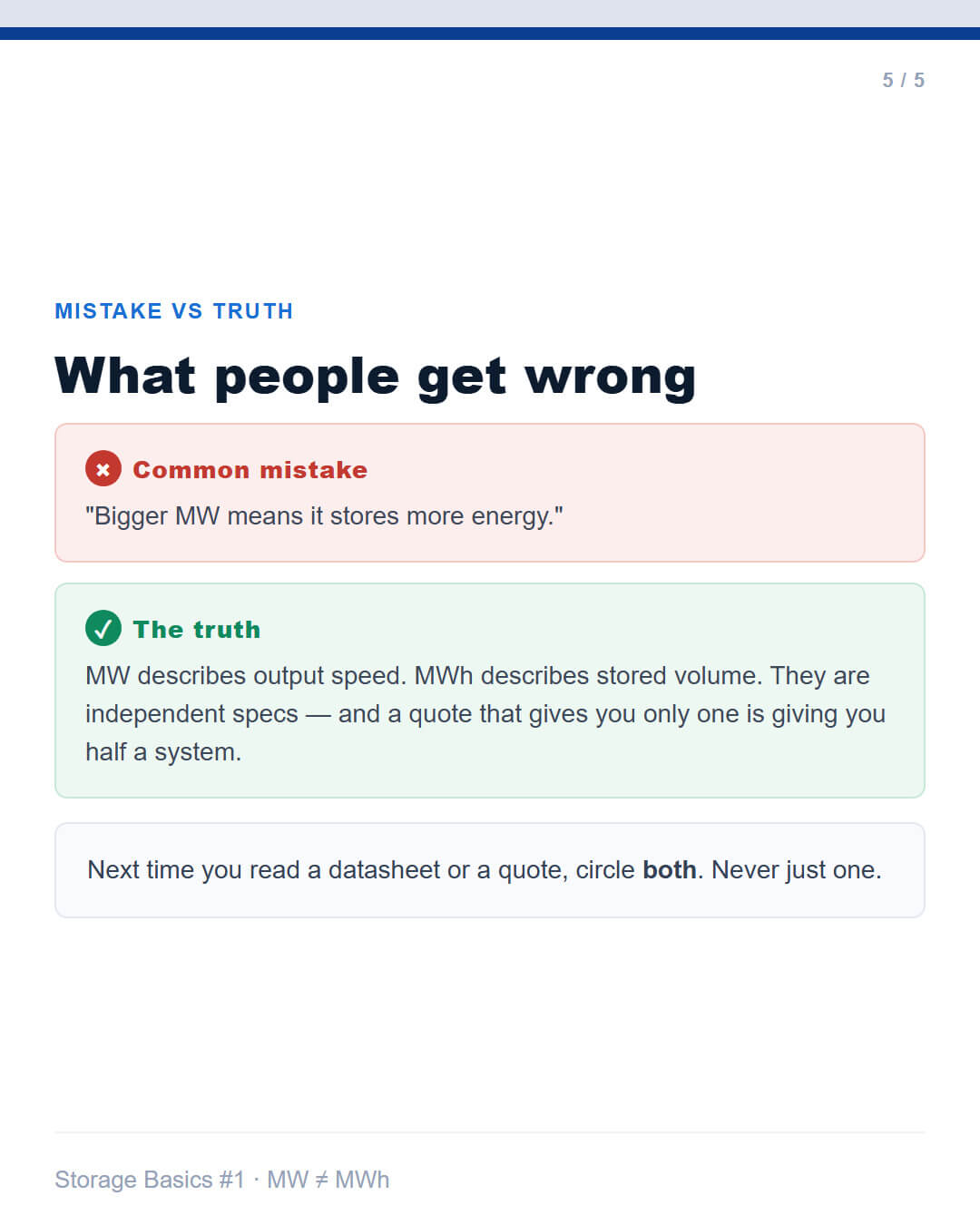
The reality: MW describes output speed. MWh describes stored volume. They are independent specifications. A supplier can increase one without touching the other.
Which leads to a practical rule worth keeping: a quotation that gives you only one of the two numbers is giving you half a system. Ask for both. Every time.
What to do at your next site survey
Before you commit to a configuration, work through these four steps:
Establish the peak load first. Not the average — the peak. This drives the MW requirement.
Establish the required backup or dispatch duration. This drives the MWh requirement, given the load.
Calculate both. Use P = E ÷ T for power and T = E ÷ P for duration. Check they agree with your load profile.
Circle both numbers on the datasheet. If one is missing, ask the supplier which one they omitted and why.
For backup applications in particular, the duration figure is usually what the client actually cares about — they want to know how long the power stays on, not how fast it can discharge in theory.
Frequently asked questions
Is 1 MWh the same as 1,000 kWh? Yes. The MWh and kWh are the same unit of energy at different scales, in the same way that 1 kilometre equals 1,000 metres. A 1 MWh system stores 1,000 kWh of energy.
Can a system have high power but low capacity? Yes, and this is common. Power and capacity are specified independently. A system rated at high MW with modest MWh is designed for short, intense bursts of output. One with lower MW and higher MWh is designed to sustain output over a long duration.
Do I need both numbers to compare two suppliers fairly? You do. Comparing two systems on MW alone ignores duration entirely, and comparing on MWh alone ignores the rate at which the energy can actually be delivered. Both are needed for a meaningful comparison.
How does duration relate to the "2-hour battery" label I keep seeing? That label is derived from the ratio of energy to power — it is a rated-condition figure, not a guarantee under all loads and temperatures. We cover what that number does and does not promise in our guide to battery duration and the "2h" claim.
In Filipino (Tagalog)
Paalala sa mga installer:
Ang MW ay bilis ng charging o discharging — ito ang power. Ang MWh ay laki ng imbak na enerhiya — ito ang capacity.
Magkaibang bagay sila. Ang isang sistema na may parehong MW ay maaaring magkaroon ng ibang tagal ng serbisyo depende sa MWh.
Formula: Tagal (oras) = MWh ÷ MW
Huwag paghaluin ang dalawa sa sizing. Kung isa lang ang nakasulat sa quote, itanong kung alin ang nawawala.
Related guides in this series
The C-rate trap: why 0.5C is not 50% of rated power
What SOC actually tells you — and what it does not
Battery duration explained: the truth about the "2h" claim
All figures in this article are illustrative examples used to explain the underlying principles. They do not represent the specifications of any particular product. For current terms, availability and technical documentation, please contact us.
Storage Basics is an educational series from VANYO's overseas team, written for installers, EPCs and system integrators working in the Philippine market.

 Address: Wanyang Gold and Silver Building 6, Circular Economy Park, Sili Town, Jiyuan City, Henan Province, China