
 Home

The C-Rate Trap: Why 0.5C Does Not Mean 50% of Rated Power
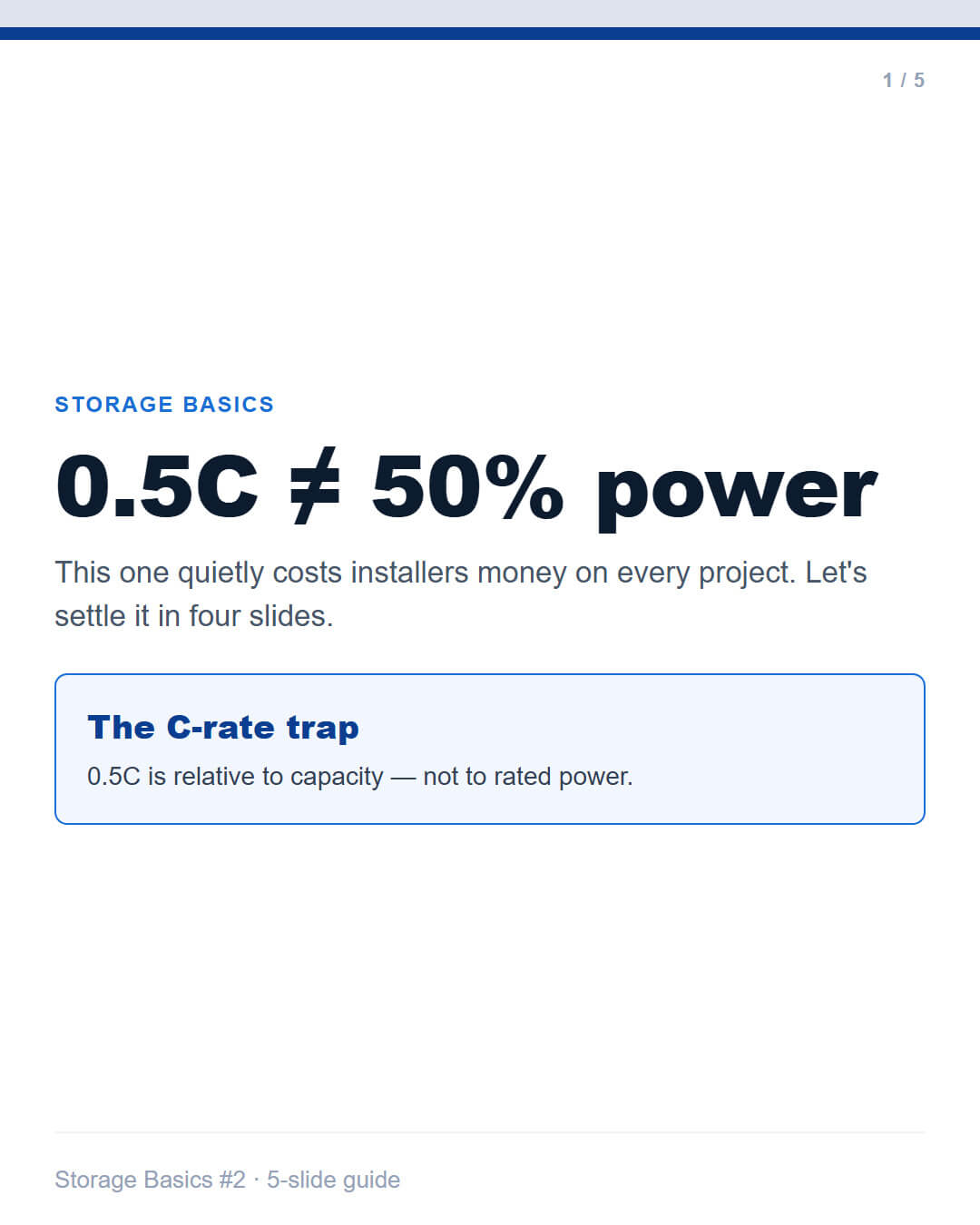
There is a specific mistake in storage sizing that is remarkably widespread, quietly expensive, and almost entirely avoidable. It involves a single letter: C.
When a quotation says "0.5C operation," most people read it as "50% of rated power." That reading is wrong. And because the error is subtle, it tends to survive all the way to commissioning — where it shows up as a system that cannot perform as promised.
This guide fixes it in about ten minutes.
What a C-rate actually is
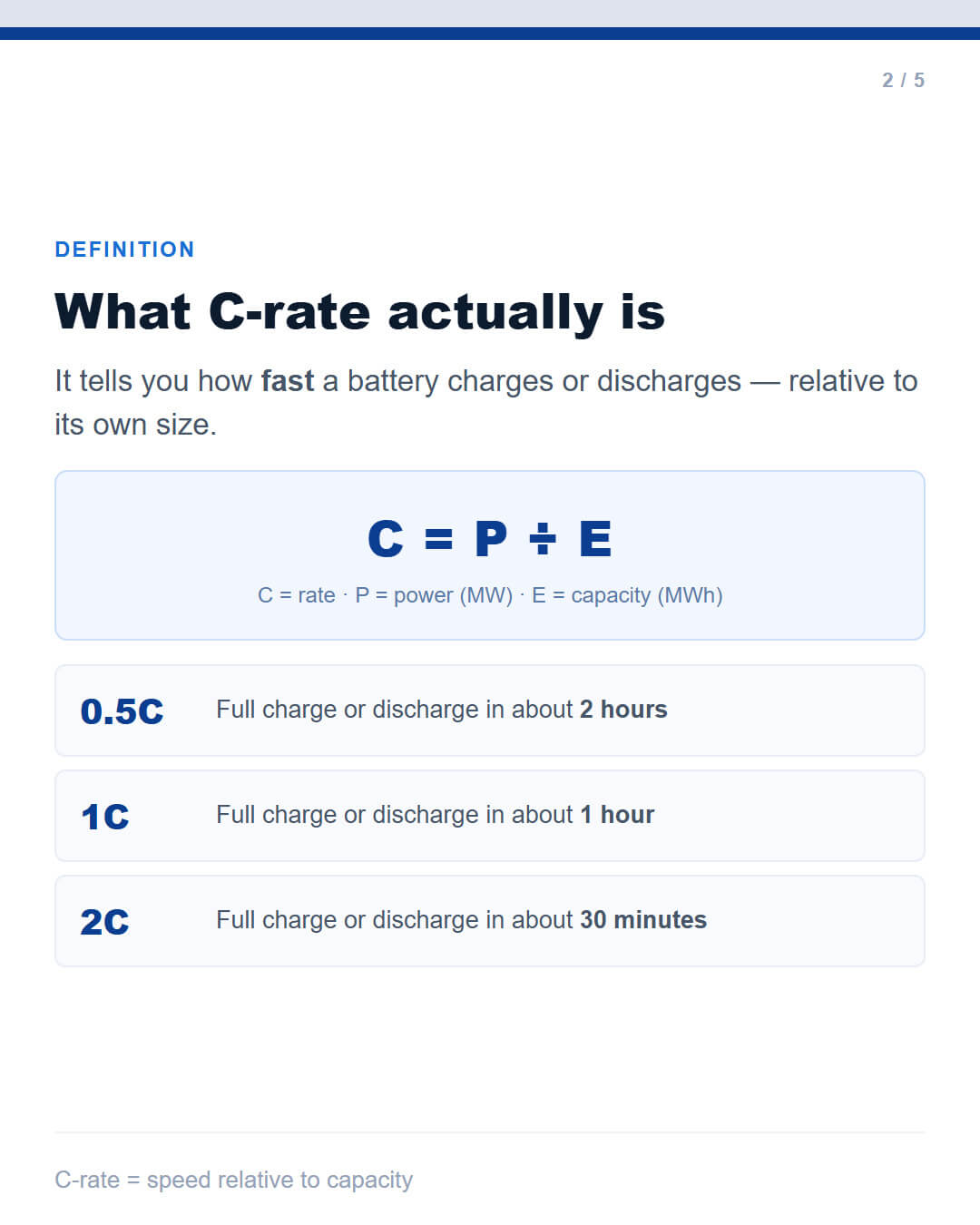
The C-rate describes how fast a battery charges or discharges — relative to its own size.
C = P ÷ E
Where:
C = the C-rate
P = power (MW)
E = energy capacity (MWh)
The key phrase is relative to its own size. A C-rate is not a proportion of the nameplate. It is a ratio between two properties of the same system.
What common C-rates mean in practice
|
C-rate |
Full charge or discharge time |
| 0.25C |
~4 hours |
| 0.5C |
~2 hours |
| 1C |
~1 hour |
| 2C |
~30 minutes |
So far, this is reasonably intuitive: a bigger C is faster.
Where it goes wrong
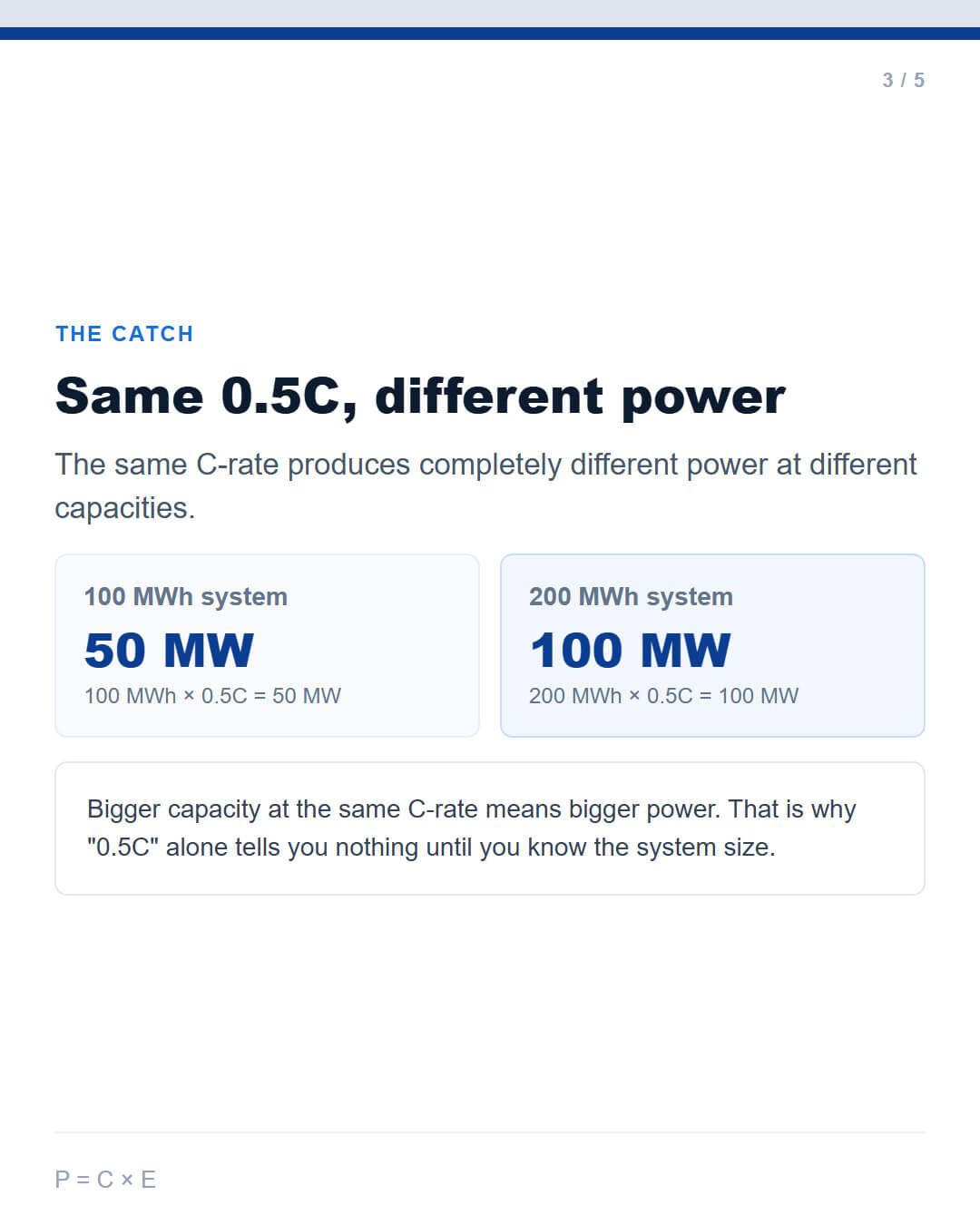
The catch is what happens when you hold the C-rate constant and change the capacity.
Because C = P ÷ E, rearranging gives us:
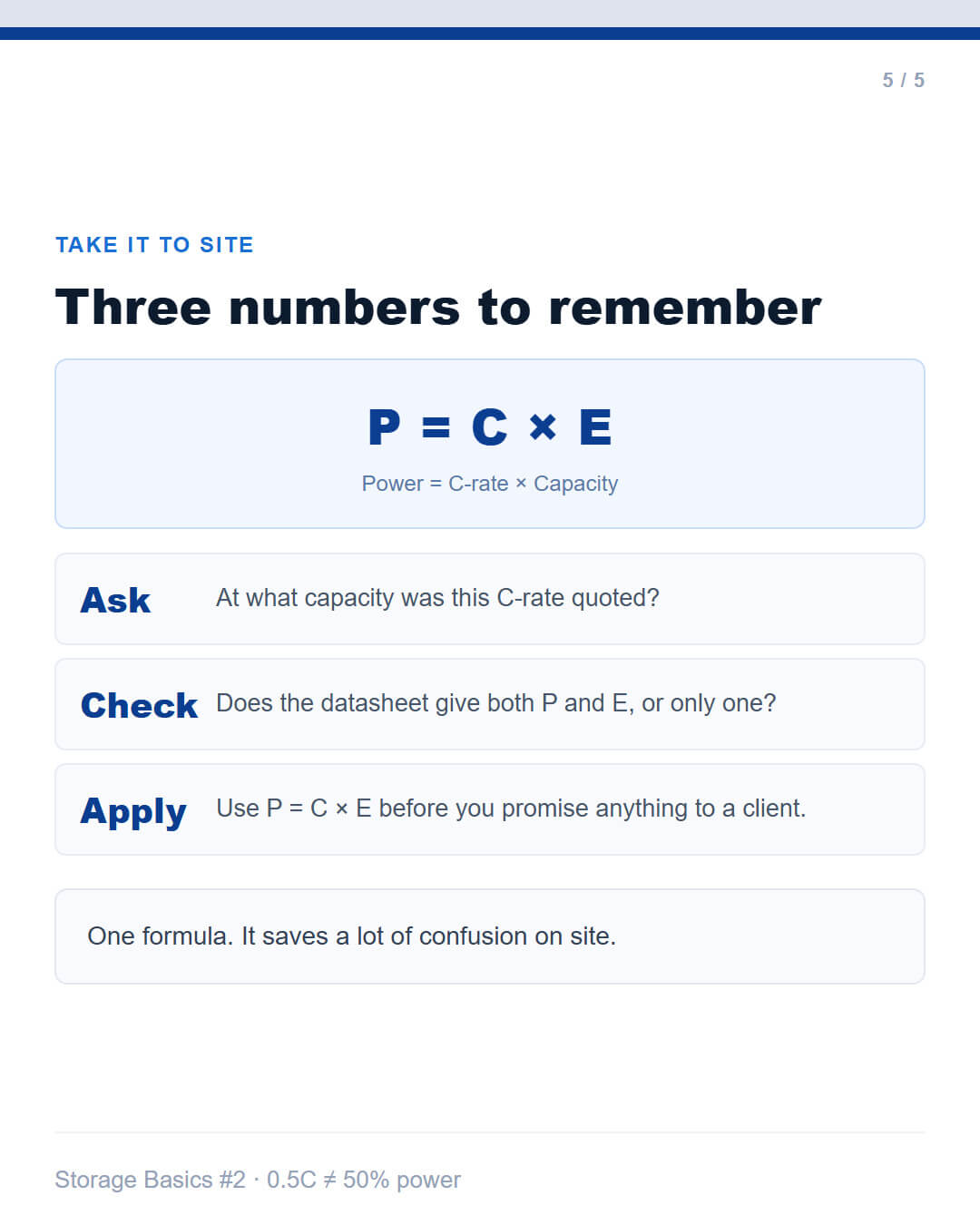
P = C × E
Power equals C-rate multiplied by capacity. Which means the same 0.5C produces completely different power at different system sizes.
|
System capacity |
At 0.5C, the power is |
| 100 MWh |
50 MW |
| 200 MWh |
100 MW |
| 400 MWh |
200 MW |
Read that table again, because this is the whole point: the C-rate did not change. The capacity did. And power moved with it.
This is why "0.5C" on its own carries almost no information. It only becomes meaningful once you know the system size it is applied to.
The mistake and the reality
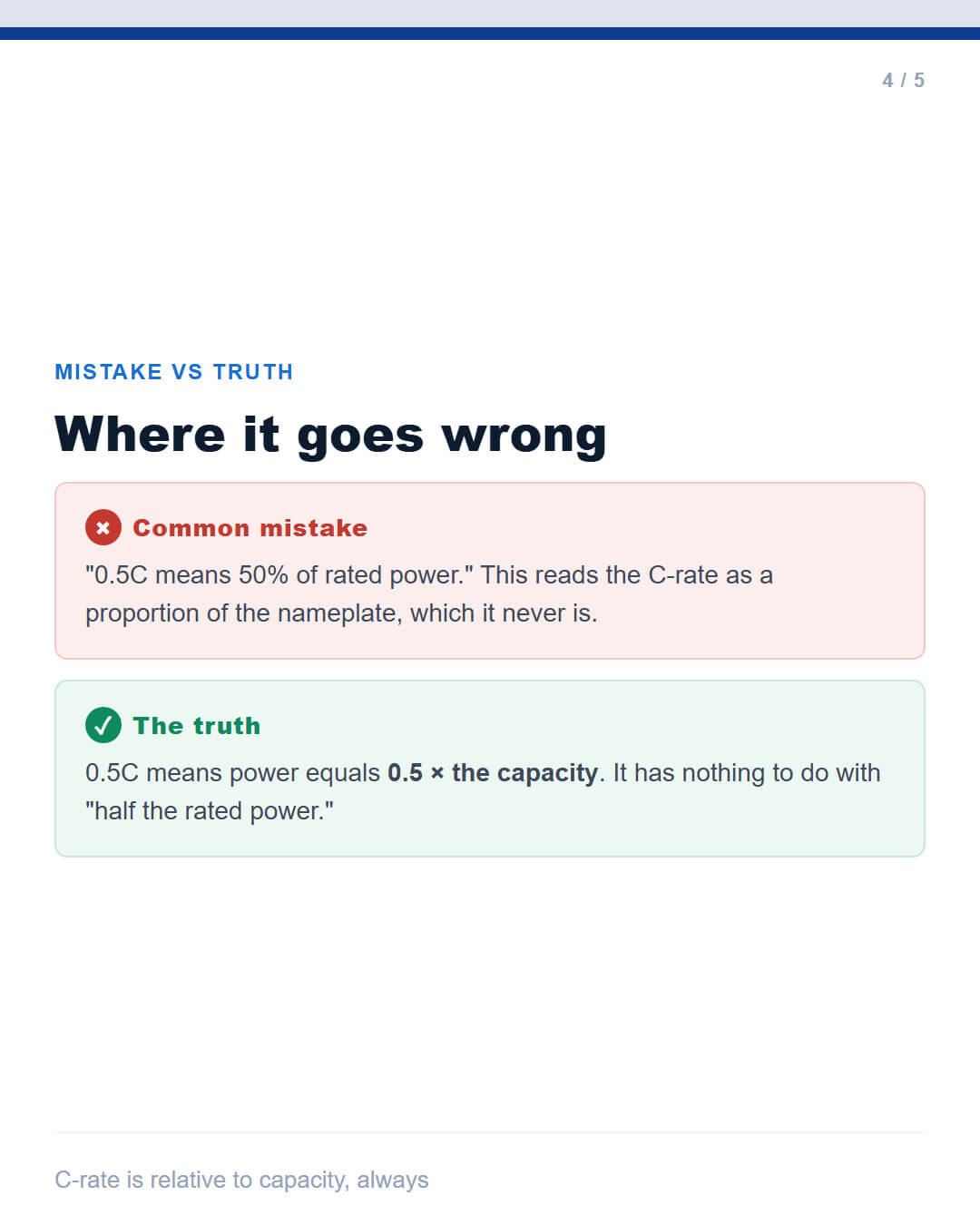
Common mistake: "0.5C means 50% of rated power."
This reading treats the C-rate as a proportion of the nameplate — as if 0.5C were half of some "1C max" figure stamped on the system. It is not.
The reality: 0.5C means power equals 0.5 × the capacity. It has nothing to do with "half the rated power."
The two are only numerically identical in one specific case. Consider a system rated 200 MWh / 100 MW:
0.5C applied to capacity = 0.5 × 200 MWh = 100 MW ✅
0.5P applied to rated power = 0.5 × 100 MW = 50 MW ❌
Wait — those do not match. Let me be precise, because this is where people get caught.
The condition under which 0.5C and 0.5P coincide is when rated power P = 0.5 × capacity E. For a 200 MWh system, that requires a rated power of 100 MW. Only in that configuration does "half the rated power" happen to equal "0.5C of capacity."
Change the system to 200 MWh / 50 MW and the two diverge completely. There is no general equivalence.
A note on 0.5C versus 0.5P
These two notations look almost identical and mean different things.
|
Notation |
Relative to |
Depends on |
| 0.5C |
Capacity |
The system's MWh |
| 0.5P |
Rated power |
The system's MW |
A C-rate scales with energy capacity. A P-rate scales with power rating. They answer different questions and cannot be compared directly.
So when a specification says "0.5C operation," the correct follow-up question is: at what capacity? Without that, the number tells you nothing.
Applying this on site
Four habits that prevent the mistake:
Always ask for both P and E. A C-rate without a capacity reference is not a specification.
Write P = C × E where you can see it. One line of arithmetic prevents most of these errors.
Check the quotation's internal consistency. If a quote claims a C-rate and a power figure, verify they agree with the stated capacity.
Do not compare C-rates across differently sized systems. The comparison is meaningless. Convert to absolute power first, then compare.
A worked example
Suppose a client needs a system that can deliver 75 MW and run for 3 hours. Watch how the C-rate falls out of those two requirements rather than being chosen up front.
Step 1 — the energy requirement.
| E = P × T = 75 MW × 3 h = 225 MWh |
Step 2 — the C-rate this implies.
| C = P ÷ E = 75 ÷ 225 = 0.333C |
So the system operates at roughly 0.33C — about a three-hour full cycle. Nobody had to pick that number. It was determined by the load and the duration the client needed.
Step 3 — sanity-check against the quotation.
If the supplier's datasheet lists a maximum C-rate of 0.5C, this requirement sits comfortably inside the rating. If it lists a maximum of 0.25C, the specified system cannot deliver 75 MW for 3 hours and something has to change.
This is the direction the calculation should always run: from the load requirement to the C-rate, never the other way around. When a sales conversation starts with a C-rate and works backwards toward what the system can do, it is easy to end up specifying something that cannot serve the actual load.
Matching C-rate to the application
Different duty cycles call for different C-rates. There is no universally correct value.
| Application pattern |
Typical C-rate character |
Why |
| Long-duration backup |
Low C |
Discharge is slow and sustained over many hours |
| Daily solar shifting |
Moderate C |
Charge and discharge across a normal day cycle |
| Peak shaving |
Higher C |
Short, repeated bursts of significant power |
| Grid frequency response |
Very high C |
Fast response matters more than duration |
The practical implication: a C-rate quoted in isolation tells you nothing about whether it suits your project. Read it against the duty cycle the client actually needs, and then verify the arithmetic.
Frequently asked questions
Is a higher C-rate always better? Not necessarily. A high C-rate means faster charge and discharge, which suits applications needing rapid response. But faster cycling generally places more stress on cells and can affect longevity. The right C-rate depends on the duty cycle your project actually needs.
Can a system run at a lower C-rate than its maximum? Yes, and many do. A system rated for 1C may operate routinely at 0.5C or below, depending on the application and how the operator manages the duty cycle. The rated maximum is a capability ceiling, not a required operating point.
Why do some quotes give C-rate and others give power? It is largely a convention difference, and it is one reason quotes can be hard to compare. Always convert to the same basis — either both to MW, or both to a C-rate referenced against a stated capacity — before drawing conclusions.
How does C-rate relate to duration? They are inversely related: duration in hours is approximately 1 ÷ C-rate for a full cycle. A 0.5C rate corresponds to roughly a 2-hour charge or discharge. We cover the duration figure and its limits in our guide to the "2h" claim.
In Filipino (Tagalog)
Paalala sa mga installer:
Ang 0.5C ay hindi 50% ng rated power. Ito ay 0.5× ng capacity.
Kaya sa isang 200 MWh na sistema, ang 0.5C ay katumbas ng 100 MW. Sa 100 MWh na sistema, ito ay 50 MW.
Formula: P = C × E (Power = C-rate × Capacity)
Kapag may nakita kang "0.5C" sa isang quote, itanong palagi: sa anong capacity? Kung wala ito, walang saysay ang numero.
Huwag ipaghambing ang 0.5C at 0.5P — magkaiba ang basehan ng dalawa.
Related guides in this series
MW vs MWh: why power and capacity are two different things
What SOC actually tells you — and what it does not
Battery duration explained: the truth about the "2h" claim
All figures in this article are illustrative examples used to explain the underlying principles. They do not represent the specifications of any particular product. For current terms, availability and technical documentation, please contact us.
Storage Basics is an educational series from VANYO's overseas team, written for installers, EPCs and system integrators working in the Philippine market.
 What SOC Actually Tells You — And What It Does Not

 Address: Wanyang Gold and Silver Building 6, Circular Economy Park, Sili Town, Jiyuan City, Henan Province, China