
 Home

Two Storage Questions Most Installers Answer Wrong
These two questions come up in real sizing conversations, usually at the point where a quotation is being checked. Both look obvious. Both catch experienced people out. And both, in the end, come down to the same habit: reading the unit before reading the number.
Answer them yourself before scrolling to the answers.
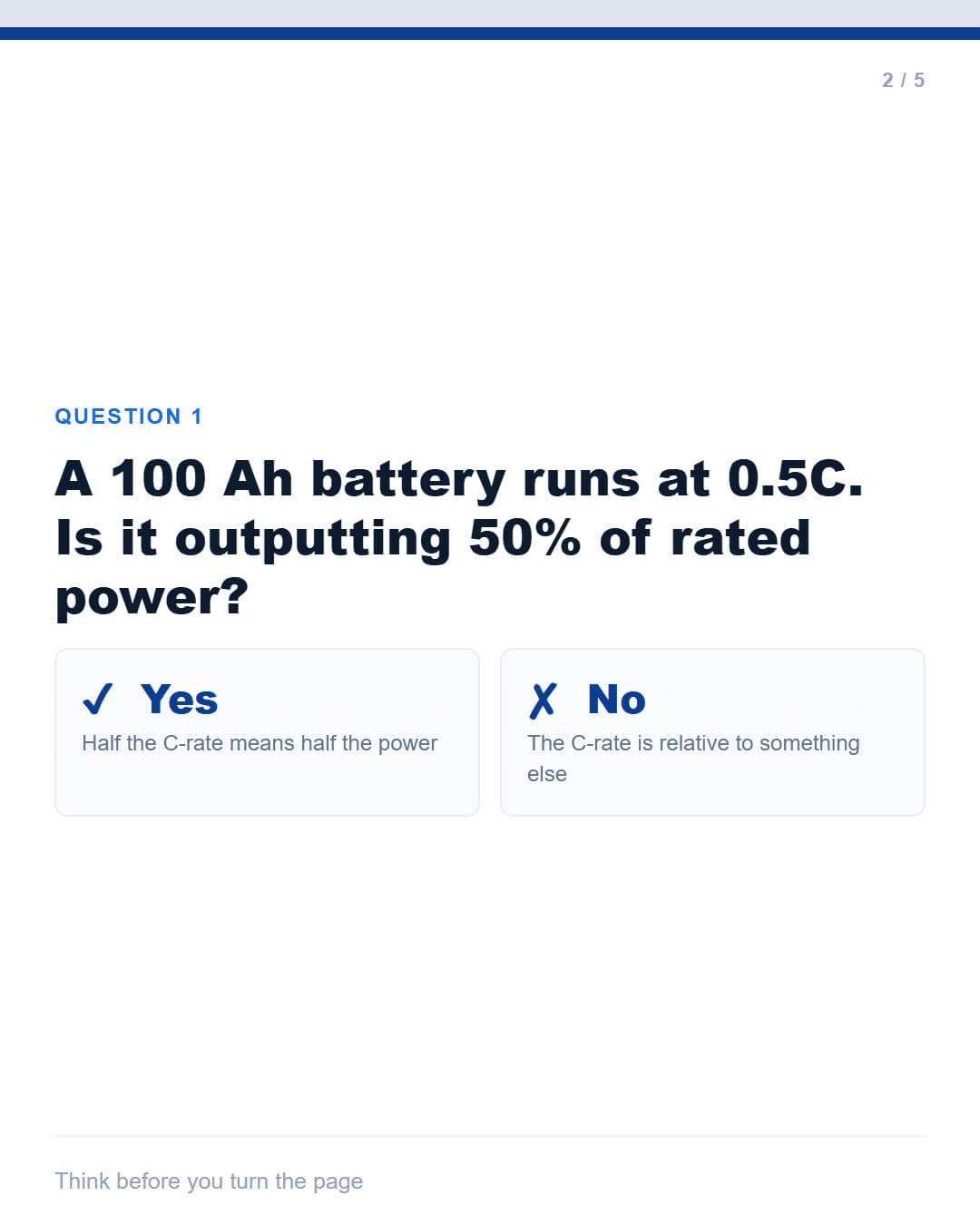
Question 1
| A 100 Ah battery runs at 0.5C. Is it outputting 50% of its rated power? |
✅ Yes / ❌ No
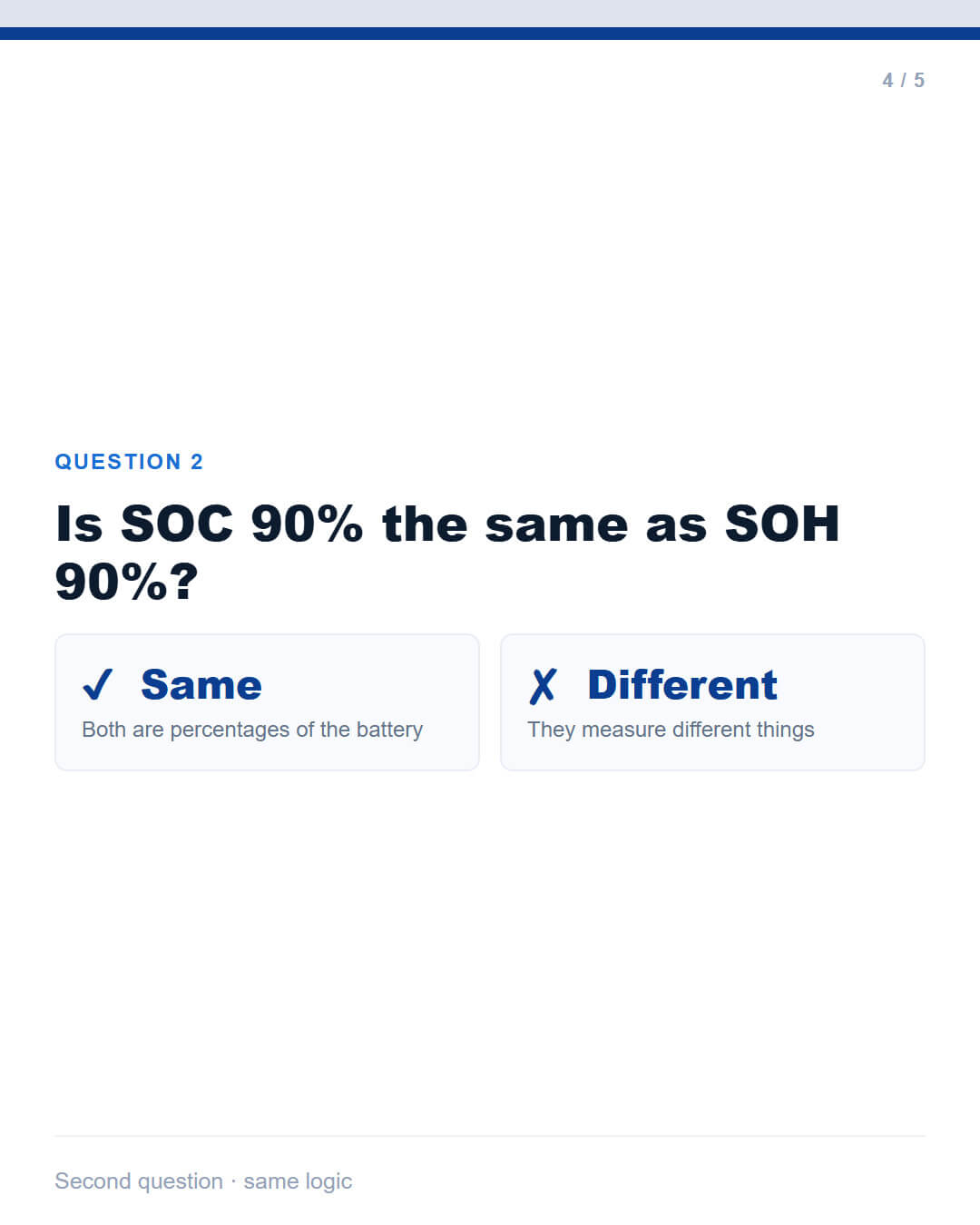
Question 2
| Is SOC 90% the same as SOH 90%? |
✅ Same / ❌ Different
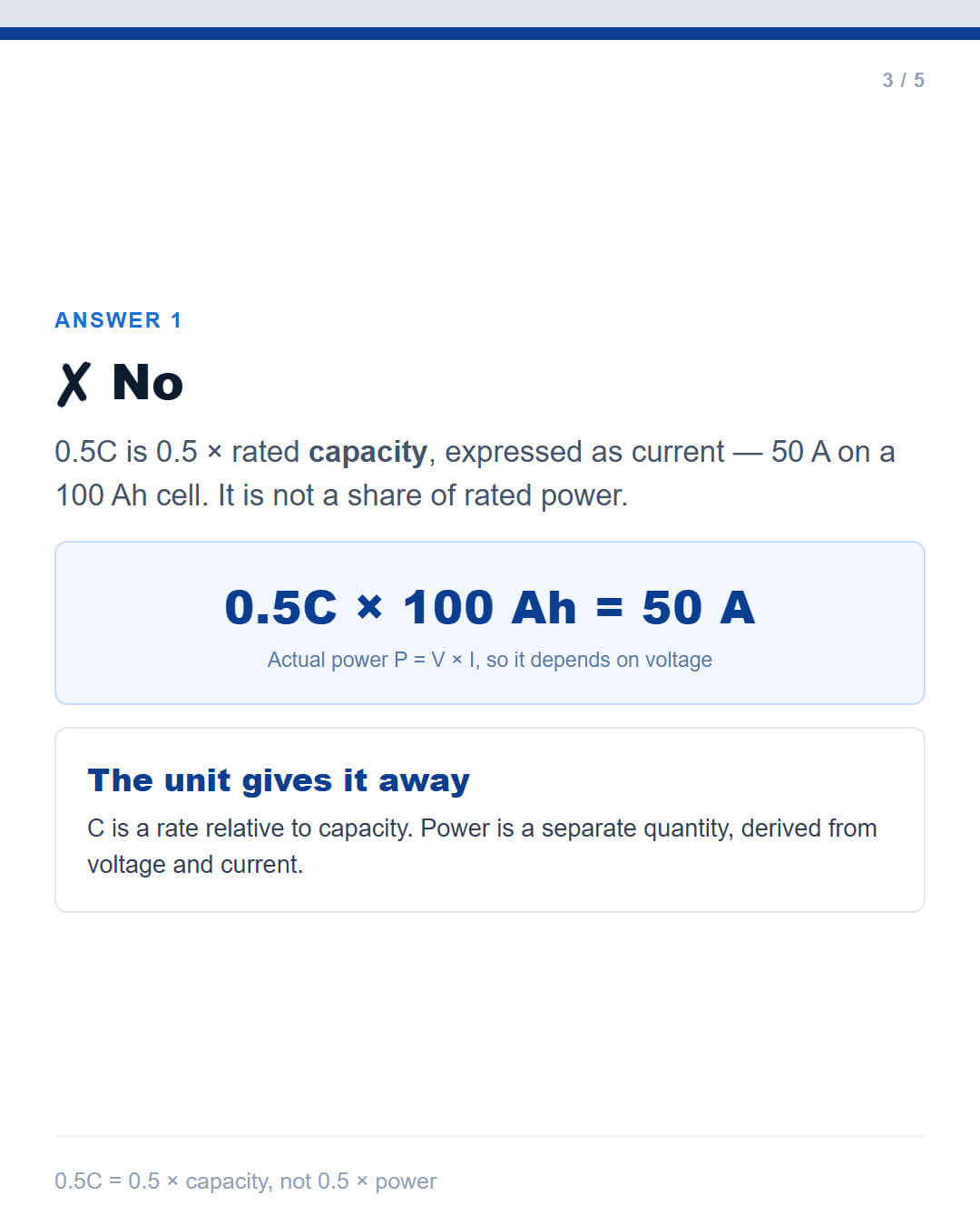
Answer 1 — No
This is the most common C-rate error in the field, and it comes from reading "0.5" as if the unit were a percentage of power.
C is a rate relative to capacity, not to power.
|
0.5C = 0.5 × rated capacity, expressed as current = 0.5 × 100 Ah = 50 A |
So 0.5C on a 100 Ah battery is 50 A of current. It says nothing directly about power.
To get power you need voltage:
|
P = V × I |
A 48 V pack drawing 50 A delivers roughly 2.4 kW. A 400 V pack drawing the same 50 A delivers roughly 20 kW. Same C-rate, same current, power differs by nearly an order of magnitude.
The lesson: a C-rate tells you how fast the battery is being cycled relative to its capacity. To move from current to power you always need the voltage. Treating 0.5C as "50% of rated power" produces an estimate that can be wrong by a factor of eight.
This is the same trap covered in The C-rate trap: why 0.5C is not 50% of rated power.
Answer 2 — Different
Both are percentages. Both appear on a BMS screen. They measure entirely different things.
|
SOC |
SOH |
|
| Stands for |
State of Charge |
State of Health |
| Answers |
How full is it right now? |
How healthy is it versus new? |
| Reference |
Usable capacity window |
Beginning-of-life performance |
| Behaviour |
Moves up and down continuously |
Only declines |
| Analogy |
Fuel gauge |
Health report |
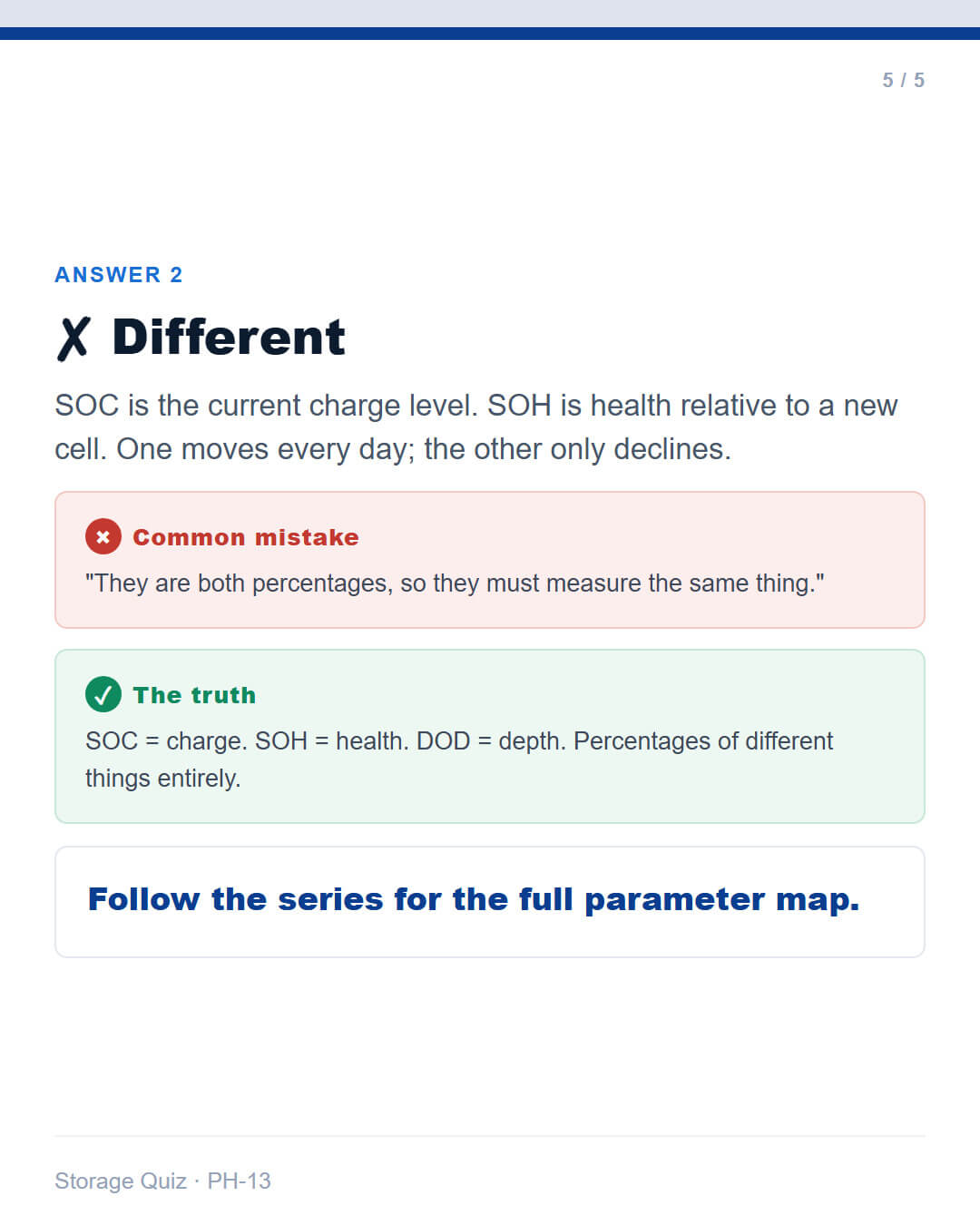
SOC is the current charge level as a share of usable capacity. It is a snapshot, refreshed continuously, and it rises every time the battery charges.
SOH is today's performance relative to a new cell — covering usable capacity, internal resistance and power capability. It does not recover. Over the life of the system it drifts in one direction only.
So "SOC 90%" and "SOH 90%" describe two different questions. One is about right now; the other is about the system's age. A battery can sit at SOC 90% while its SOH has fallen to 80% — both statements true, both meaningful, and neither a substitute for the other.
This connects directly to how DOD works alongside them: SOC, SOH and DOD answer three different questions.
The habit behind both mistakes
In both cases the error is the same: the number was read before the unit.
"0.5" was read as a power percentage instead of a capacity-linked rate.
"90%" was read as one thing when two different reference values were in play.
This is why the first move when checking any specification is to identify what the number is relative to — rated power, capacity, beginning-of-life performance, or a defined SOC window. The unit and the reference value carry the meaning. The digits alone do not.
Getting these right takes ten seconds. Getting them wrong produces a specification error that takes a project to fix.
Frequently asked questions
Does 0.5C always mean a 2-hour discharge? Yes, in the sense that 0.5C corresponds to a full charge or discharge in about 2 hours at the rated capacity. But the usable energy delivered inside that window depends on the SOC limits applied, so a "2-hour" 0.5C discharge may deliver noticeably less than nameplate.
Can SOH ever increase? Under normal operation, no. SOH describes degradation relative to a new cell and declines over service life. Some BMS implementations recalibrate the SOH estimate after a full cycle, which can shift the reported figure slightly — but the underlying trend is downward.
Why do BMS screens show both SOC and SOH? Because operators need both questions answered simultaneously: how much energy is available now (SOC), and how much the system has aged (SOH). A dispatch decision uses one; a maintenance or warranty decision uses the other.
Is a high SOC always better for battery life? Not necessarily. Batteries are typically happiest in the middle of their SOC range. Sitting at very high SOC for long periods can accelerate calendar ageing, which is why usable windows are often capped below 100%.
In Filipino (Tagalog)
Tanong 1: Ang 0.5C ba ay 50% ng rated power? Sagot: Hindi. Ang 0.5C ay 0.5 × ng capacity (50 A sa 100 Ah na baterya). Ang aktwal na power ay P = V × I — nakadepende sa boltahe.
Tanong 2: Pareho ba ang SOC 90% at SOH 90%? Sagot: Hindi. Ang SOC ay kasalukuyang charge level. Ang SOH ay kalusugan ng baterya kumpara sa bago. Ang isa ay gumagalaw araw-araw; ang isa ay pababa lamang.
Basahin muna ang unit bago ang numero.
Related guides in this series
The C-rate trap: why 0.5C is not 50% of rated power
SOC, SOH and DOD: three battery metrics that answer three different questions
What SOC actually tells you — and what it does not
All figures in this article are illustrative examples used to explain the underlying principles. They do not represent the specifications of any particular product. For current terms, availability and technical documentation, please contact us.
Storage Basics is an educational series from VANYO's overseas team, written for installers, EPCs and system integrators working in the Philippine market.
 From Parameters to Profit: How a Storage Datasheet Becomes a Business Case

 Address: Wanyang Gold and Silver Building 6, Circular Economy Park, Sili Town, Jiyuan City, Henan Province, China