
 Home

From Parameters to Profit: How a Storage Datasheet Becomes a Business Case
You can read every specification on the sheet, quote it correctly, and still lose money. Not because any single figure was wrong — because the figures were never joined up.
A storage project is not a list of parameters. It is a chain, and every link has to hold. Break one and the return on paper does not survive contact with the site.
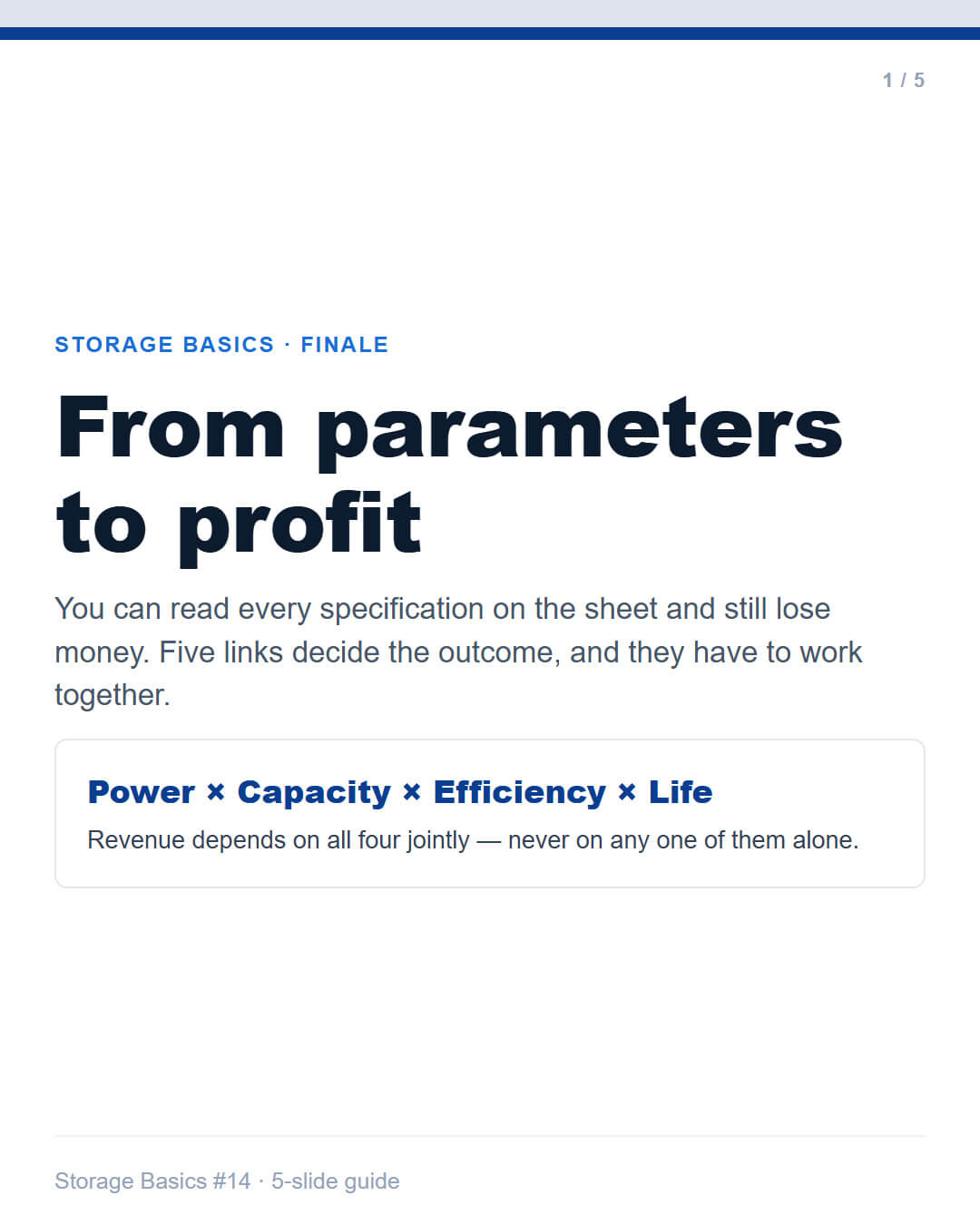
This is the final article in the Storage Basics PH series. It draws the earlier pieces together into the chain that actually decides your client's outcome.
The chain, link by link
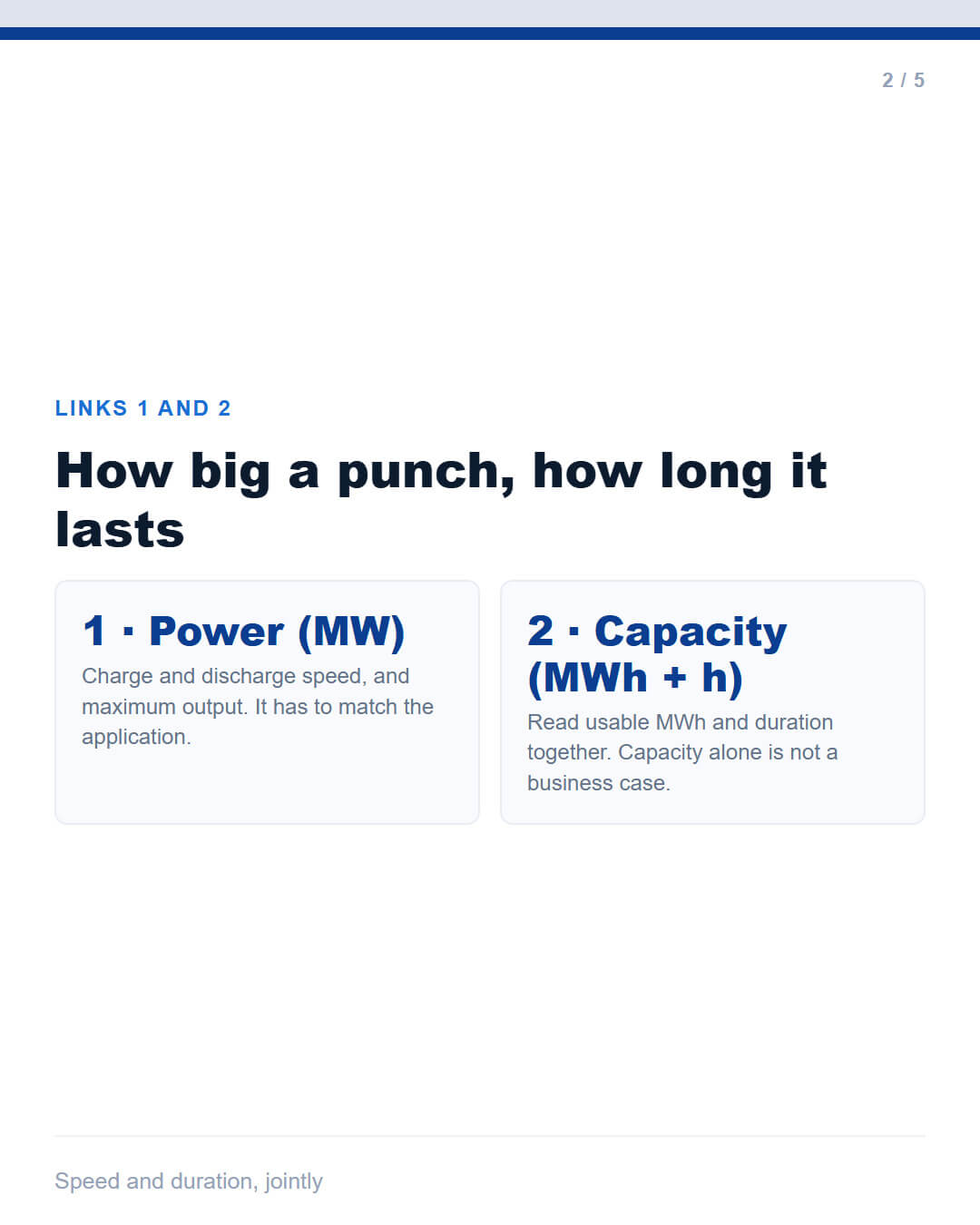
① Power (MW) → How big a punch?
Power is the charge and discharge rate — how fast energy can move in or out, and the maximum output the system can sustain.
It has to match the application. A system sized for peak shaving needs power; one sized for overnight shifting needs duration. Read more in Rated power (P) explained.
② Capacity (MWh + h) → How long can it serve?
Capacity is stored energy, and it converts directly into duration:
|
T = E ÷ P |
Read usable MWh and duration together. Capacity alone is not a business case — 10 MWh delivered over two hours and over ten hours serve completely different loads. See Battery capacity (E) explained and the truth about the "2h" claim.
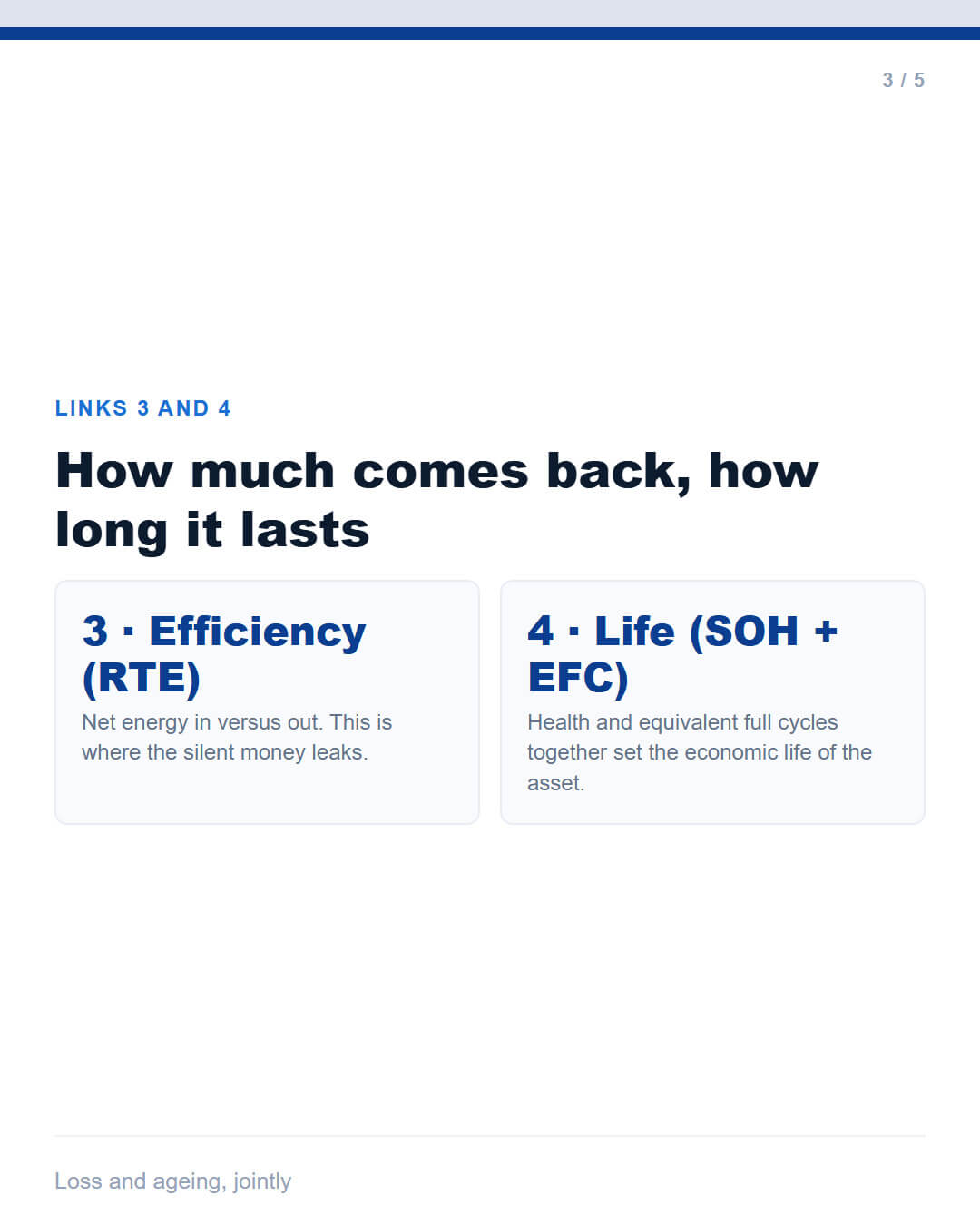
③ Efficiency (RTE) → How much comes back?
Round-trip efficiency is net energy out divided by net energy in, measured at system level. Every conversion and every auxiliary load sits between the two.
This is where the silent money leaks. A two-point difference in system RTE compounds across thousands of cycles into a material energy loss — one that never appears on a datasheet headline. See Round-trip efficiency: a system number, not a cell number.
④ Life (SOH + EFC) → How long will it last?
State of health and equivalent full cycles together define the system's economic life. Cycle-life figures are meaningless without their conditions — DOD, temperature and the EOL criterion all move the number substantially.
The difference between a 3,000-cycle and an 8,000-cycle service life at the same capex is the difference between a project that repays and one that does not. See SOC, SOH and DOD.
⑤ Return → What's the final number?
Revenue is driven by all four together:
|
Return ∝ power × capacity × efficiency × life |
They multiply. Improving any one link without breaking another lifts the whole result; a weak link drags everything with it. The metric that captures this is cost per delivered kWh over the project life — not the sticker price.
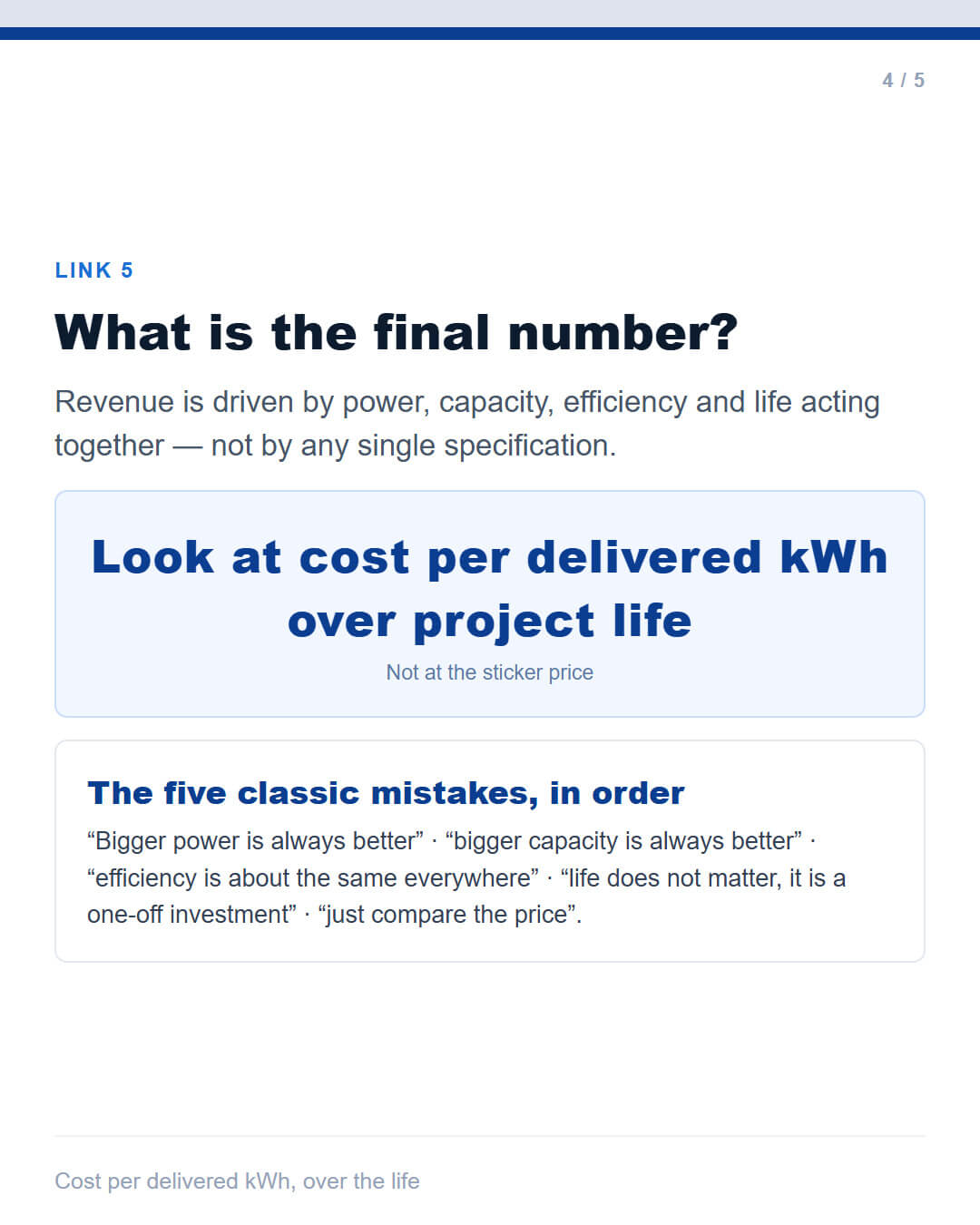
The five classic mistakes, in order
❌ "Bigger power is always better." Power that the load profile never calls on is capex that never earns.
❌ "Bigger capacity is always better." Capacity without a matched duty cycle is energy that sits idle and ages.
❌ "Efficiency is roughly the same everywhere." System-level RTE varies meaningfully between designs, and it compounds over the project's life.
❌ "It's a one-off investment — life doesn't matter." Life is the denominator of every return calculation. Halving service life doubles the cost per delivered kWh.
❌ "Just compare the price." Price without boundary, scope and conditions is not a comparison. It is a number.
✅ The truth: a storage project is a system optimisation. Every parameter on the datasheet eventually becomes a line in your client's bill.
What this means in practice
The practical consequence is a change in the order of operations.
Instead of starting from a price and working backwards, start from the load profile and move forward: what power does the load need, for how long, at what efficiency, over what service life — and only then, what does it cost per delivered kWh across that life.
| Starting point |
Result |
| Price first |
Cheapest capex, uncertain return |
| Load profile first |
Matched system, defensible return |
For a Philippine installer or EPC, this ordering is also the strongest commercial position. A supplier conversation that begins with "here is my load profile, here is what I need it to do" produces a specification. A conversation that begins with "what's your best price" produces a number — and numbers cannot be compared to each other.
The full series
If you have read this far, the earlier pieces are worth working through in order:
MW vs MWh: why power and capacity are two different things
The C-rate trap: why 0.5C is not 50% of rated power
What SOC actually tells you
Battery duration: the truth about the "2h" claim
SOC, SOH and DOD: three metrics, three questions
RTE: a system number, not a cell number
Storage specs are four dimensions, not one list
Rated power (P): the width of the pipe
Capacity (E): the tank, not the pipe
0.5C vs 0.5P: one letter apart
DC vs AC capacity: which boundary is quoted?
Five questions before you compare two quotes
Two storage questions most installers answer wrong
Save the set. The next time a quotation lands in your inbox, you will read it differently.
Frequently asked questions
What is the single most useful metric for comparing storage options? Cost per delivered kWh over the project life. It folds power, capacity, efficiency, life and price into one figure that can be compared across systems of different design.
Why is cost per delivered kWh better than cost per MWh installed? Because cost per MWh installed ignores efficiency, usable SOC window and service life. Two systems at the same installed cost per MWh can deliver very different lifetime energy.
Does the cheapest system always have the worst return? No — but it is the one most likely to have at least one of the five issues above. A lower price usually corresponds to a narrower scope somewhere. The five questions in our procurement guide are how you find out where.
Where should a project start? With the load profile, not the price. Power requirement, duration requirement and duty cycle first; system selection second; price comparison third.
In Filipino (Tagalog)
Mula sa parameter, tungo sa kita.
| Power × Capacity × Efficiency × Life = kita |
Ang bawat parametro sa datasheet ay nagiging linya sa bill ng kliyente mo.
Huwag tumingin sa presyo lamang — tingnan ang cost per delivered kWh sa buong buhay ng proyekto.
Magsimula sa load profile, hindi sa presyo. Doon nag-uumpisa ang tamang sistema.
Planning a project?
Talk to us about what your load profile actually needs — power, duration and duty cycle — before the quotation stage. That conversation is where the return is decided.
All figures in this article are illustrative examples used to explain the underlying principles. They do not represent the specifications of any particular product. For current terms, availability and technical documentation, please contact us.
Storage Basics is an educational series from VANYO's overseas team, written for installers, EPCs and system integrators working in the Philippine market.
VANYO — Real facility. Real stock. Real service.
 Two Storage Questions Most Installers Answer Wrong

 Address: Wanyang Gold and Silver Building 6, Circular Economy Park, Sili Town, Jiyuan City, Henan Province, China