
 Home

Battery Capacity (E) Explained: The Tank, Not the Pipe
Capacity is how much energy a storage system holds, measured in kWh or MWh. If power is the width of the pipe, capacity is the size of the tank — and a wide pipe attached to a small tank simply empties it faster.
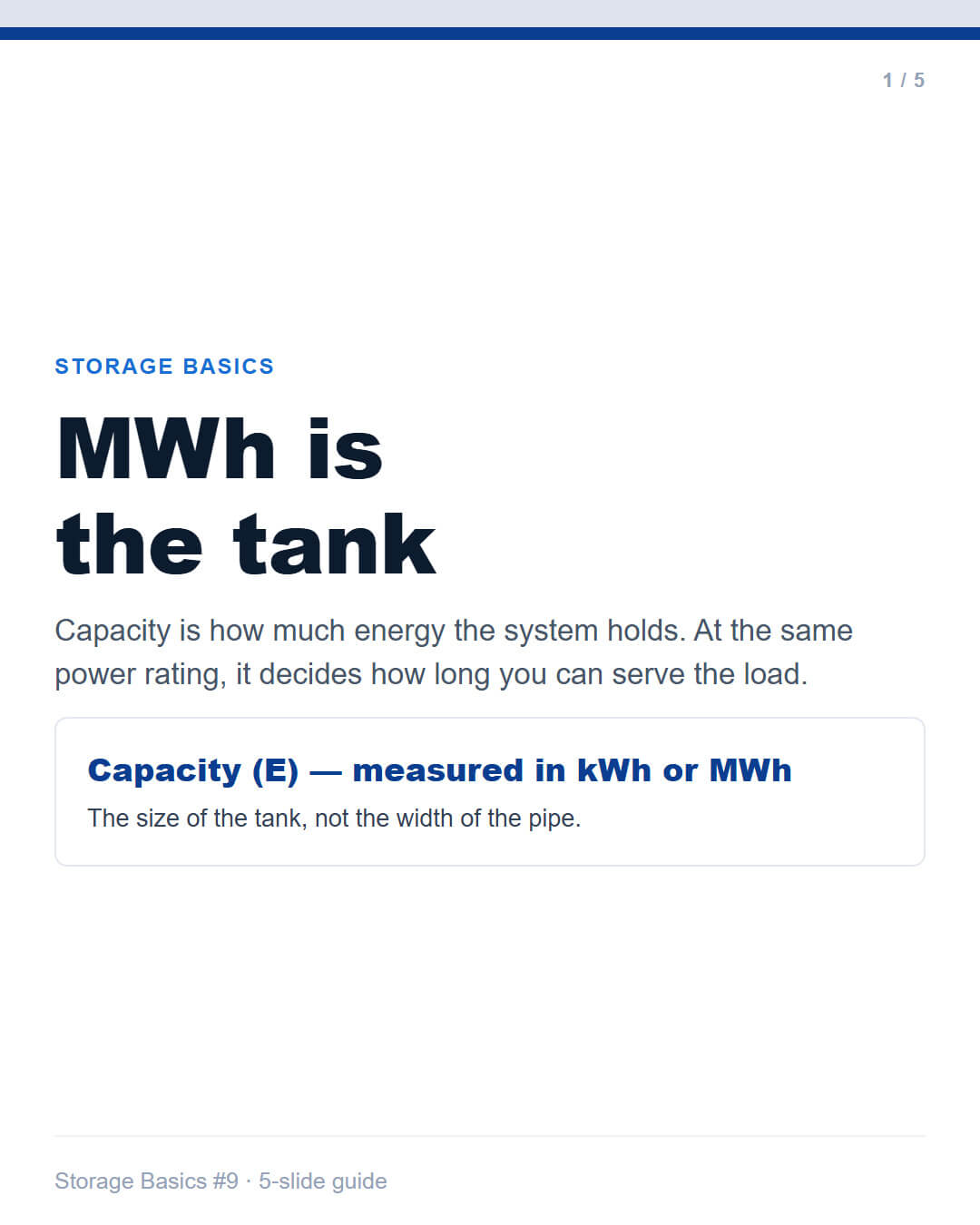
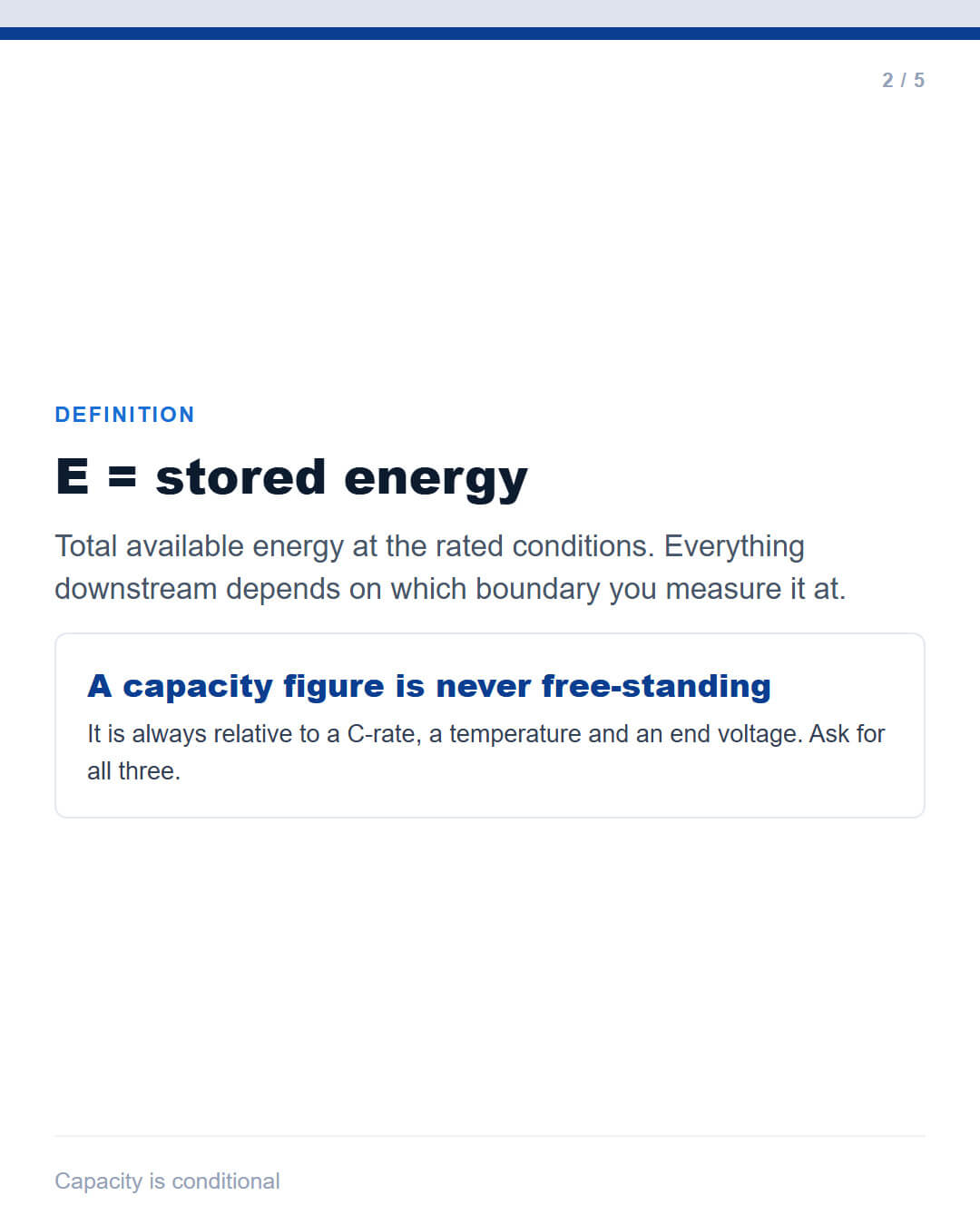
Capacity is also the specification that converts most directly into something the client actually experiences: how long the power stays on.
The duration formula
|
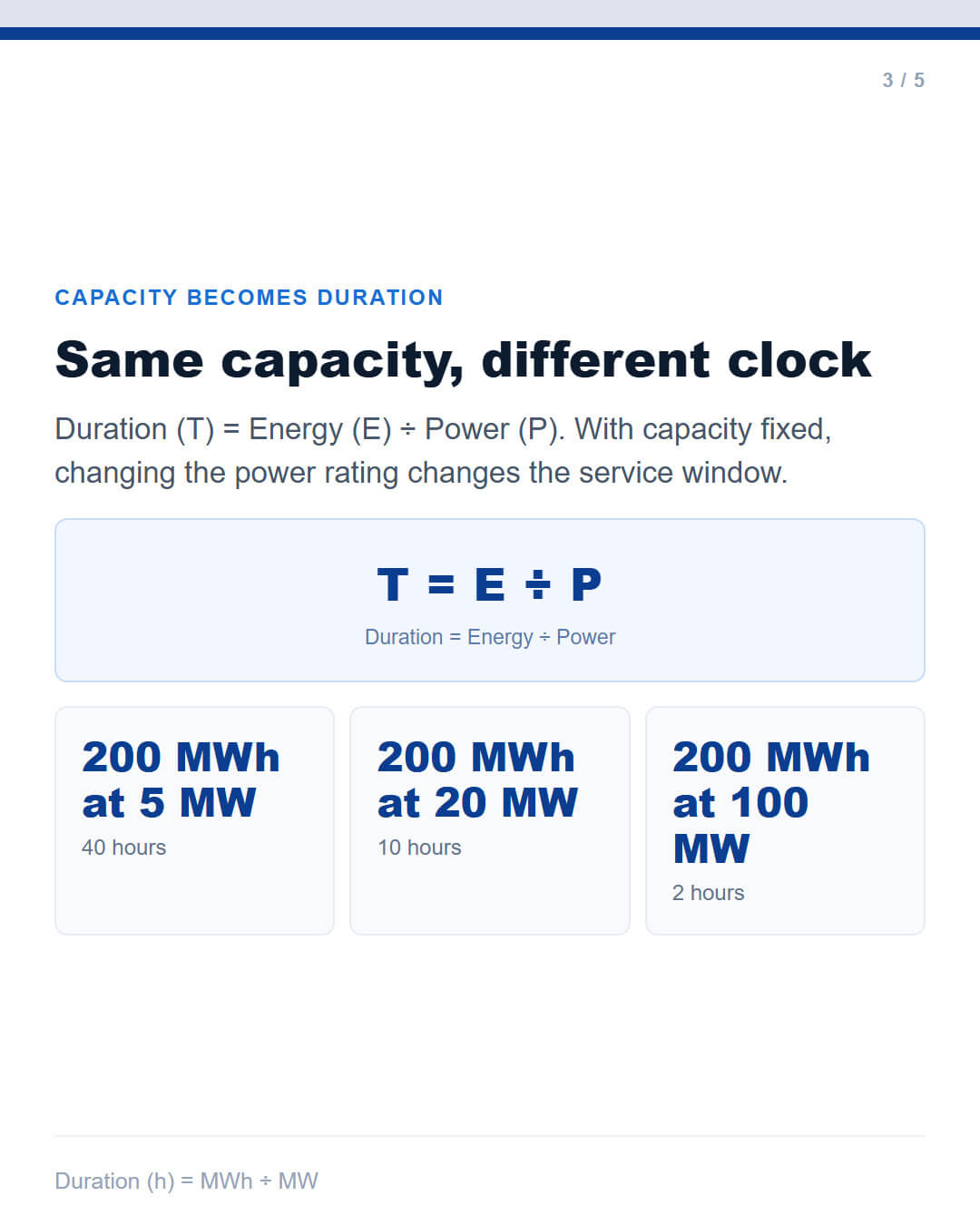
Duration (h) = Energy (MWh) ÷ Power (MW) |
Hold capacity fixed and change the power rating, and the service window changes dramatically:
| Configuration |
Calculation |
Duration at rated output |
| 200 MWh at 5 MW |
200 ÷ 5 |
40 hours |
| 200 MWh at 20 MW |
200 ÷ 20 |
10 hours |
| 200 MWh at 100 MW |
200 ÷ 100 |
2 hours |
The same tank, emptied at three different rates. This is why a capacity figure on its own is not a business case — it only becomes one when paired with the power rating it will operate at.
Nameplate capacity is not usable capacity
This is where proposals most often drift out of step with reality. Three things sit between the figure on the datasheet and the energy the client can actually draw:
The SOC window. A 10%–90% operating band means 20% of nameplate is never used.
Temperature. Usable capacity falls away at high ambient temperatures. In Philippine conditions this is a first-order effect, not a footnote.
End-of-life derating. A capacity figure quoted at beginning of life is not the figure the system will deliver in year eight.
Ask for all three before treating a capacity number as a design input.
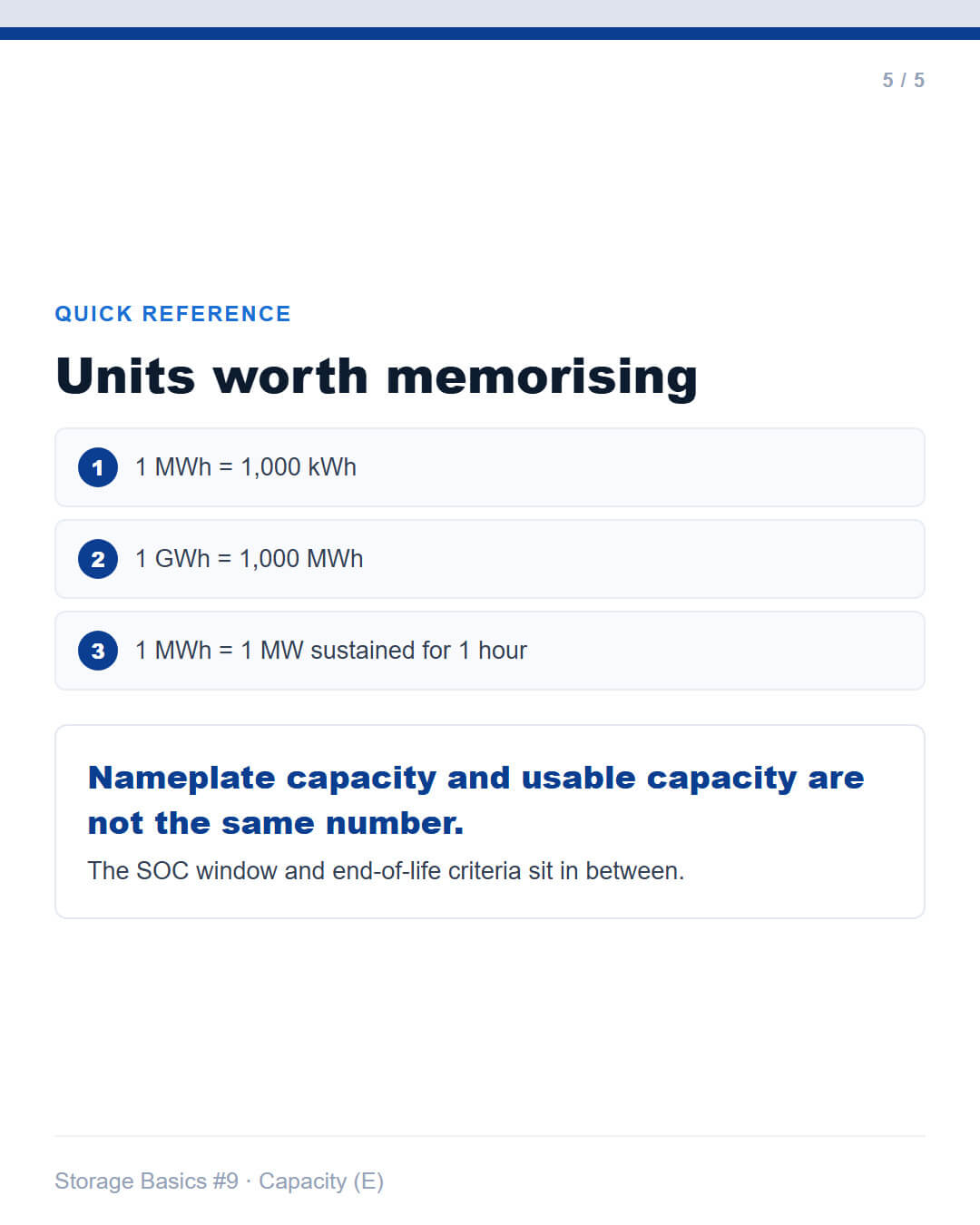
Units worth memorising
| Conversion |
Equivalent |
| 1 MWh |
1,000 kWh |
| 1 GWh |
1,000 MWh |
| 1 MWh |
1 MW sustained for 1 hour |
The third line is the one that makes the power/capacity relationship click: one megawatt-hour is one megawatt held for one hour. It is a definition, not a coincidence — and it is why duration is simply energy divided by power.
Why capacity alone is not a business case
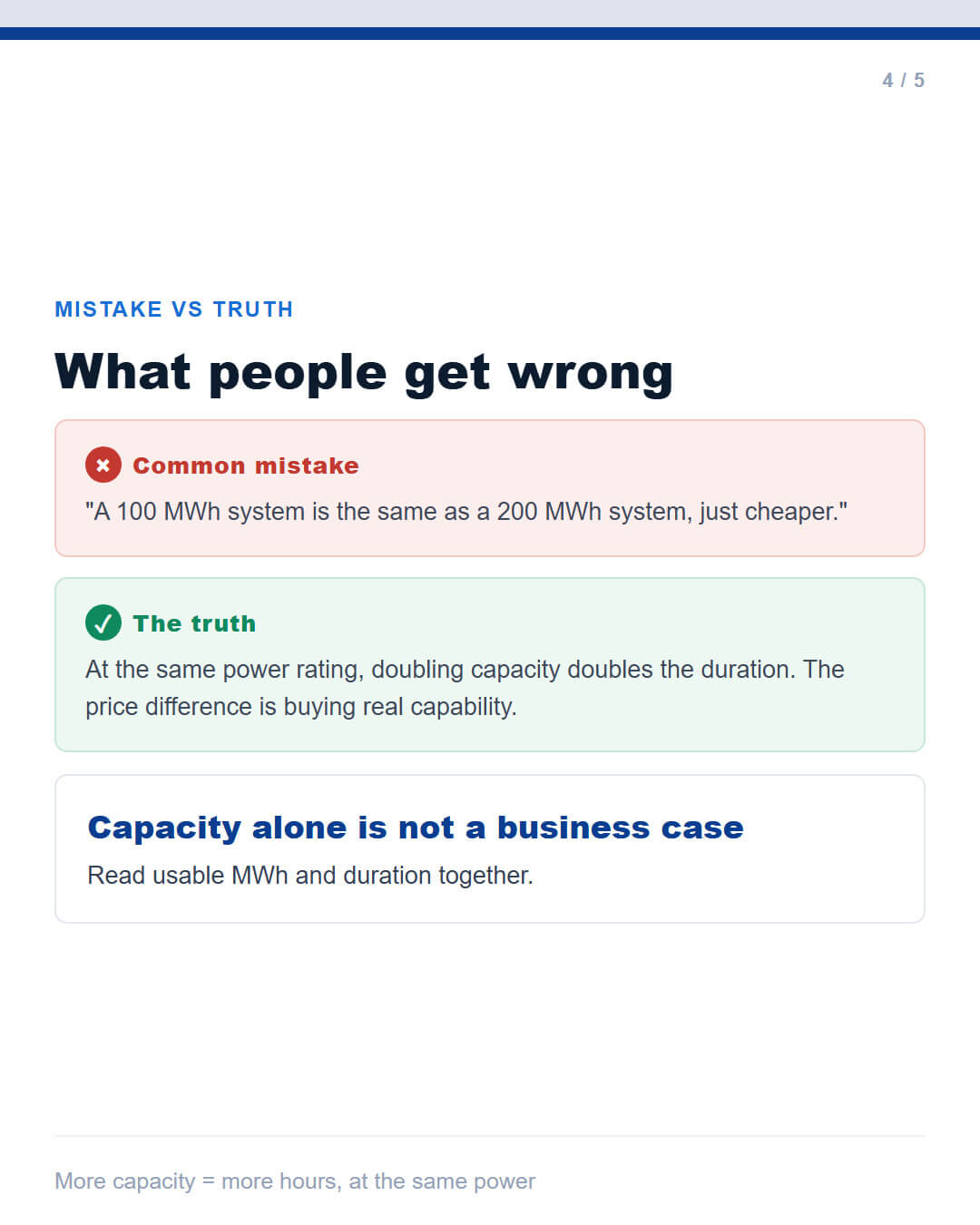
At the same power rating, doubling capacity doubles the duration. That means the price difference between a 100 MWh and a 200 MWh system is not margin — it is real capability, and the client is buying a longer service window with it.
The converse is equally true. A system sized on capacity without regard to the load profile can be simultaneously oversized and unable to serve the site, because the energy is there but the duration at peak load is not.
For a worked treatment of that trade-off in a typhoon-season backup context, see the truth about the "2h" claim.
Frequently asked questions
Is 1 MWh the same as 1,000 kWh? Yes. They are the same unit at different scales, in the same way that 1 kilometre equals 1,000 metres.
Can two systems with the same MWh have different durations? Yes. Duration depends on power as well as energy. At the same capacity, a system with a higher power rating will run for less time.
Why is usable capacity lower than nameplate capacity? Because of the operating SOC window, temperature derating and the end-of-life criterion. Nameplate figures are typically quoted under specific test conditions.
Does capacity decrease over time? Usable capacity declines as the battery ages — that decline is what SOH measures. This is why capacity figures should be paired with an end-of-life statement.
In Filipino (Tagalog)
Ang capacity (MWh) ay laki ng imbak. Ang duration ay T = E ÷ P.
Halimbawa: 200 MWh sa 5 MW = 40 oras; 200 MWh sa 100 MW = 2 oras. Parehong tank, ibang bilis ng paglabas.
Tandaan: 1 MWh = 1,000 kWh at 1 GWh = 1,000 MWh.
At hindi pareho ang nameplate capacity sa tunay na magagamit na enerhiya — kasama ang SOC window, temperatura at end-of-life derating.
Related guides in this series
MW vs MWh: why storage power and capacity are two different things
Rated power explained: the width of the pipe
Battery duration explained: the truth about the "2h" claim
All figures in this article are illustrative examples used to explain the underlying principles. They do not represent the specifications of any particular product. For current terms, availability and technical documentation, please contact us.
Storage Basics is an educational series from VANYO's overseas team, written for installers, EPCs and system integrators working in the Philippine market.
 From Parameters to Profit: How a Storage Datasheet Becomes a Business Case

 Address: Wanyang Gold and Silver Building 6, Circular Economy Park, Sili Town, Jiyuan City, Henan Province, China