
 Home

Rated Power (P) Explained: The Width of the Pipe, Not the Size of the Tank
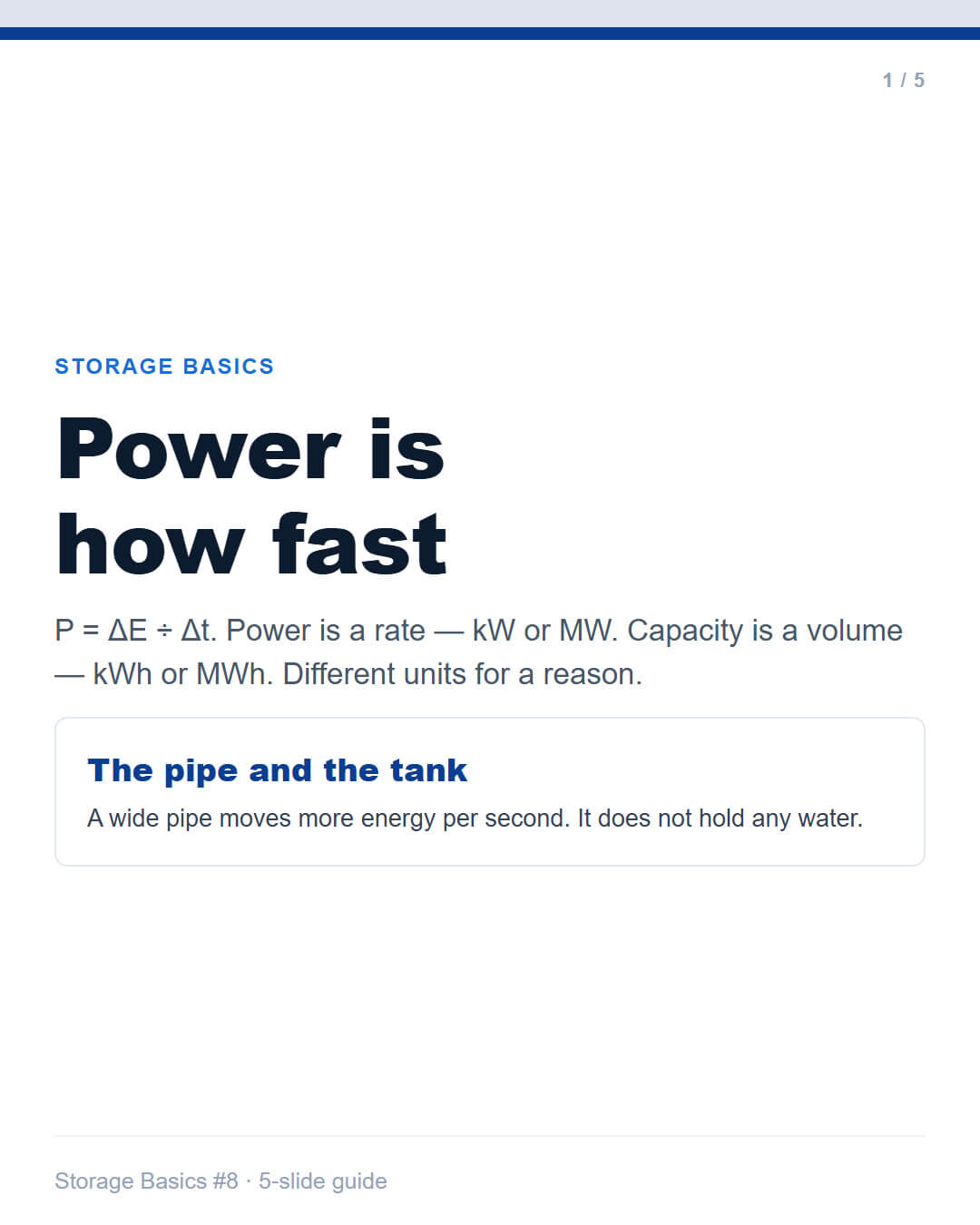
Power is the specification people feel most confident about and misread most often. It is a rate, not a volume:
|
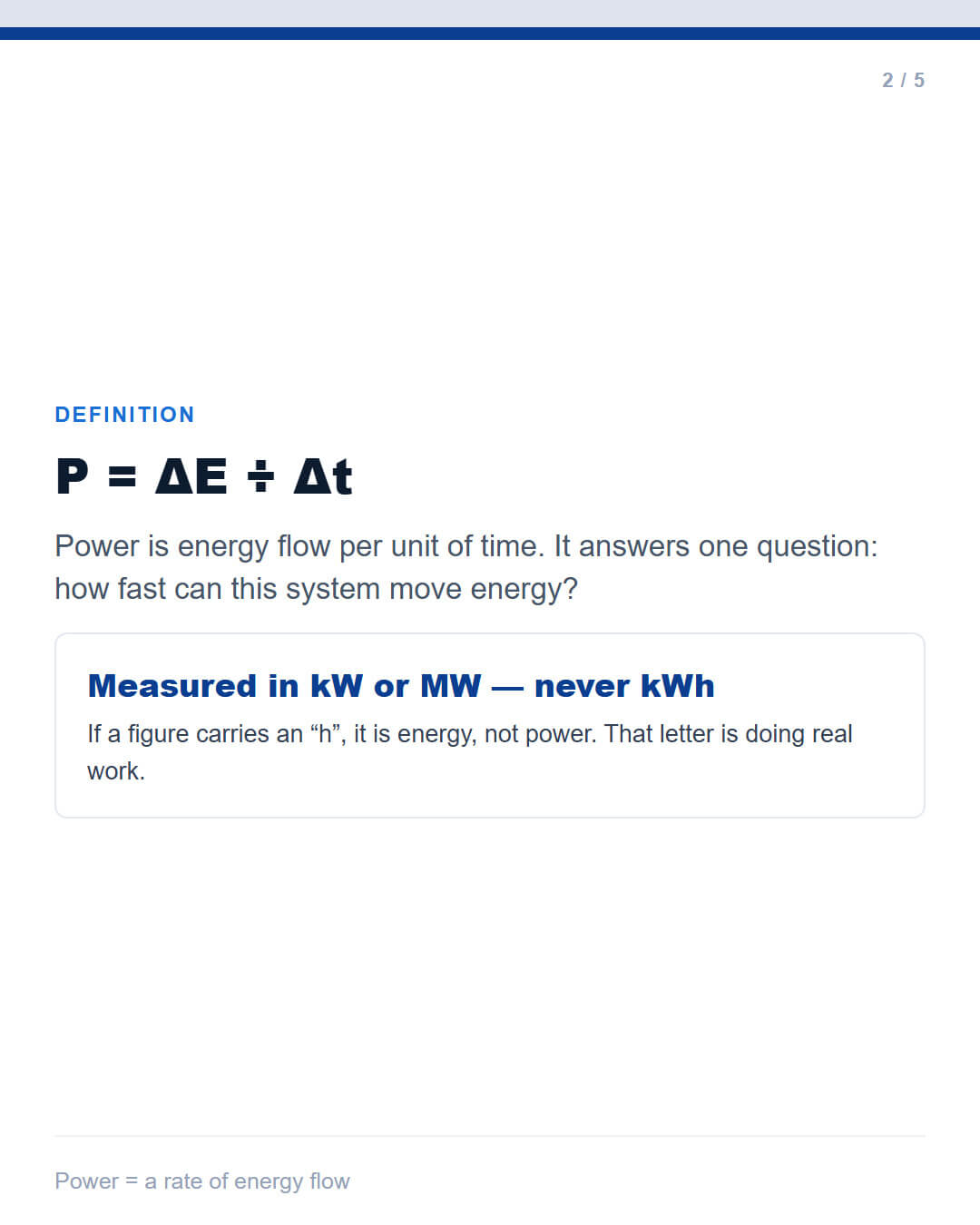
P = ΔE ÷ Δt |
Power is energy flow per unit of time, measured in kW or MW. Capacity is stored energy, measured in kWh or MWh. The unit gives the game away — the "h" means energy, and the absence of it means power.
The pipe and the tank
Power (MW) is the width of the pipe. A wide pipe moves more energy per second.
Capacity (MWh) is the size of the tank. A bigger tank holds more energy.
A wide pipe connected to a small tank empties it fast. A narrow pipe connected to a large tank sustains flow for a long time. Neither configuration is "better" — they answer different questions, and the question being asked is set by the site.
What a power rating actually promises
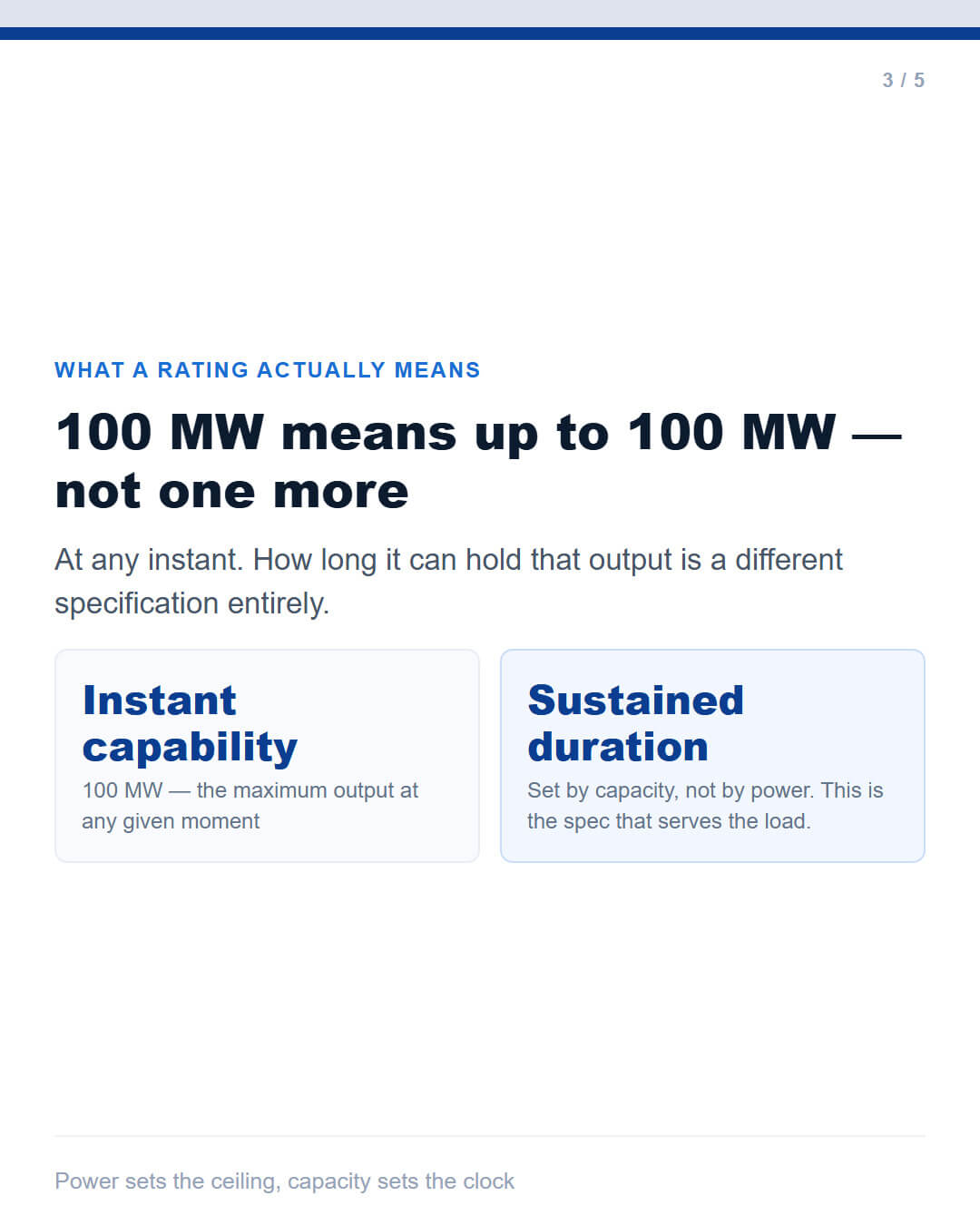
A 100 MW rating means the system can deliver up to 100 MW at any instant — and not one MW more.
How long it can sustain that output is a different specification entirely, and it is the one that decides whether the design serves the load. Power sets the ceiling. Capacity sets the clock.
That distinction produces a failure mode we see regularly: a system specified on an impressive MW figure that cannot carry the site through a realistic outage, because the load needed hours rather than minutes.
Power ratings come in three flavours
Not every MW figure means the same thing, and this is worth pinning down before comparing two quotes:
| Rating |
Meaning |
| Rated |
The nameplate figure |
| Continuous |
What the system can hold indefinitely under stated conditions |
| Peak |
Available briefly, typically for seconds or minutes |
A quotation that says "100 MW" without naming the flavour has given you one third of the information.
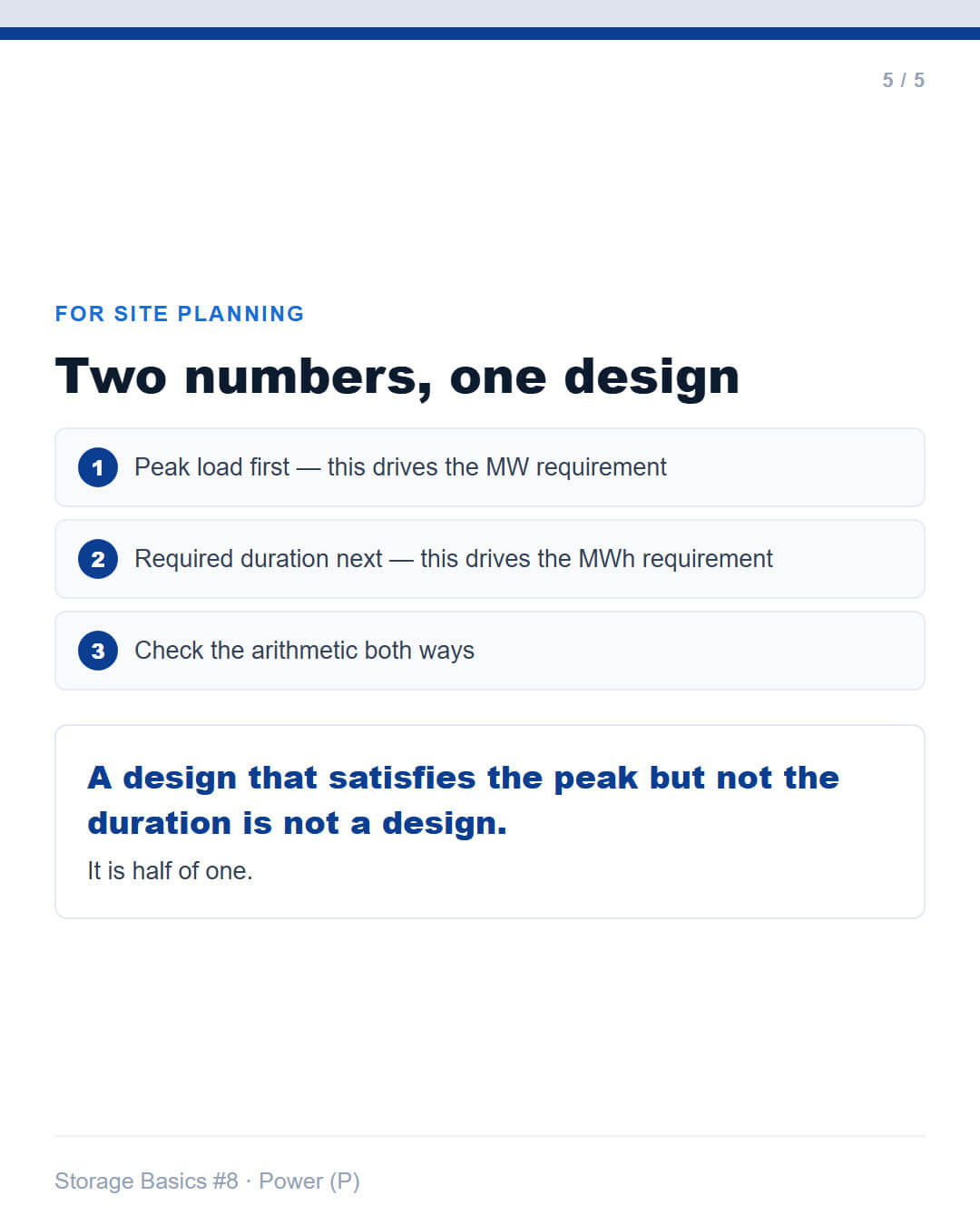
Sizing order: peak load first
The order of operations matters more than most people expect:
Establish the peak load. Not the average — the peak. This drives the MW requirement.
Establish the required duration. This drives the MWh requirement at that load.
Check the arithmetic both ways. Use P = E ÷ T for power and T = E ÷ P for duration.
Confirm the rating flavour. Rated, continuous or peak — and at what ambient temperature.
For backup applications the peak often arrives with a surge — motor starting, for instance — which is why the peak figure deserves to be measured rather than assumed.
Frequently asked questions
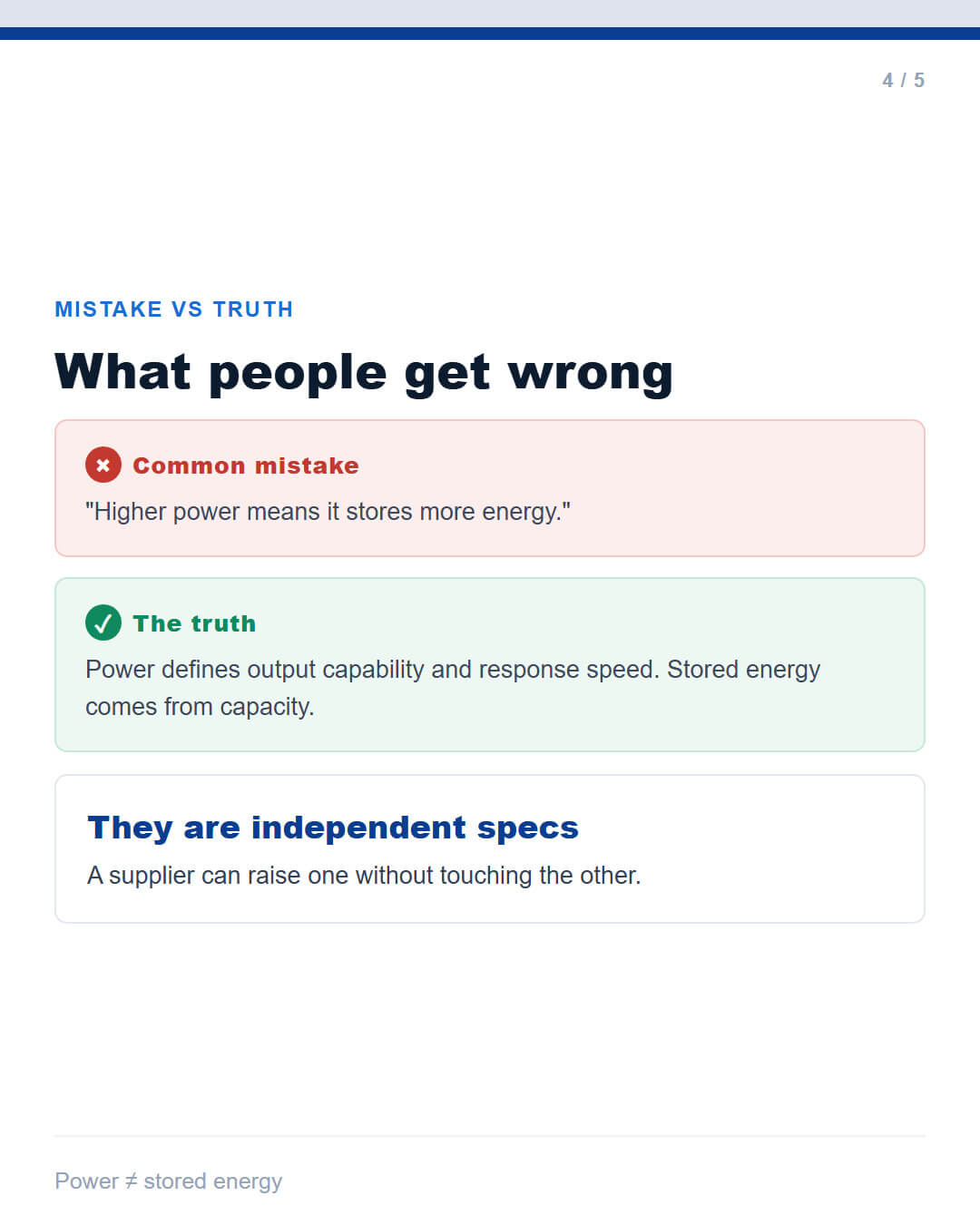
Can a storage system have high power and low capacity? Yes, and it is a common configuration. Such a system is built for short, intense output rather than long duration. Power and capacity are specified independently.
Does a higher MW rating mean better performance? Not on its own. A high MW rating with modest MWh is a design optimised for instantaneous output. Whether that is better depends entirely on the load profile.
What is the difference between rated power and peak power? Rated is the nameplate figure. Peak is achievable briefly, typically for seconds or minutes, and should never be assumed for continuous operation.
Can I compare two suppliers on MW alone? No. Comparing on MW alone ignores duration; comparing on MWh alone ignores the rate at which energy can be delivered. Both figures are needed.
In Filipino (Tagalog)
Ang power (MW) ay bilis. Ang capacity (MWh) ay laki ng imbak.
Ang 100 MW na rating ay hanggang 100 MW lang sa isang sandali — hindi more. Kung gaano katagal niya kayang itaguyod ang output na iyon ay ibang spec, at iyon ang madalas na tumutukoy kung sapat ang disenyo.
Itanong: rated, continuous o peak ba ang MW na nasa quote?
Related guides in this series
MW vs MWh: why storage power and capacity are two different things
Battery capacity explained: the tank, not the pipe
Five questions to ask before you compare two storage quotes
All figures in this article are illustrative examples used to explain the underlying principles. They do not represent the specifications of any particular product. For current terms, availability and technical documentation, please contact us.
Storage Basics is an educational series from VANYO's overseas team, written for installers, EPCs and system integrators working in the Philippine market.
 Battery Capacity (E) Explained: The Tank, Not the Pipe

 Address: Wanyang Gold and Silver Building 6, Circular Economy Park, Sili Town, Jiyuan City, Henan Province, China