
 Home

DC vs AC Capacity: Which Boundary Is Your Quote Measuring?
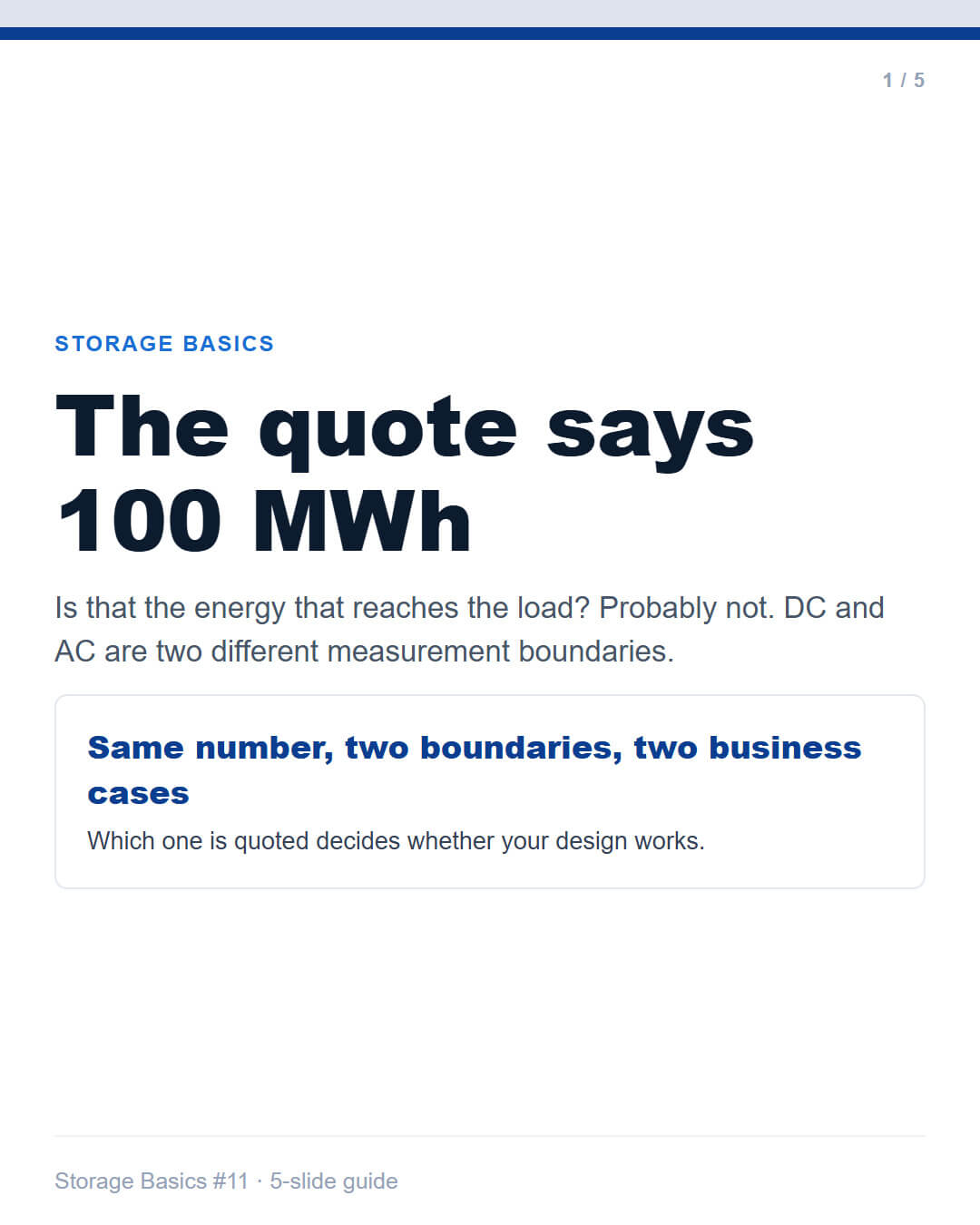
A quotation arrives stating 100 MWh. The natural reading is that 100 MWh is available at the point of connection. In most systems it is not — and the gap is not a rounding error. It is a defined technical boundary that the quotation may or may not have declared.
Two identical battery containers can be described by two different numbers, and both descriptions can be technically honest. Understanding which boundary a figure refers to is one of the most reliable ways to compare offers that at first glance look incomparable.
Where the boundary sits
A battery energy storage system has two measurement points:
DC side — the battery's own DC capacity: the energy physically stored in the cells, measured before any conversion takes place.
AC side — the capacity that reaches the point of connection after the power conversion system (PCS), the transformer and auxiliary consumption have each taken their share.
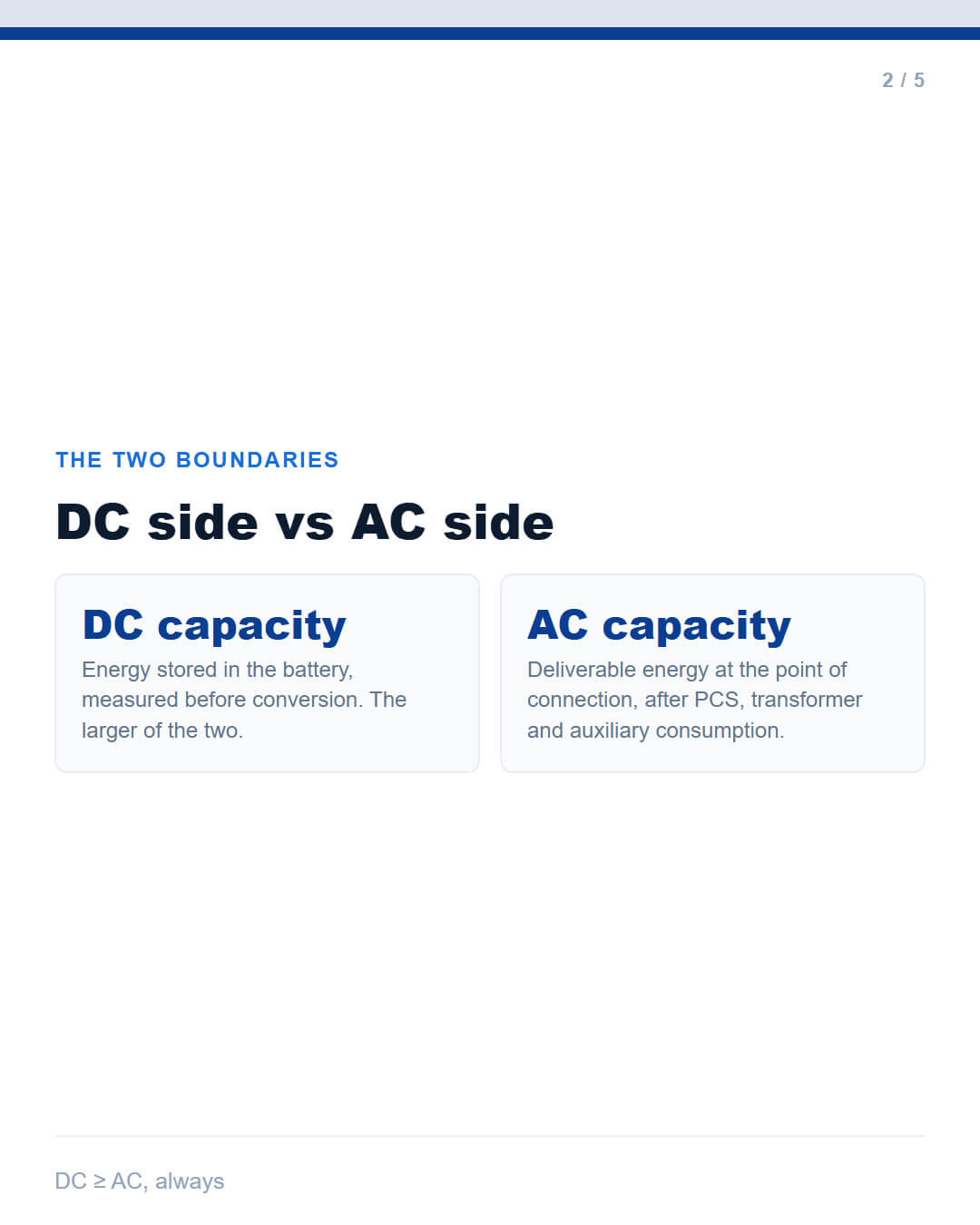
The DC figure is what the battery holds. The AC figure is what the client's load can actually use. By definition they are not equal.
|
DC capacity → PCS → transformer → auxiliaries → AC capacity ~2% ~1% ~2% |
The losses in between
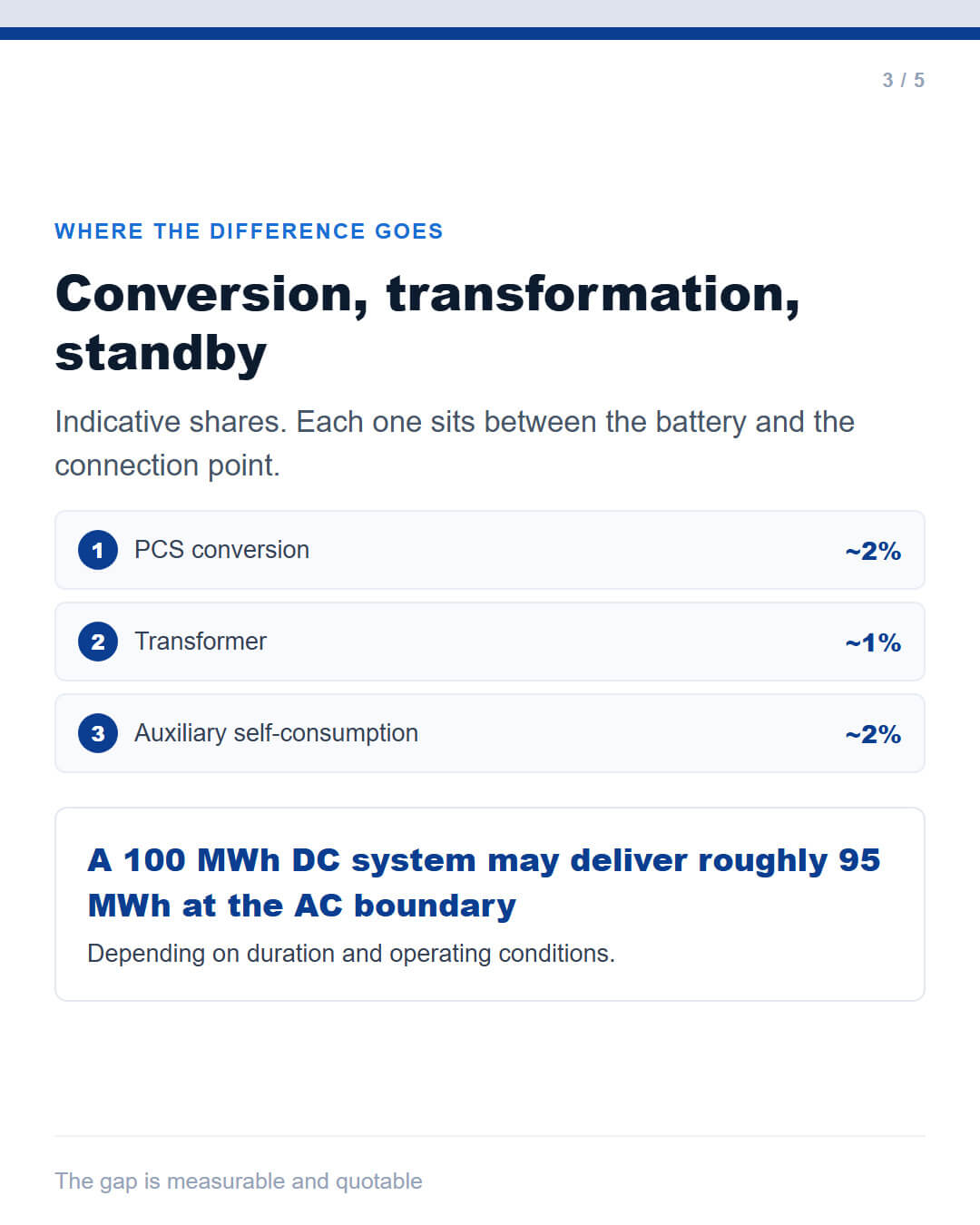
Indicative figures for a modern containerised system:
| Stage |
Indicative loss |
| PCS conversion |
~2% |
| Transformer |
~1% |
| Auxiliary self-consumption (thermal management, controls) |
~2% |
Stacked, these take a meaningful bite. A 100 MWh DC system may deliver roughly 90 MW / ~95 MWh AC depending on duration and site conditions. The exact numbers move with operating point, ambient temperature and how the auxiliary load is accounted for.
Worth noting: the two figures do not scale identically. Auxiliary consumption is closer to a fixed overhead, so it weighs more heavily on a short-duration system than on a long one. Two systems quoting "100 MWh" can behave quite differently across a 1-hour and a 4-hour design.
Duration is evaluated at the AC boundary, not the DC one
This is where the boundary question becomes commercial rather than academic.
When a client asks for "2 hours", the useful question is: two hours of what? Two hours at DC nameplate is not the same duty as two hours at the point of connection. If the AC capacity is lower, the achievable duration at the same power output is shorter — or the power output must be reduced to hold the duration.
|
Quoted |
Boundary |
What the client actually gets |
| 100 MWh |
DC |
~95 MWh at the point of connection (illustrative) |
| 2 h @ 50 MW |
DC |
Duration shortens unless output is de-rated |
| 2 h @ 50 MW |
AC |
The load sees the full two hours |
The same project can be presented as meeting the requirement or falling short of it, depending entirely on the boundary the number was measured at. Neither presentation is dishonest on its own — but only one of them matches the client's load profile.
The mistake and the truth
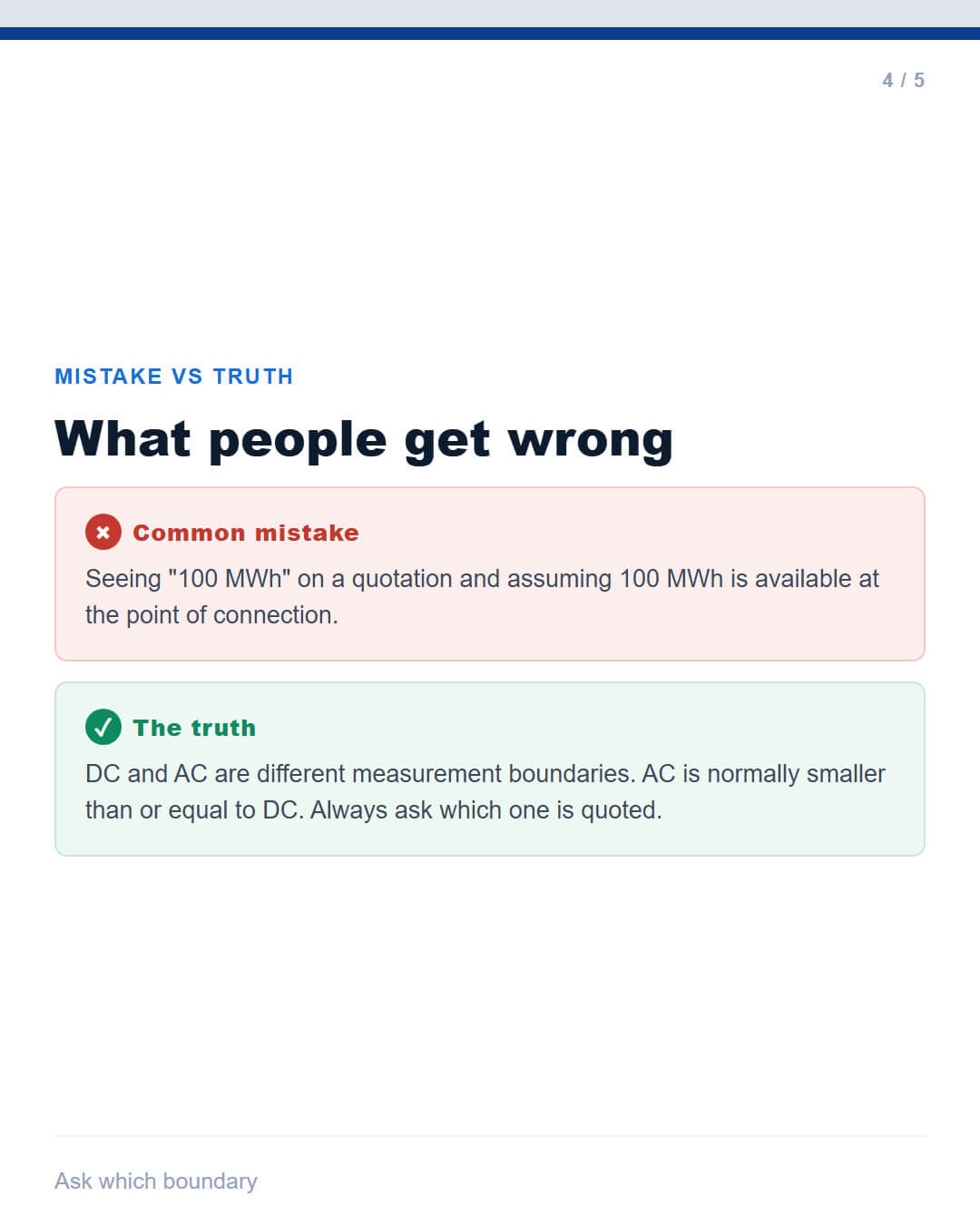
❌ Common mistake: seeing "100 MWh" on a quote and assuming 100 MWh is available at the point of connection.
✅ The truth: DC and AC are different measurement boundaries. AC is usually smaller than or equal to DC. Always ask which one is being quoted.
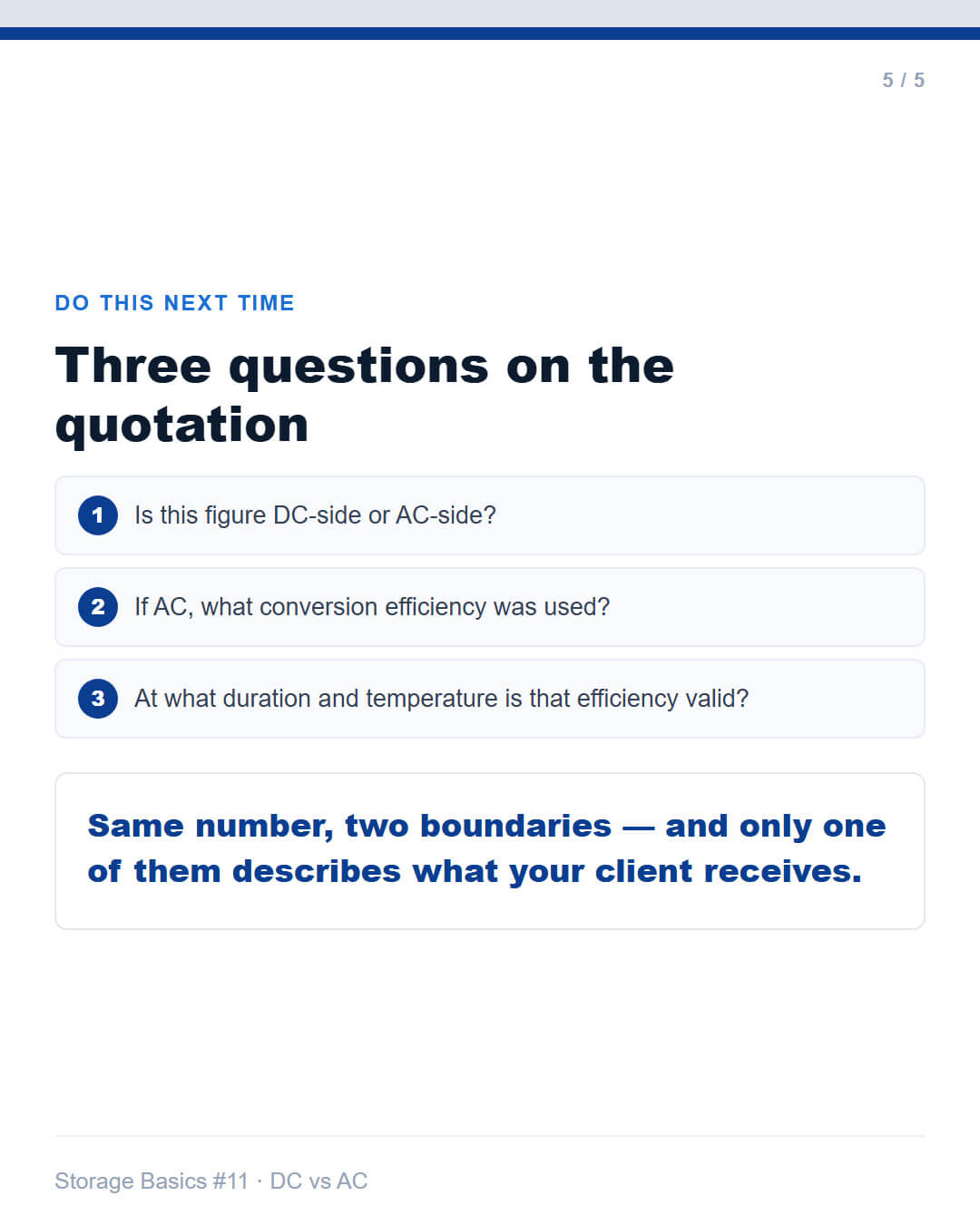
The one question to add to every comparison
When two quotations are placed side by side:
| Is the MWh figure DC-side battery capacity or AC-side available capacity? |
Then ask for the conversion efficiency that connects them. A supplier who can state both boundaries clearly has specified the system. A supplier who cannot has given a number without a definition — and a number without a definition cannot be compared to anything.
Same figure, two boundaries, two very different business cases for your client.
Frequently asked questions
Is AC capacity always lower than DC capacity? In practice, yes — conversion and auxiliary consumption both sit between the battery and the point of connection. The size of the gap varies with system design, duration and operating conditions, but the direction does not.
Which figure should appear in a contract? Both, stated explicitly, with the boundary named for each. A contract that specifies only "MWh" without declaring the boundary leaves the most commercially important detail undefined.
Does a higher DC-to-AC conversion efficiency always mean a better system? Not on its own. Conversion efficiency interacts with thermal design, auxiliary load and how the system is dispatched. A system with slightly lower peak conversion efficiency but lower auxiliary consumption can deliver more usable energy over a full day.
Why do some quotations use DC capacity exclusively? Because it is the figure tied to the battery cells and therefore the easiest to quote consistently across suppliers. It is a legitimate engineering figure — it simply needs to be labelled, and translated to the AC boundary before it is compared with a load requirement.
In Filipino (Tagalog)
Ang DC capacity ay hindi katumbas ng AC capacity.
Ang AC ay mas maliit dahil sa PCS, transformer at auxiliary losses. Ang DC ang nasa baterya; ang AC ang nakakarating sa load.
Isang sistema na 100 MWh DC ay maaaring maghatid ng humigit-kumulang 95 MWh AC, depende sa duration at kondisyon ng site.
Itanong palagi: DC ba o AC ang nasa quote? At ano ang conversion efficiency sa pagitan ng dalawa?
Related guides in this series
Five questions to ask before you compare two storage quotes
Storage specs are four dimensions, not one list
Battery capacity (E) explained: the tank, not the pipe
All figures in this article are illustrative examples used to explain the underlying principles. They do not represent the specifications of any particular product. For current terms, availability and technical documentation, please contact us.
Storage Basics is an educational series from VANYO's overseas team, written for installers, EPCs and system integrators working in the Philippine market.
 Rated Power (P) Explained: The Width of the Pipe, Not the Size of the Tank

 Address: Wanyang Gold and Silver Building 6, Circular Economy Park, Sili Town, Jiyuan City, Henan Province, China