
 Home

0.5C vs 0.5P: One Letter Apart, Two Different Frameworks
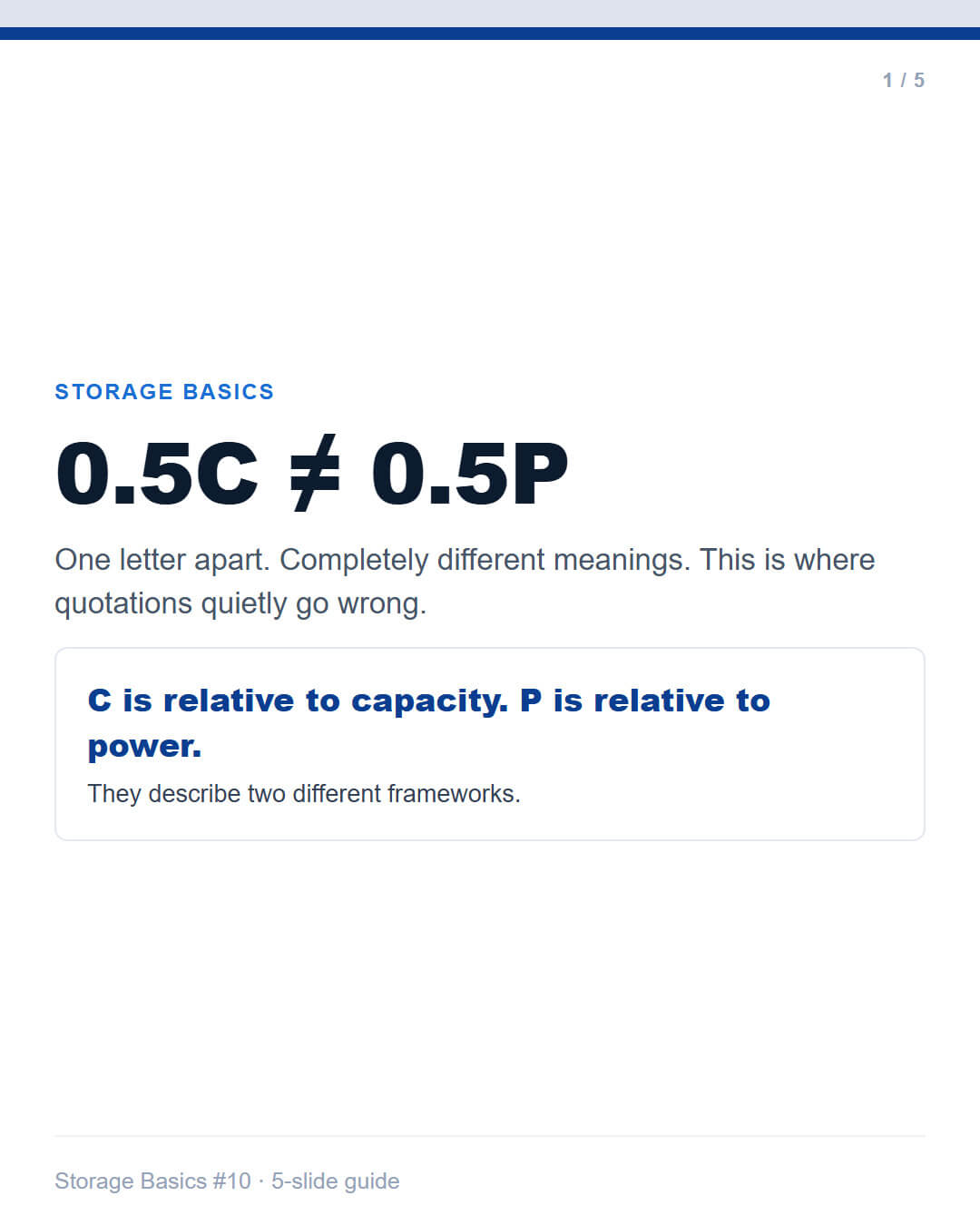
On storage quotations these two notations appear side by side, separated by a single letter. They describe fractions of two different quantities, and treating them as interchangeable is one of the most common errors in procurement.
The distinction is simple once you see it: C is relative to capacity. P is relative to power.
0.5C — a rate relative to capacity
|
C = P ÷ E |
A C-rate expresses power as a multiple of the system's capacity.
On a 200 MWh system, 0.5C = 100 MW
A 0.5C rate corresponds to a full charge or discharge in about 2 hours
1C ≈ 1 hour; 2C ≈ 30 minutes
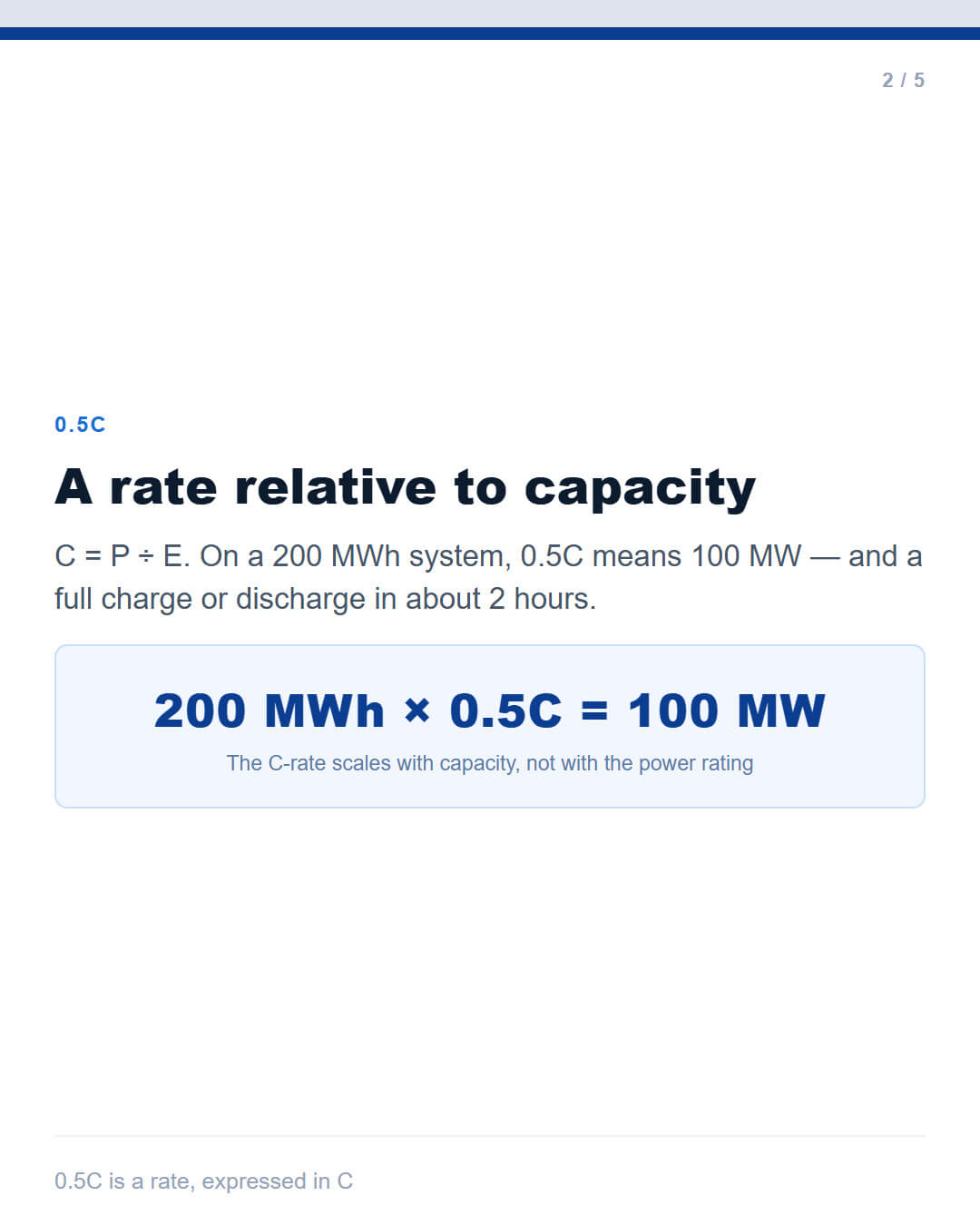
Because the reference value is capacity, the same C-rate produces different absolute power on systems of different size. 0.5C on a 400 MWh system is 200 MW, not 100 MW.
0.5P — a share of rated power
A P-fraction expresses a share of the nameplate power rating.
On a 100 MW system, 0.5P = 50 MW
It says nothing about capacity
It says nothing about duration
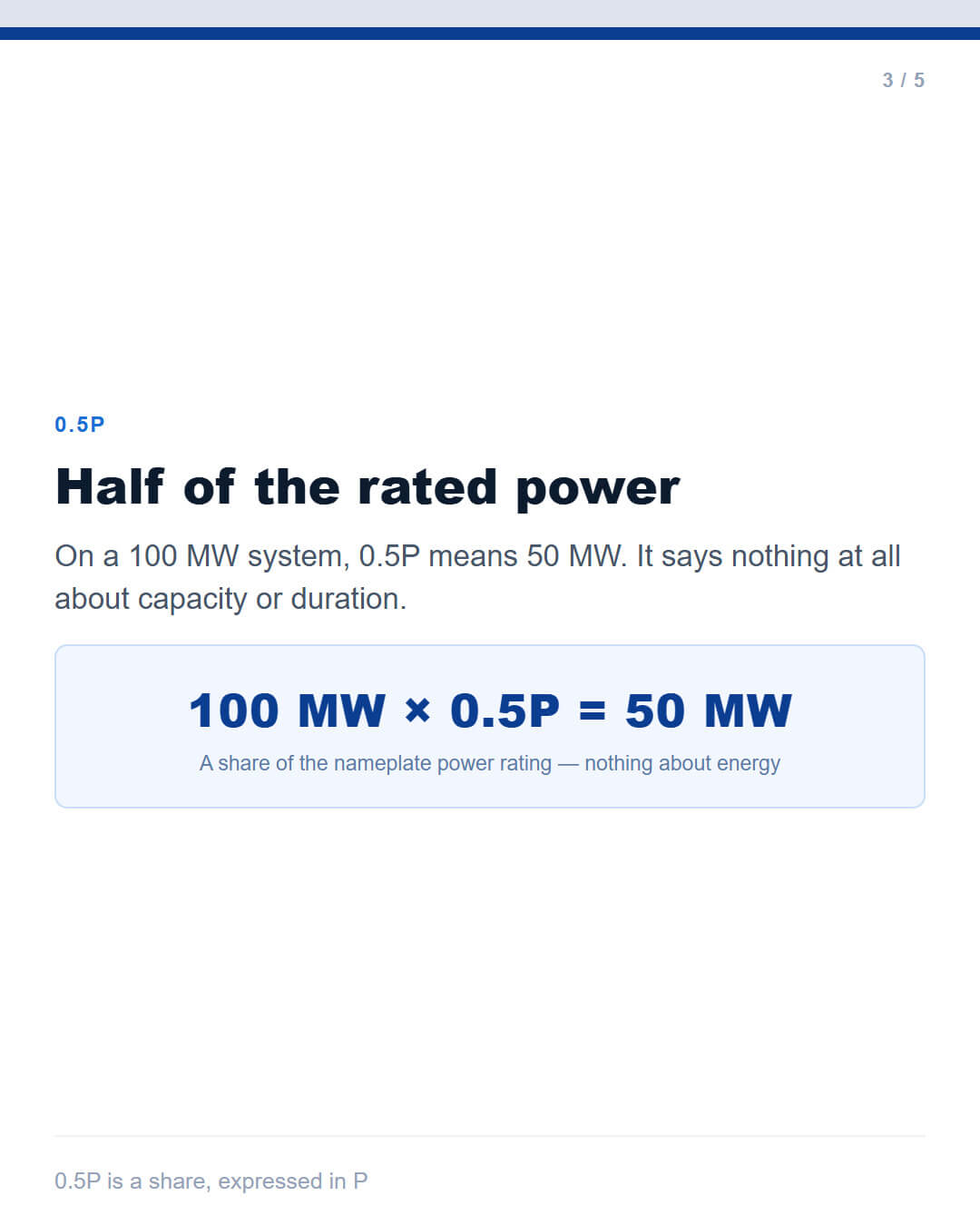
0.5P is a statement about how hard the system is being worked relative to its own rating — not about how much energy it holds.
When the two figures coincide
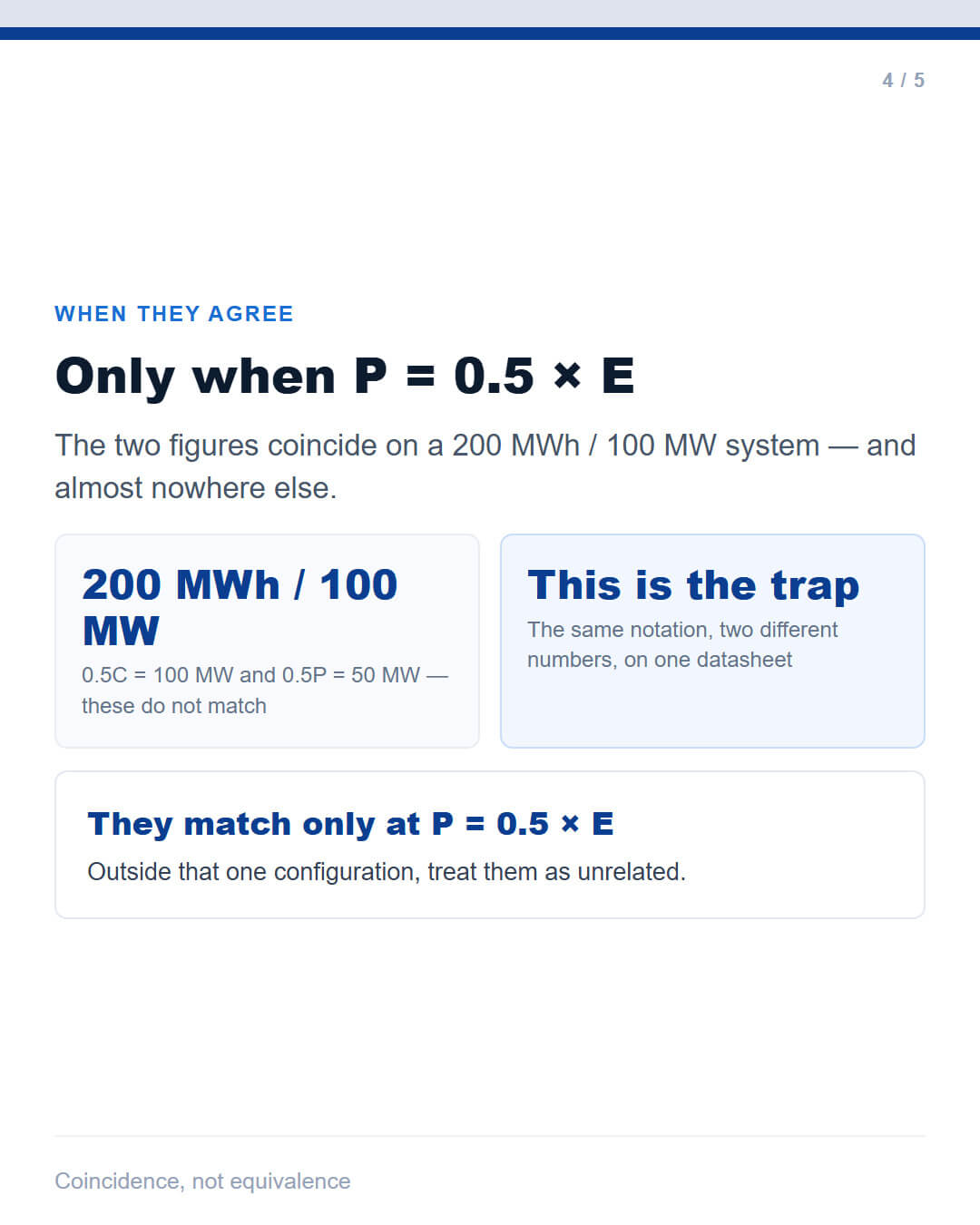
They produce the same number only when the system happens to sit at:
|
P = 0.5 × E |
A 200 MWh / 100 MW configuration is the classic example. At that one point, 0.5C = 100 MW and 0.5P = 50 MW… which do not match either — and that mismatch is the point. The two notations do not become equivalent; they simply describe two separate properties of the same machine.
| System |
0.5C gives |
0.5P gives |
| 200 MWh / 100 MW |
100 MW |
50 MW |
| 400 MWh / 100 MW |
200 MW |
50 MW |
| 100 MWh / 50 MW |
50 MW |
25 MW |
Read down the 0.5C column and the numbers move with capacity. Read down the 0.5P column and they move with the power rating. Two independent dials.
The question that protects the comparison
When a quotation says "0.5C operation", ask:
| At what capacity? |
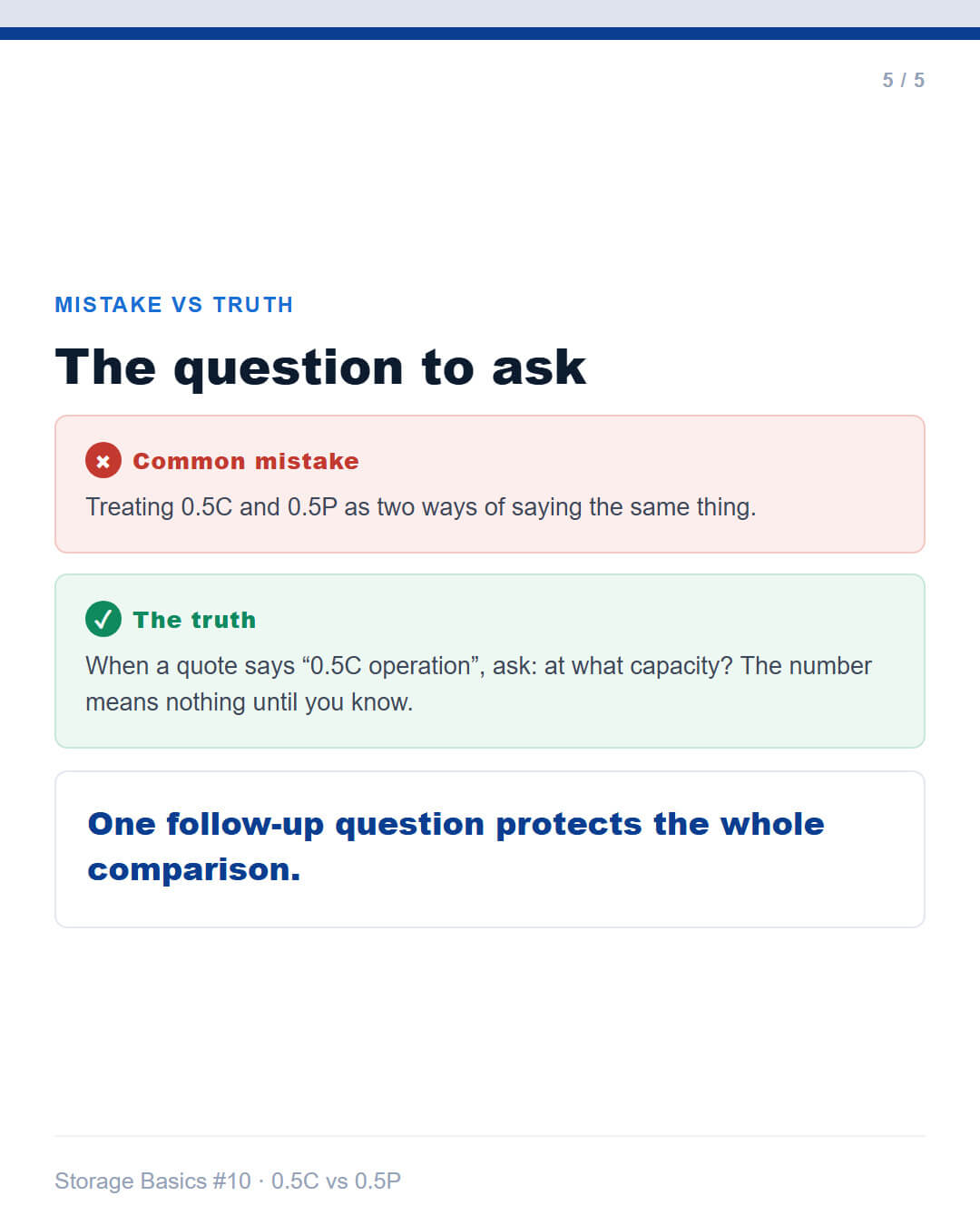
The figure means nothing until you know. A supplier who cannot answer that question has not specified the system.
Frequently asked questions
Does 0.5C mean 50% of rated power? No. 0.5C means the power is 0.5 × the capacity. On a 100 Ah battery that is 50 A of current; actual power is P = V × I and depends on voltage.
Are 0.5C and 0.5P ever interchangeable? Only in the specific configuration where the C-rate and the P-fraction happen to produce the same absolute power. Outside that configuration they describe different properties and should not be substituted for one another.
Which notation is more useful? C-rate is more useful for describing duty cycle and cycle-life conditions, because it is linked to capacity and therefore to throughput. P-fractions are more useful when describing how hard a system is being pushed relative to its rating.
Why do suppliers use both? Because the two notations serve different purposes in different documents — one in the technical specification, one in the commercial summary. The confusion arises when they are carried across without the reference value.
In Filipino (Tagalog)
Ang 0.5C ay base sa capacity. Ang 0.5P ay base sa rated power.
Sa 200 MWh na sistema, ang 0.5C = 100 MW. Sa 100 MW na sistema, ang 0.5P = 50 MW.
Dalawang magkaibang reference value sa isang mukhang parehong notation.
Itanong palagi: sa anong capacity ang 0.5C na nasa quote?
Related guides in this series
The C-rate trap: why 0.5C is not 50% of rated power
Five questions to ask before you compare two storage quotes
Storage specs are four dimensions, not one list
All figures in this article are illustrative examples used to explain the underlying principles. They do not represent the specifications of any particular product. For current terms, availability and technical documentation, please contact us.
Storage Basics is an educational series from VANYO's overseas team, written for installers, EPCs and system integrators working in the Philippine market.
 DC vs AC Capacity: Which Boundary Is Your Quote Measuring?

 Address: Wanyang Gold and Silver Building 6, Circular Economy Park, Sili Town, Jiyuan City, Henan Province, China