
 Home

Five Questions to Ask Before You Compare Two Storage Quotes
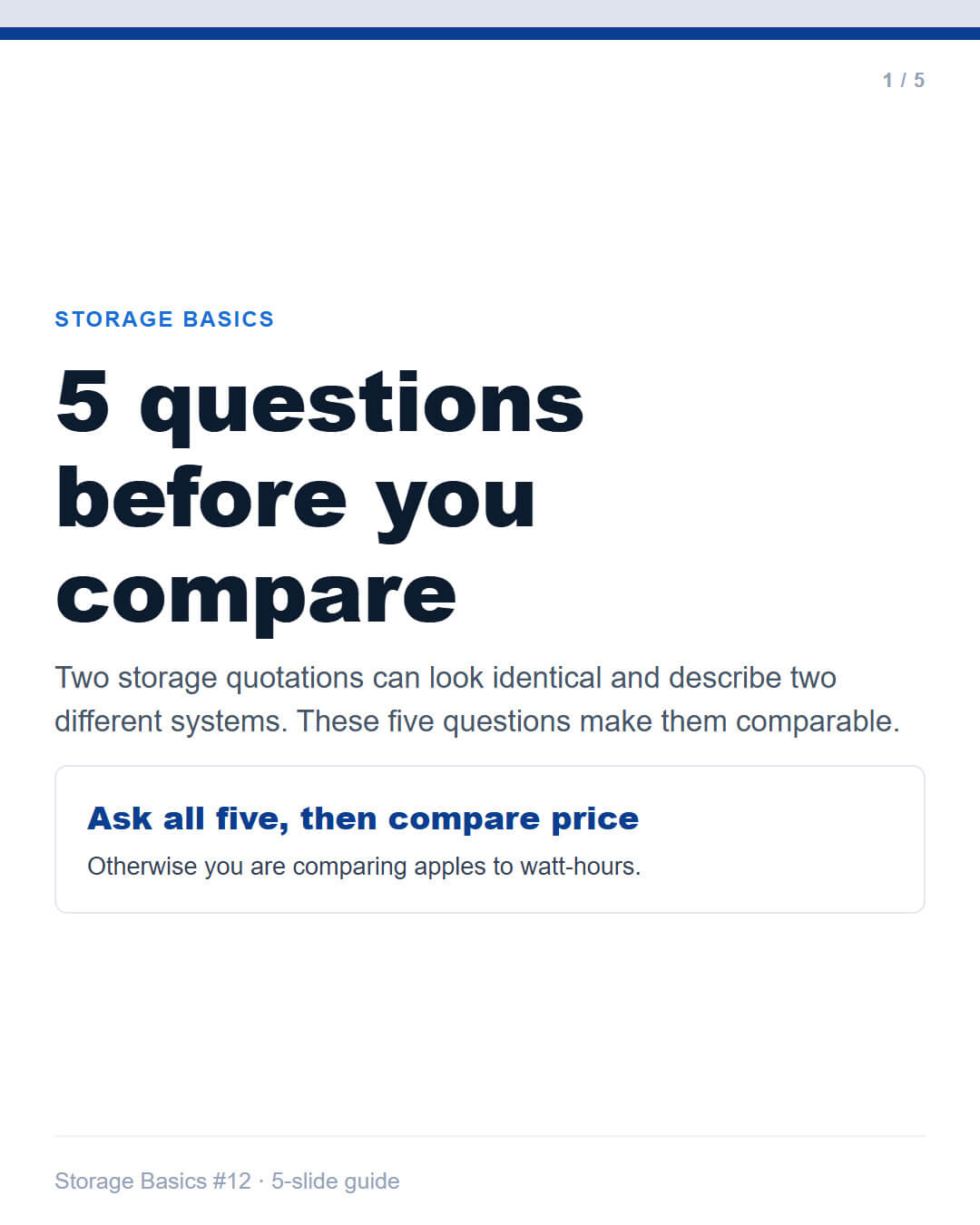
Comparing two storage quotations on price alone is the fastest way to buy the wrong system. Not because suppliers are dishonest — because the same physical system can be described by several legitimate figures, and two quotes using different conventions will look comparable when they are not.
These five questions force every quotation onto the same footing. Ask them before you compare anything. They take ten minutes and they protect a multi-year decision.
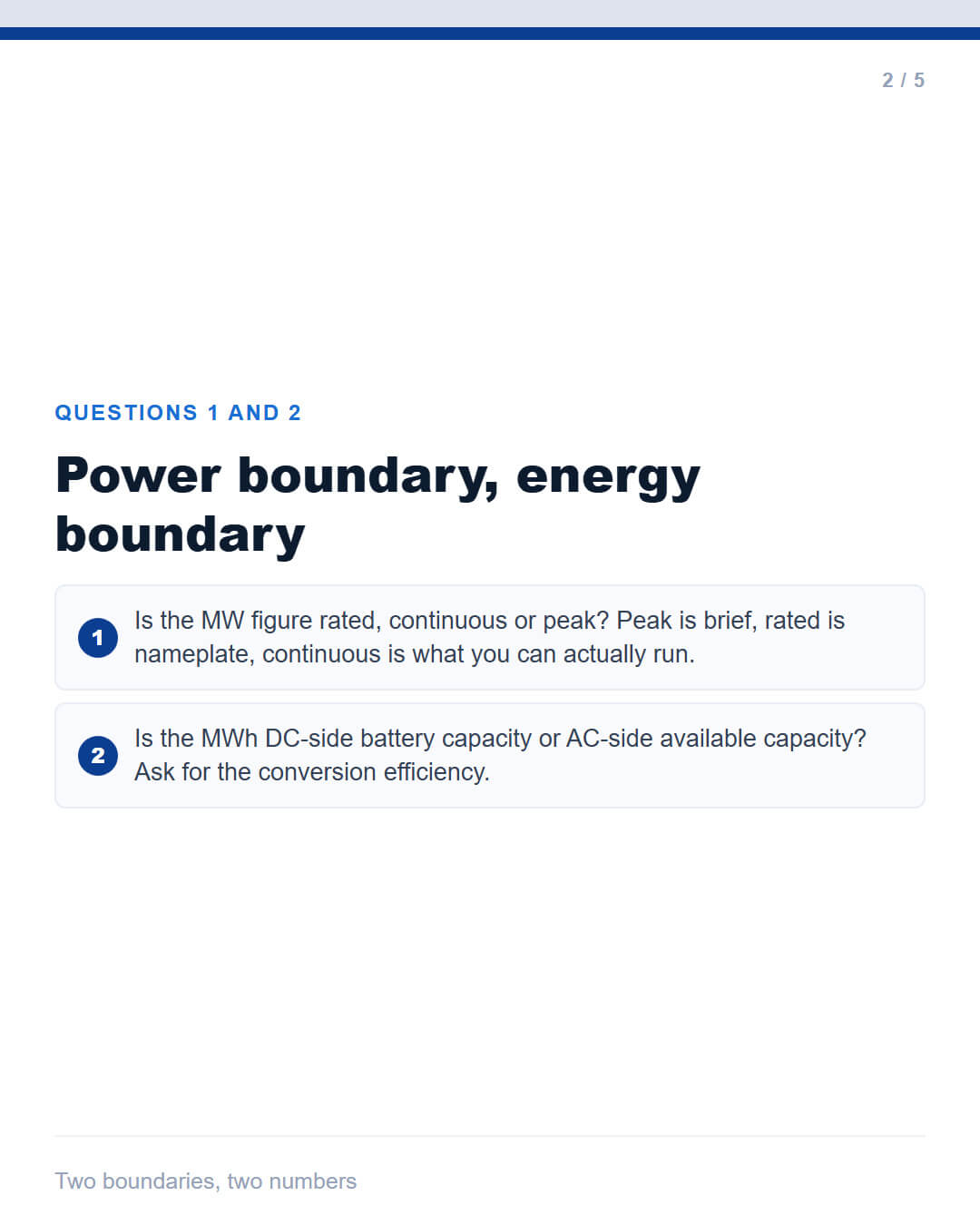
1️⃣ Is the MW figure rated, continuous, or peak?
Three different numbers hide behind one unit.
Rated — the nameplate figure. A reference point, not a promise about sustained operation.
Continuous — what the system can actually deliver indefinitely under stated conditions. This is the number that matters for a load profile.
Peak — available briefly, usually for seconds to minutes. Relevant for transients, not for a duty cycle.
A quote that says "50 MW" without qualifying which of the three is being stated has not specified the power capability. Two suppliers can both write "50 MW" and be describing systems that behave completely differently at the point of dispatch.
Ask: Rated, continuous, or peak — and under what ambient conditions?
2️⃣ Is the MWh figure DC-side battery capacity or AC-side available capacity?
DC is what the battery holds. AC is what reaches the point of connection after PCS, transformer and auxiliary losses. The second number is smaller, and it is the one your client's load experiences.
This is covered in full in our guide to DC vs AC capacity, but the operational rule is simple.
Ask: Which boundary is this figure measured at — and what conversion efficiency connects the two?
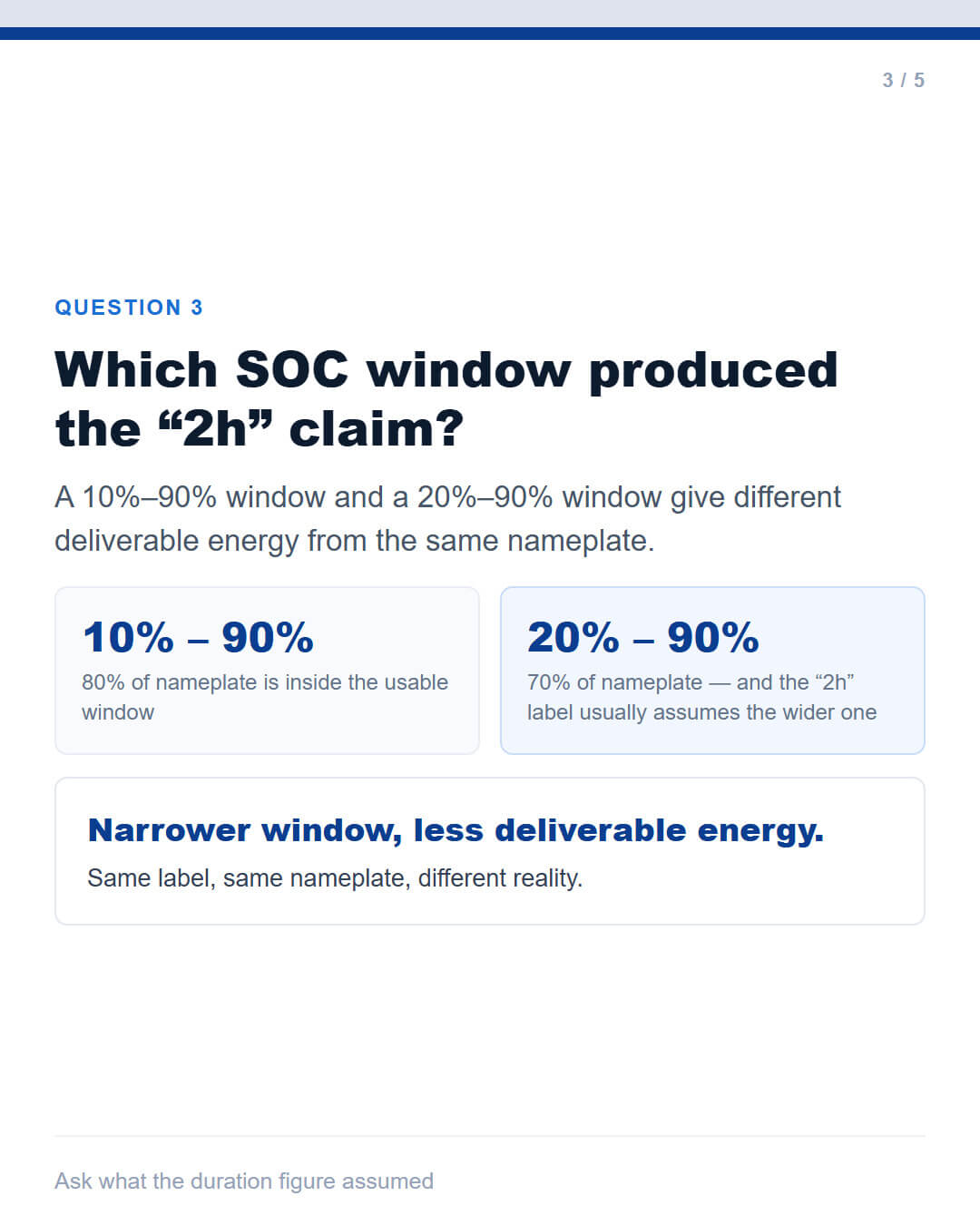
3️⃣ For a "2h" claim — which SOC window was used?
Duration is a ratio, and the denominator is not always the full nameplate capacity.
A "2-hour" system running from 10% to 90% SOC has a narrower usable window than one running from 20% to 90% at a lower depth. The narrower the usable window, the less deliverable energy sits behind the same nameplate figure. BMS reserve margins, protection thresholds and warranty limits all shrink the usable window further.
Two systems can both truthfully claim "2 hours" at the same nameplate capacity while delivering visibly different energy to the load.
Ask: What SOC window was used for the duration claim, and what reserve margin is held back?
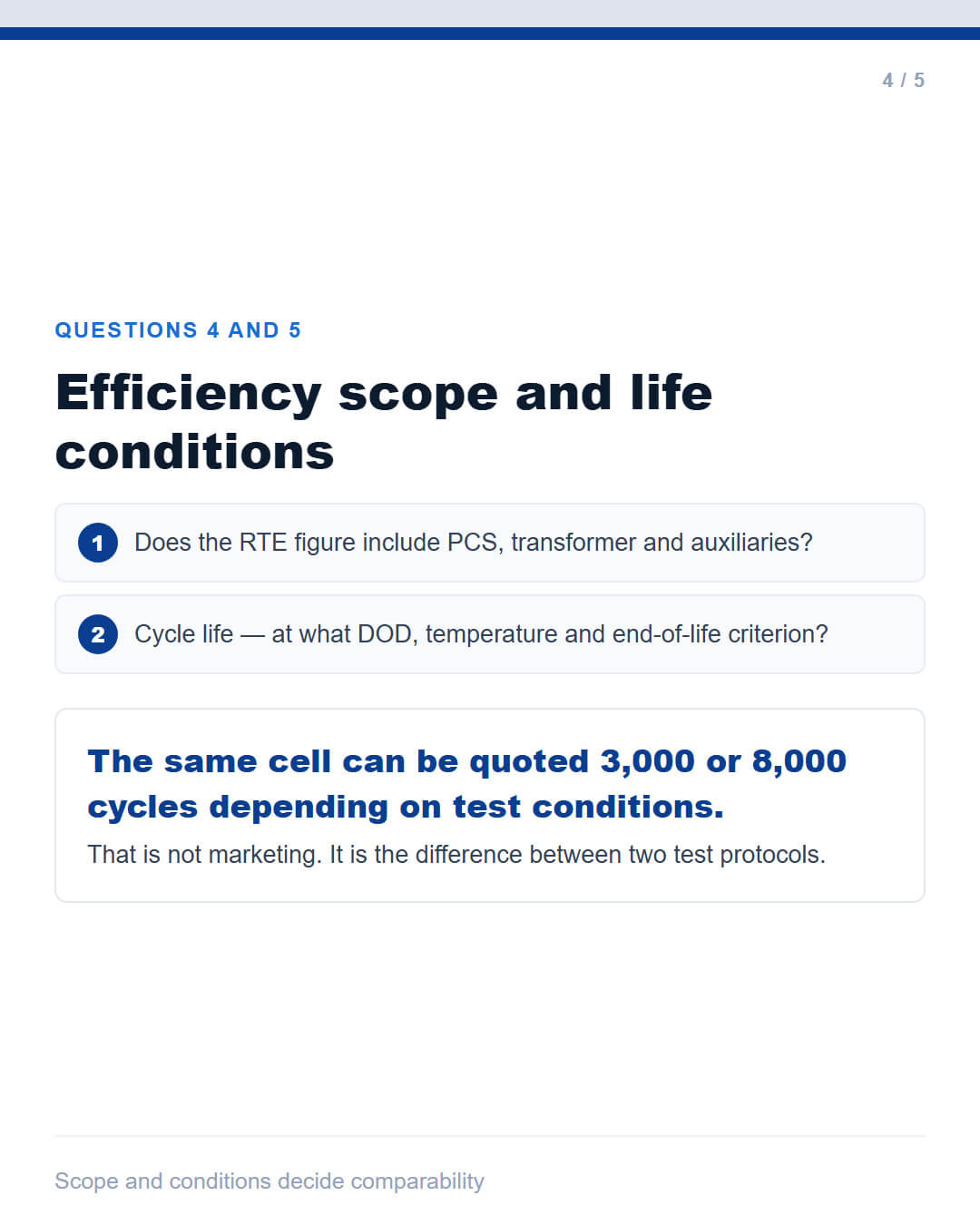
4️⃣ Does the RTE figure include PCS, transformer and auxiliaries?
Round-trip efficiency is quoted at several levels, and the levels differ substantially.
Cell-level efficiency looks excellent and is almost irrelevant to a commercial case.
System-level efficiency includes every conversion and every auxiliary load between the grid and the grid.
A quotation citing a high RTE without stating its scope is comparing a component to a system. Over a project's life, that gap compounds into real energy — the silent leak discussed in our RTE guide.
Ask: Is this RTE measured at cell level, PCS level, or full system level — and at what operating point?
5️⃣ Cycle life — at what DOD, temperature and EOL criterion?
The same cell can legitimately be quoted at 3,000 cycles or 8,000 cycles. Cycle life is not a property of the cell alone; it is a property of the cell under stated conditions.
Three conditions change the answer most:
DOD — depth of discharge per cycle. Deeper cycles age a battery faster.
Temperature — ambient and cell temperature, both of which depend heavily on the thermal management system.
EOL criterion — the end-of-life threshold. 80% of beginning-of-life capacity is a common definition, but 70% is also used, and the choice materially changes the count.
A cycle-life figure without a condition sheet is a marketing number.
Ask: What DOD, what temperature, and what EOL criterion — and can I see the test condition sheet?
Putting them together
| # |
Question |
What it protects against |
| 1 | Rated, continuous or peak MW? | Overstated power capability |
| 2 | DC or AC MWh? |
Overstated deliverable energy |
| 3 | Which SOC window for "2h"? | Overstated usable duration |
| 4 | What scope of RTE? | Overstated round-trip efficiency |
| 5 | What DOD / temperature / EOL? | Overstated service life |
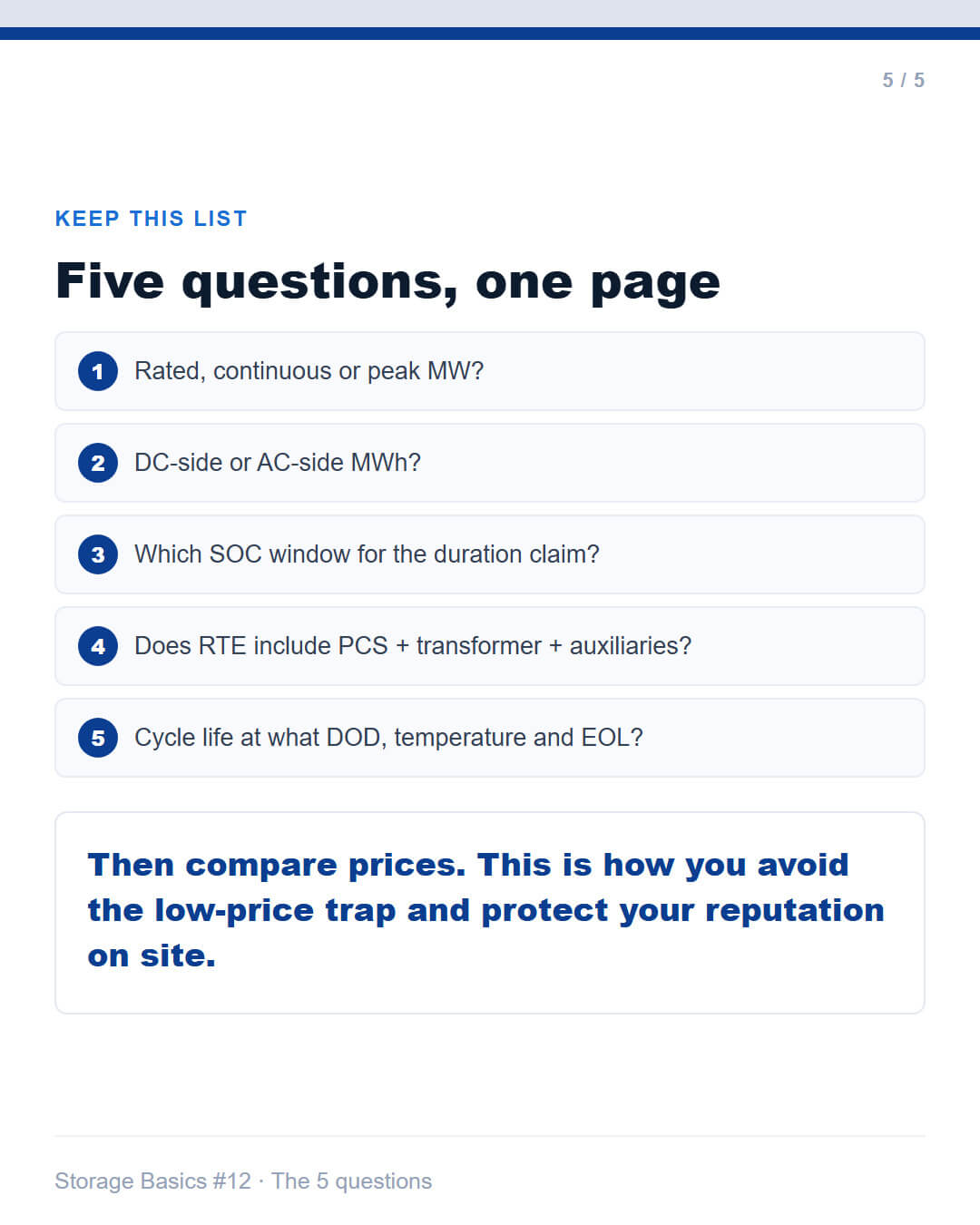
Ask all five. Then compare prices.
This is how you avoid the low-price trap — and, more importantly, how you protect your own reputation on site when the system has to perform in year three, not just on commissioning day.
Frequently asked questions
Do I need to ask all five for every quote? For a small single-site system, questions 1 and 5 usually drive the outcome. For a multi-megawatt project going to tender, all five belong in the specification document, not in a follow-up email.
What if a supplier cannot answer question 4? Treat it as an incomplete quotation rather than a refusal. Ask for the system-level efficiency at the intended operating point. A supplier with a real engineering team will have the figure; one reselling a datasheet may not.
Is the cheapest quote usually the one cutting corners? Not necessarily. But a quote that is materially cheaper than three comparable offers is worth interrogating against all five questions. The gap has to come from somewhere — often a narrower SOC window, a lower EOL criterion, or a DC-side capacity figure presented as if it were deliverable energy.
Can I use these questions in a tender document? Yes — and you should. Written into the specification, they produce comparable bids instead of bids that need to be normalised afterwards.
In Filipino (Tagalog)
Limang tanong bago magkumpara ng quote:
Rated, continuous o peak ang MW?
DC o AC ang MWh?
Anong SOC window ang ginamit sa "2h"?
Kasama ba ang PCS at transformer sa RTE?
Anong DOD, temperatura at EOL criterion sa cycle life?
Itanong lahat bago magkumpara ng presyo. Ito ang paraan para maiwasan ang bitag ng murang presyo — at para protektahan ang sarili mong reputasyon sa site.
Related guides in this series
DC vs AC capacity: which boundary is your quote measuring?
0.5C vs 0.5P: one letter apart, two different frameworks
Round-trip efficiency (RTE): why it is a system number, not a cell number
All figures in this article are illustrative examples used to explain the underlying principles. They do not represent the specifications of any particular product. For current terms, availability and technical documentation, please contact us.
Storage Basics is an educational series from VANYO's overseas team, written for installers, EPCs and system integrators working in the Philippine market.
 0.5C vs 0.5P: One Letter Apart, Two Different Frameworks

 Address: Wanyang Gold and Silver Building 6, Circular Economy Park, Sili Town, Jiyuan City, Henan Province, China