
 Home

Storage Specs Are Four Dimensions, Not One List
A storage datasheet presents dozens of figures in a single column. They look like one long list of specifications. They are actually four different kinds of measurement printed on the same page.
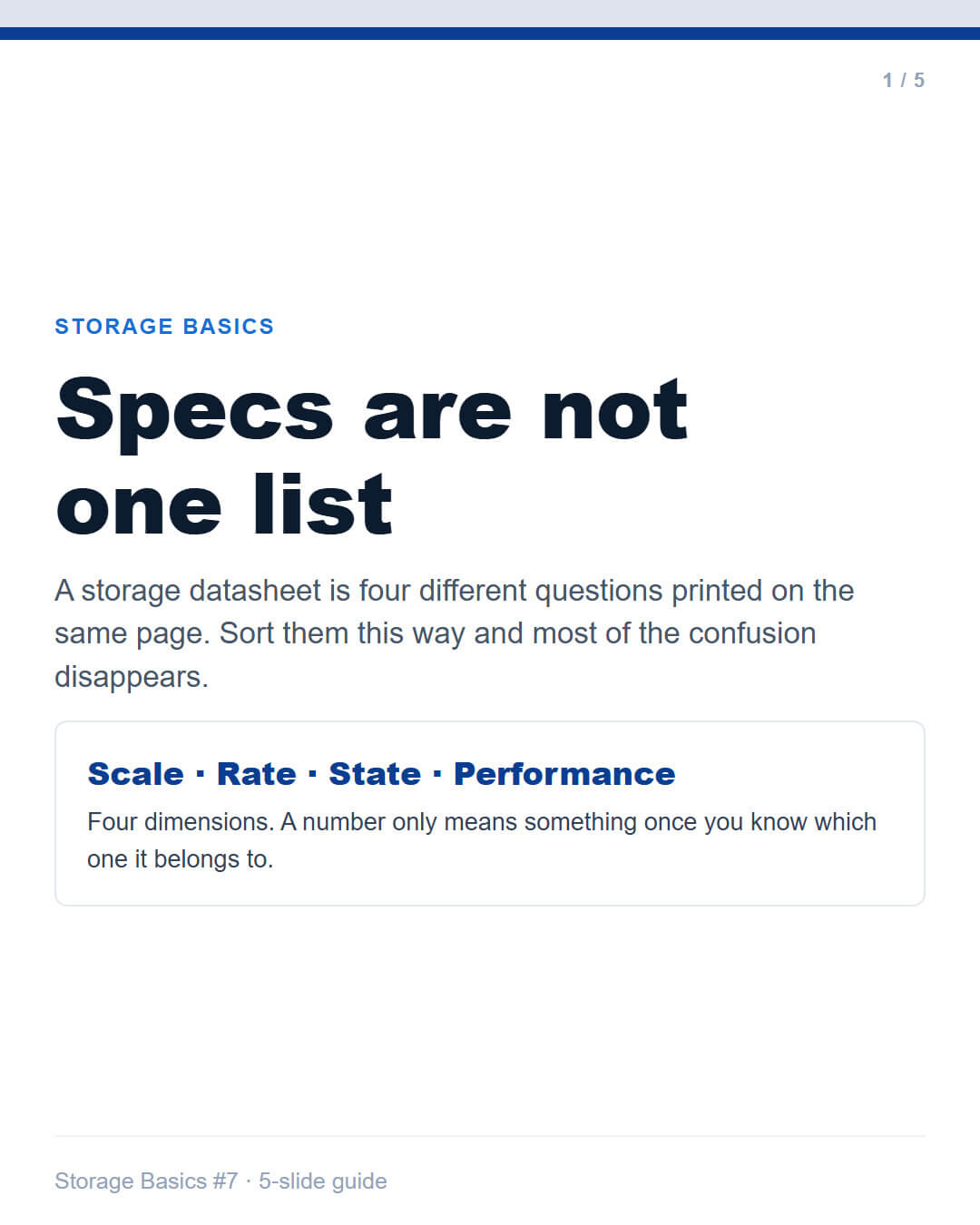
Sort them into those four dimensions and most of the confusion disappears — including the confusion that quietly causes bad comparisons during procurement.
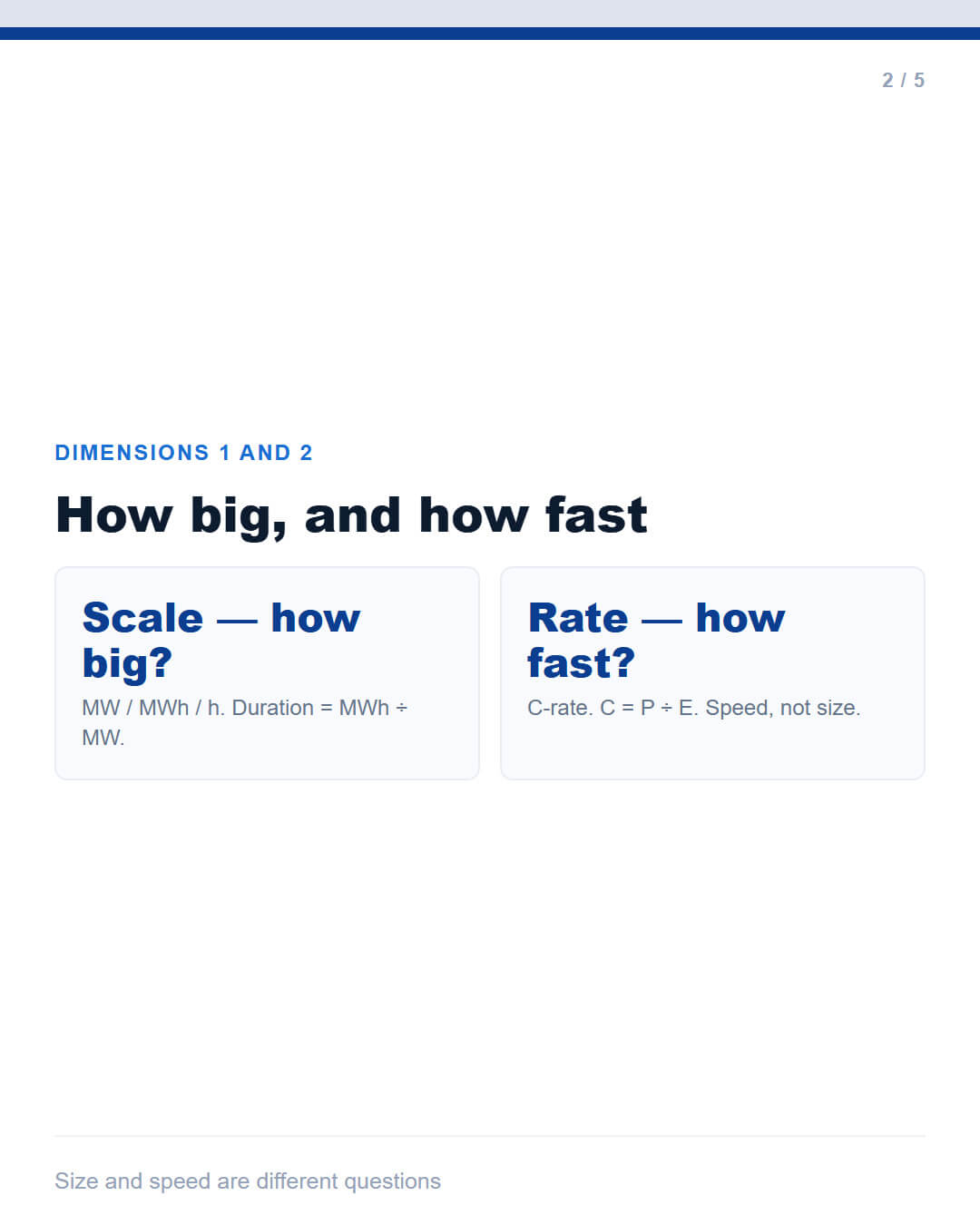
Dimension 1 — Scale: how big?
The size of the system, expressed three ways.
| Figure |
Unit |
What it means |
| Power |
MW |
Maximum output at any instant |
| Energy |
MWh |
Total stored energy |
| Duration |
h |
Duration = MWh ÷ MW |
Scale is about size and configuration. It is the dimension most people are already comfortable with.
Dimension 2 — Rate: how fast?
The C-rate expresses power relative to the system's own capacity.
|
C = P ÷ E |
0.5C ≈ full charge or discharge in 2 hours
1C ≈ full charge or discharge in 1 hour
2C ≈ full charge or discharge in 30 minutes
This is a speed measure, not a size measure. A 200 MWh system running at 0.5C delivers 100 MW; the same 0.5C on a 400 MWh system delivers 200 MW. The rate is identical; the power is not.
We cover the C-rate in detail in the C-rate trap and the 0.5C/0.5P distinction in 0.5C vs 0.5P.
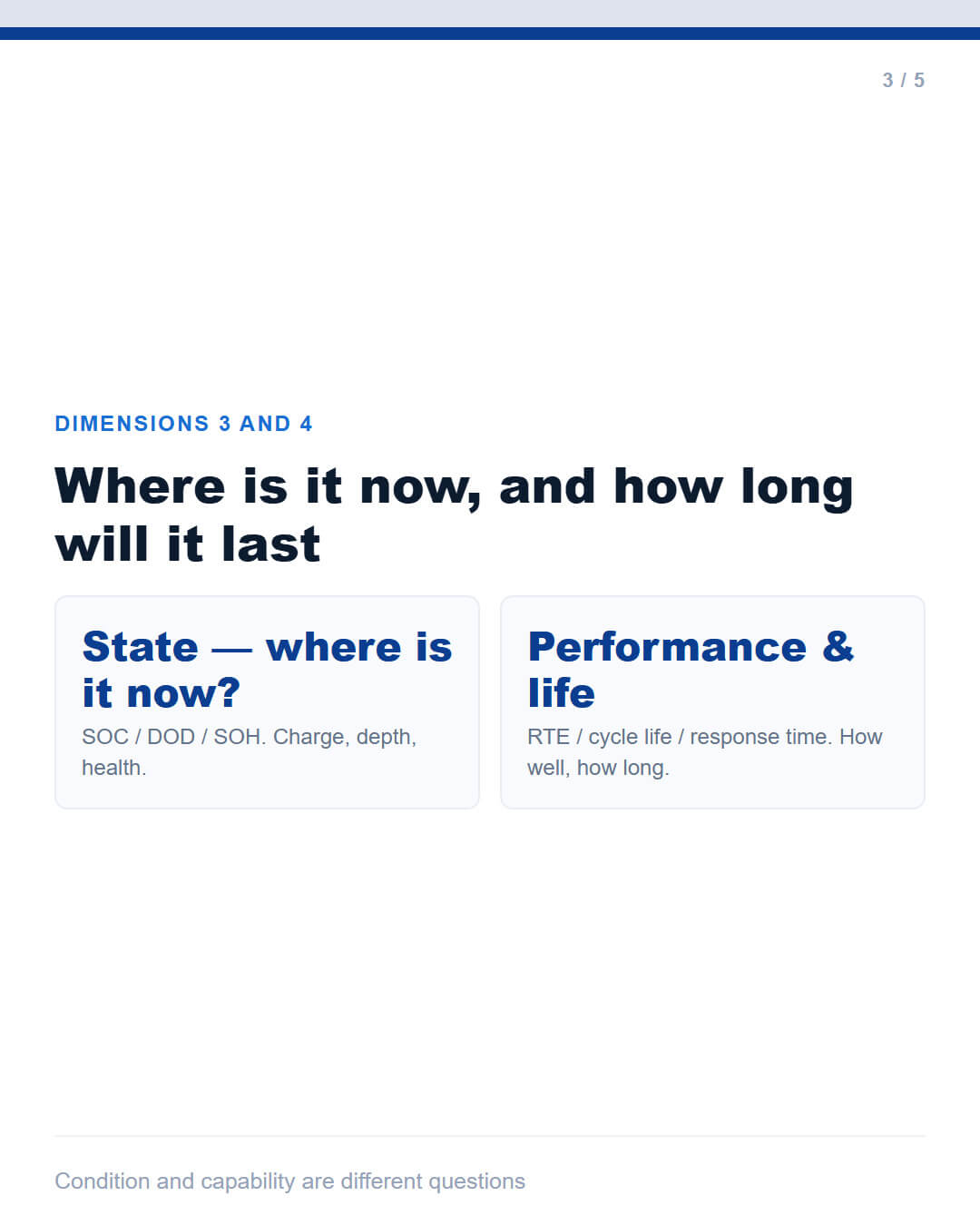
Dimension 3 — State: where is it now?
The condition of the system at a given moment.
| Figure |
Question |
Behaviour |
| SOC |
How full is it now? |
Moves every cycle |
| DOD |
How deep did this cycle go? |
Resets every cycle |
| SOH |
How healthy is it? |
Only declines |
State figures are readings and trends, not design specifications. They describe what the system is doing and how much life it has left — which is why they belong in the operating plan and the warranty conversation rather than in the sizing calculation.
Dimension 4 — Performance and life: how well, how long?
How efficiently and how durably the system performs its job.
| Figure |
What it describes |
| RTE |
Fraction of energy recovered |
| Cycle life |
Cycles before end of life |
| Response time |
How quickly the system follows a setpoint |
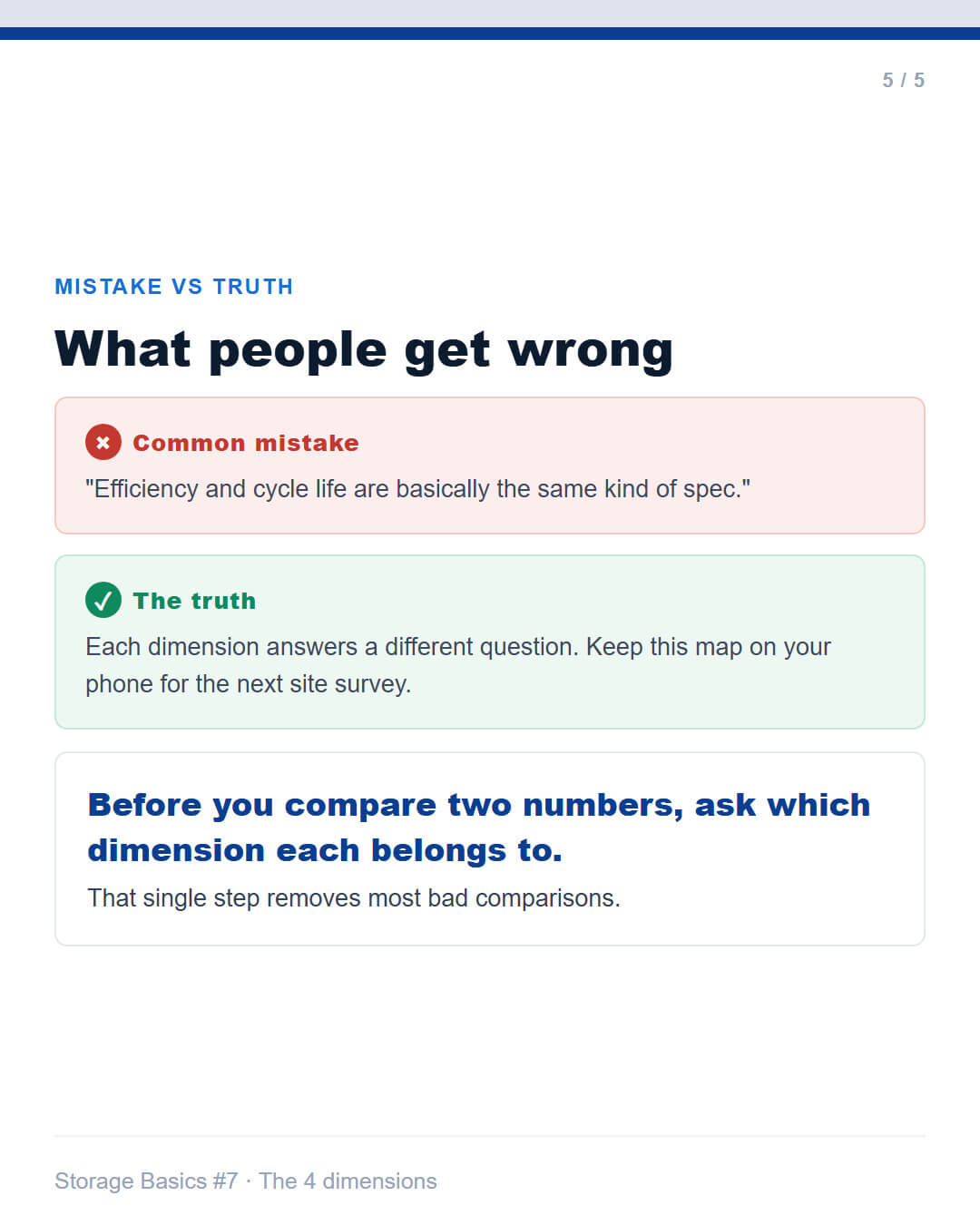
These three are often quoted interchangeably. They are not. Efficiency, durability and speed are separate properties, and a system can be strong in one and ordinary in another.
The practical failure mode
Almost every misread datasheet comes down to the same thing: comparing a number from one dimension with a number from a different dimension.
Common examples:
Comparing cycle life against efficiency as if they were alternatives
Comparing C-rate against duration
Comparing a DC-side capacity with an AC-side capacity
Both numbers in each case are correct. The comparison is meaningless.
Keep the map on your phone
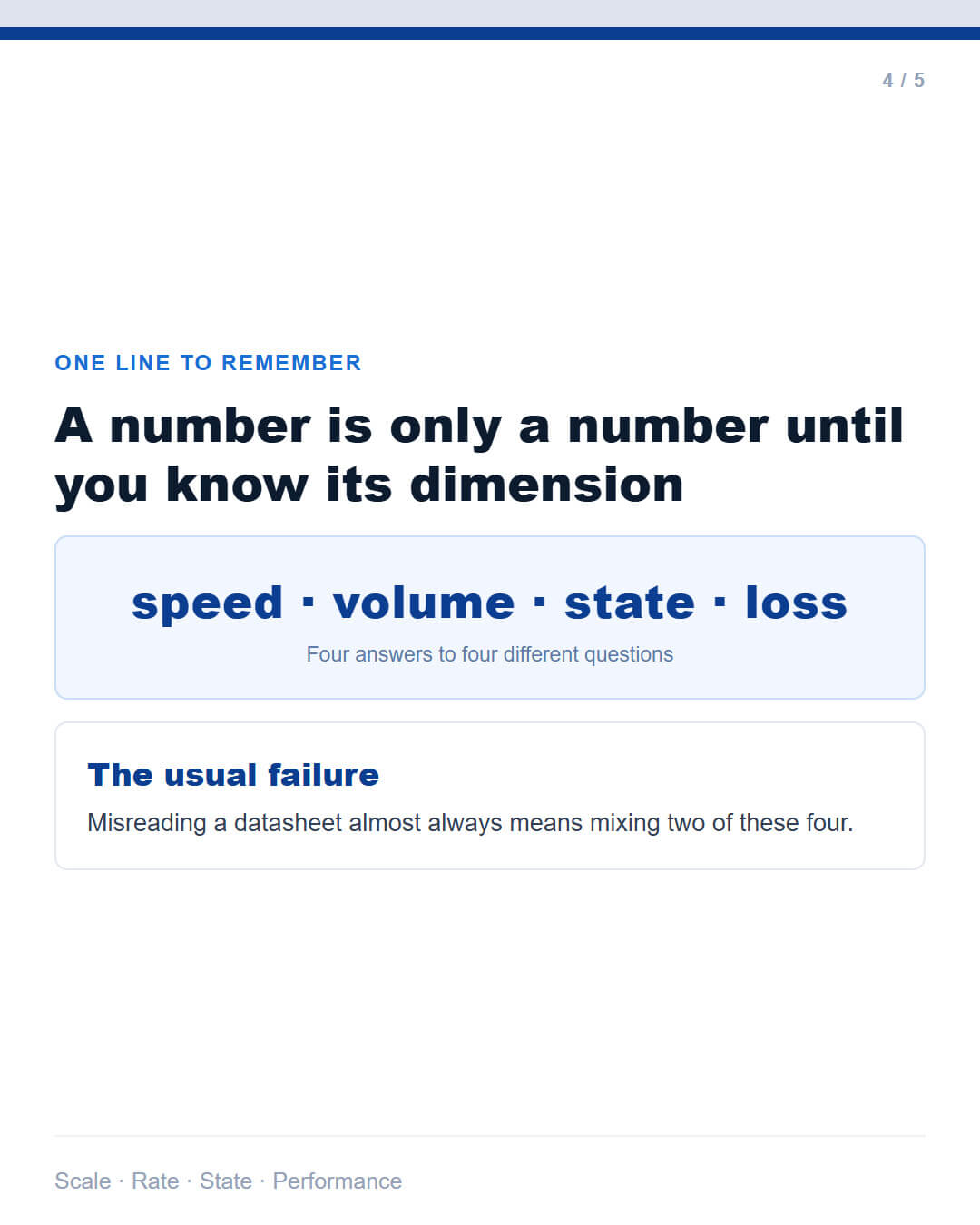
One line covers the whole framework:
| speed · volume · state · loss |
Four questions, four sets of units, four different kinds of answer. Before comparing any two figures, ask which dimension each belongs to — that single step removes most bad comparisons before they reach a quotation.
Frequently asked questions
Which dimension matters most for a backup application? Scale — specifically duration, which is a function of both power and capacity. But the answer is only reliable once you know which SOC window and which end-of-life condition the duration figure assumes.
Why do different vendors give such different cycle-life numbers for similar cells? Because cycle life is a performance-and-life figure that depends on test conditions — DOD, temperature and end-of-life criterion. Without the conditions, the number is not comparable.
Is C-rate a scale figure or a rate figure? Rate. It expresses power relative to capacity, so the same C-rate produces different absolute power on systems of different size.
Can a system have good efficiency and poor cycle life? Yes. The four dimensions are independent, and strength in one does not imply strength in another.
In Filipino (Tagalog)
Apat na dimensyon ng specs:
1️⃣ Scale (sukat) — MW / MWh / h; Tagal = MWh ÷ MW 2️⃣ Rate (bilis) — C-rate; C = P ÷E 3️⃣ State (estado) — SOC / DOD / SOH 4️⃣ Performance at buhay — RTE / cycle life / response time
Iba-iba ang kahulugan ng apat. Ang madalas na pagkakamali ay paghahambing ng numero mula sa magkaibang dimensyon.
Related guides in this series
MW vs MWh: why storage power and capacity are two different things
The C-rate trap: why 0.5C is not 50% of rated power
SOC, SOH and DOD: three metrics, three different questions
Round-trip efficiency: a system number, not a cell number
All figures in this article are illustrative examples used to explain the underlying principles. They do not represent the specifications of any particular product. For current terms, availability and technical documentation, please contact us.
Storage Basics is an educational series from VANYO's overseas team, written for installers, EPCs and system integrators working in the Philippine market.
 Five Questions to Ask Before You Compare Two Storage Quotes

 Address: Wanyang Gold and Silver Building 6, Circular Economy Park, Sili Town, Jiyuan City, Henan Province, China