
 Home

Round-Trip Efficiency (RTE): Why It Is a System Number, Not a Cell Number
"95% round-trip efficiency" is a headline figure that appears on almost every storage datasheet. It is also one of the most commonly misused numbers in procurement, because round-trip efficiency is a property of a boundary, not of a battery.
Measured across one boundary it can read 95%. Measured across another — the one that actually describes what your client receives — it is usually lower.
What RTE measures
|
RTE = energy out ÷ energy in |
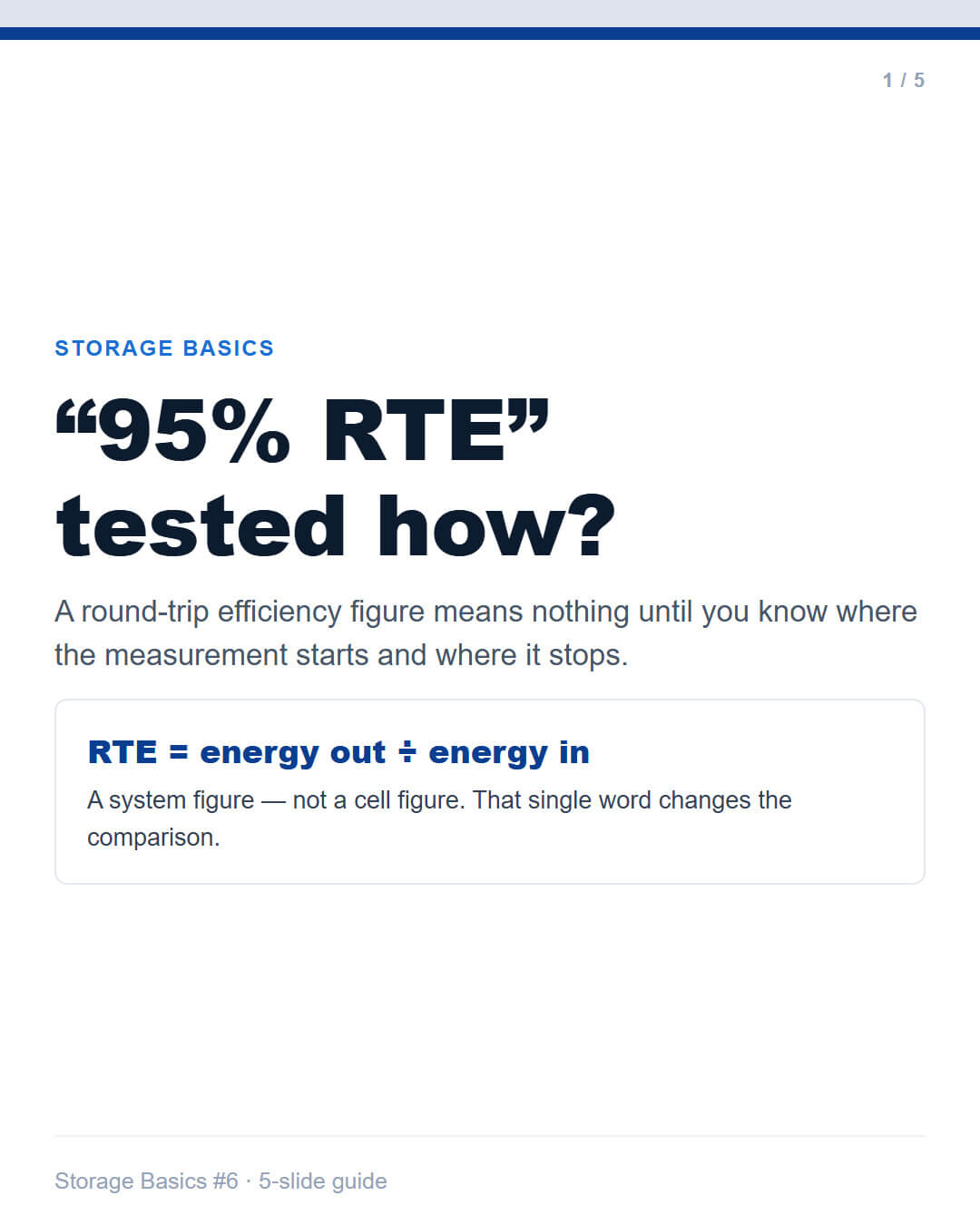
Both sides of that equation have to be measured at the same boundary. The confusion starts because different documents quietly use different boundaries:
| Boundary |
What is included |
Typical effect |
|
Cell-level |
The cells only |
Highest figure |
| DC system |
Cells + BMS + DC cabling |
Slightly lower |
| AC system |
Cells + BMS + PCS + transformer + auxiliaries |
Lowest — and most realistic |
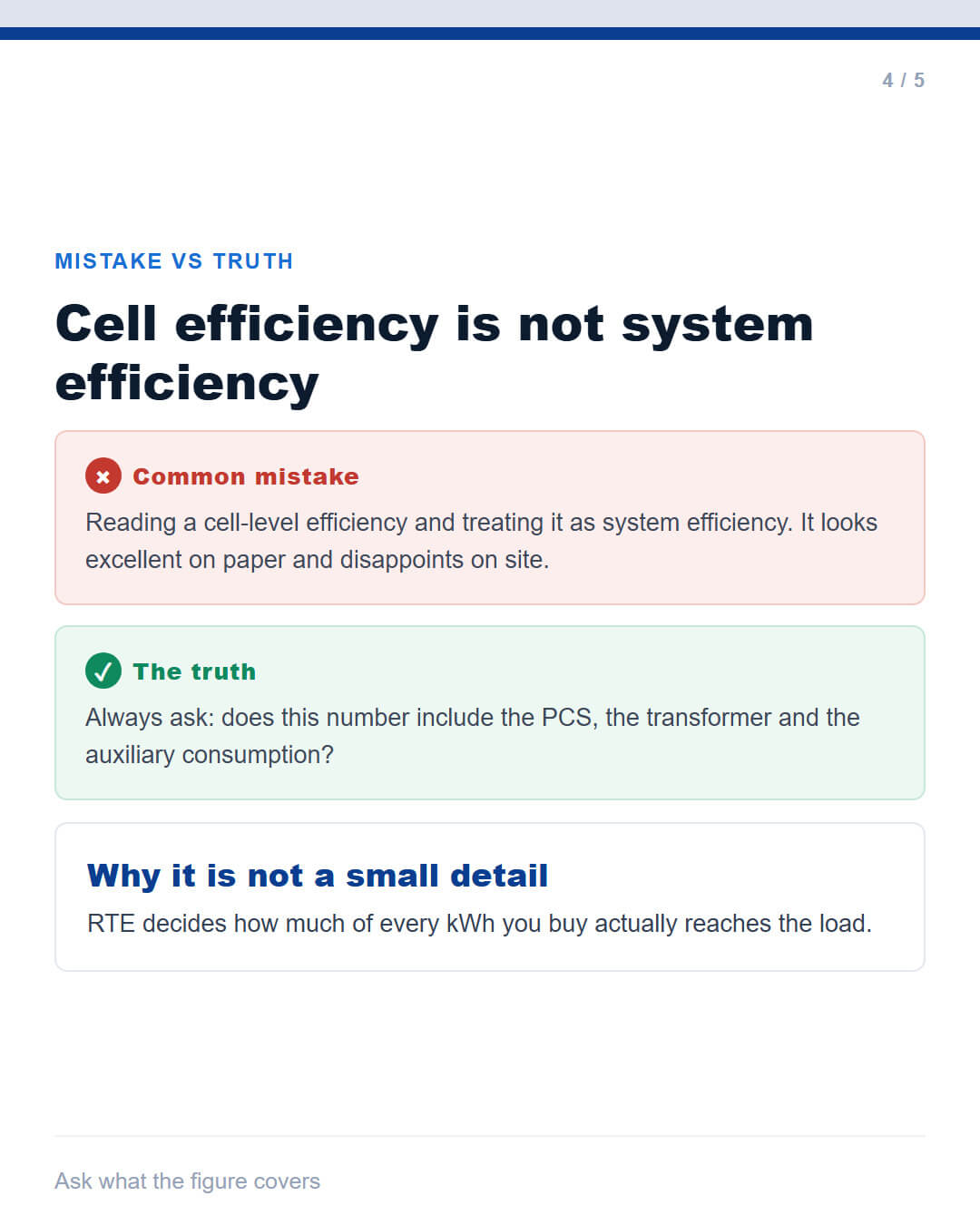
A cell-level figure describes excellent electrochemistry. It does not describe your project.
Where the losses sit
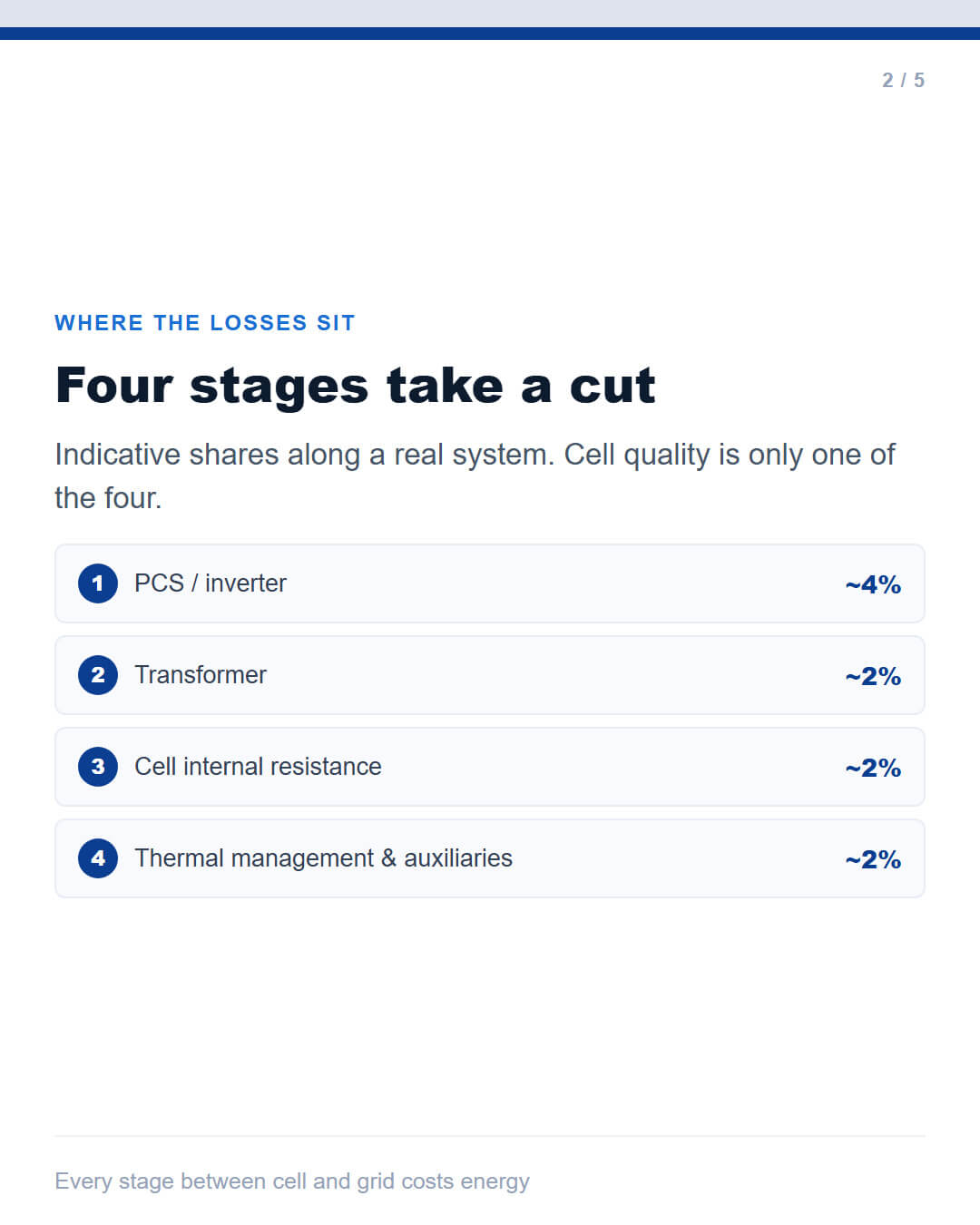
Along the path from cell to grid connection, four stages take a cut. The shares below are indicative, but the order of magnitude is stable:
| Stage |
Indicative loss |
What it represents |
| PCS / inverter |
~4% |
DC–AC conversion |
| Transformer |
~2% |
Voltage transformation plus no-load loss |
| Cell internal resistance |
~2% |
I²R losses inside the cells |
| Thermal management & auxiliaries |
~2% |
Cooling, controls, standby consumption |
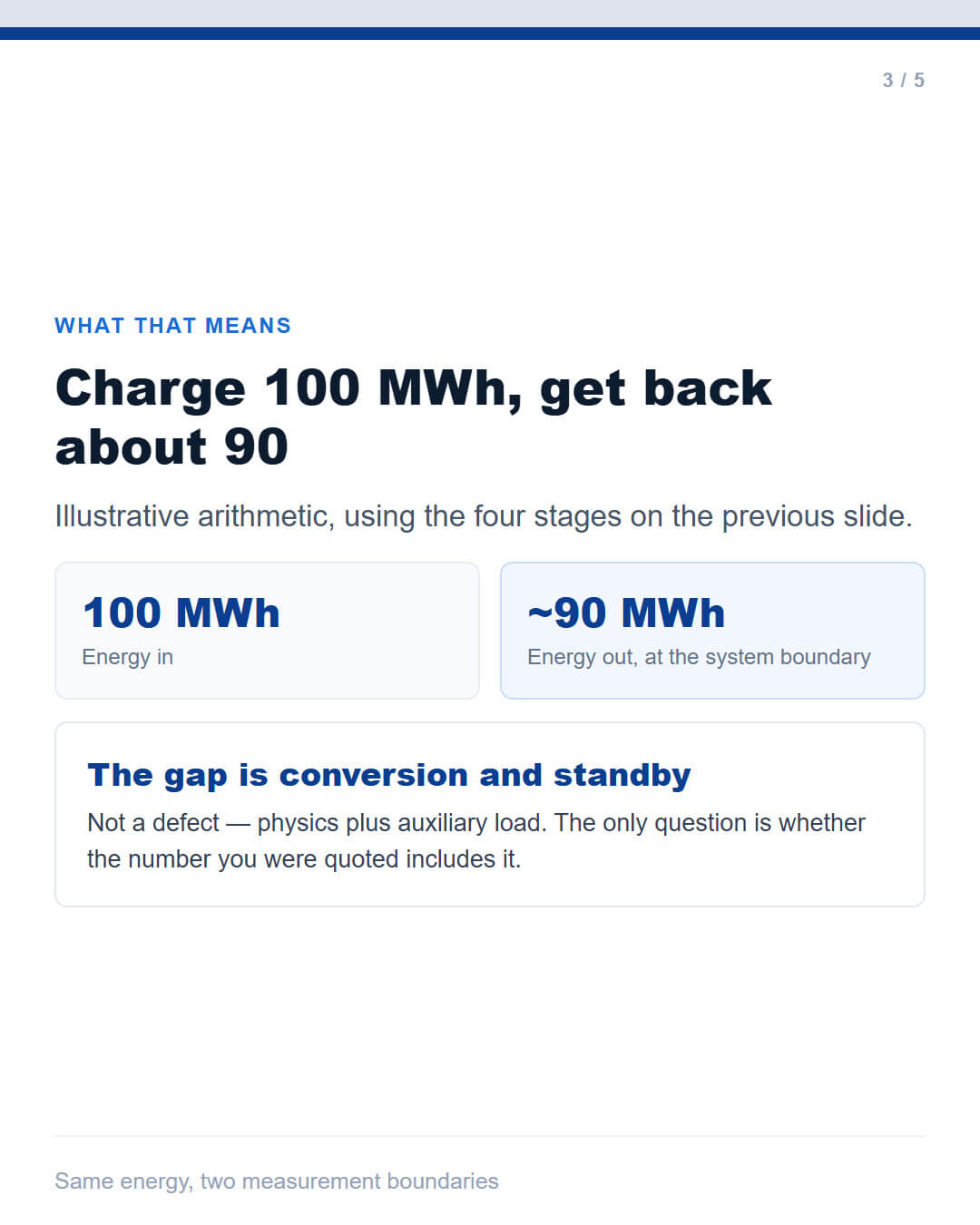
Charge 100 MWh and you may get back something in the region of 90 MWh — measured at the system boundary.
Two things are worth noting about that gap. First, it is not a defect; it is physics plus auxiliary load. Second, and more importantly, auxiliary consumption runs whether or not you are cycling the battery. A system that sits idle still consumes energy for cooling and controls.
Why it matters commercially
Efficiency is not an engineering footnote. It decides how much of every kWh you purchase actually reaches the load.
Across a ten-year project, a few percentage points of efficiency is a material difference in operating cost — and it compounds, because the loss occurs on every single cycle, not once at commissioning.
That is why RTE belongs in the commercial comparison, not just the technical annex.
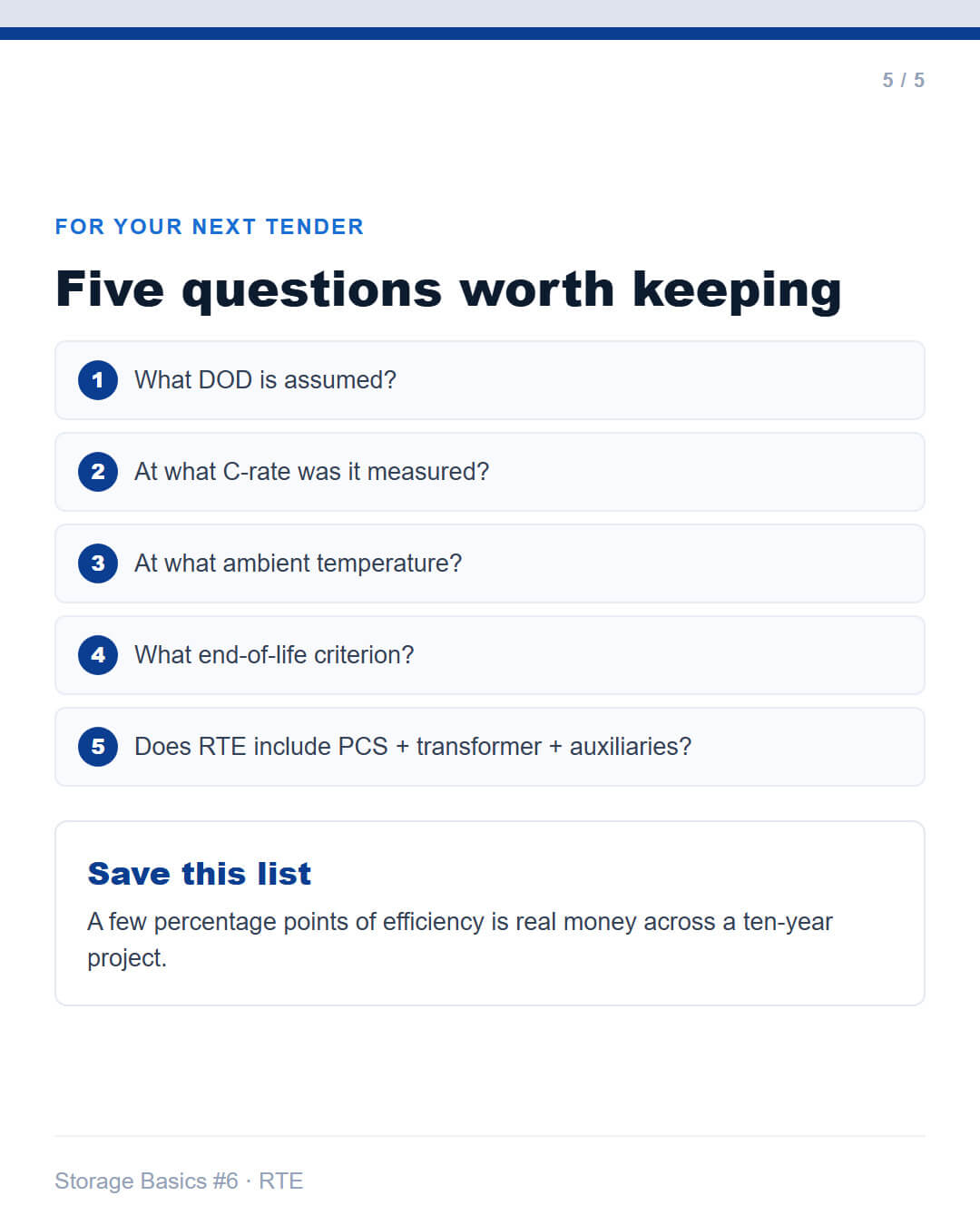
The four questions to ask
When a supplier quotes an efficiency figure, ask:
Does this figure include the PCS?
Does it include the transformer?
Does it include auxiliary consumption?
At what duration, C-rate and ambient temperature was it measured?
Without those four answers, two suppliers can quote "95%" and deliver meaningfully different systems.
Frequently asked questions
Is round-trip efficiency the same as cell efficiency? No. Cell efficiency describes the cells alone. Round-trip efficiency normally refers to the whole system, including conversion, transformation and auxiliary load — though this is precisely why you should confirm the boundary.
What is a normal round-trip efficiency for a battery storage system? It varies with configuration, duration and operating conditions. The useful number is not an industry average but the figure for the specific boundary and conditions your project will operate under.
Does auxiliary consumption count when the system is idle? Yes. Cooling, controls and standby systems continue to draw power. This is one reason a system's real-world efficiency can differ from a figure measured over a single clean cycle.
Does efficiency get worse over the life of the system? It can. Internal resistance rises as cells age, which increases I²R losses. This is one of the reasons end-of-life conditions matter for the commercial case.
In Filipino (Tagalog)
Ang RTE ay system-level, hindi cell-level.
Kasama sa tunay na round-trip efficiency ang PCS, transformer, internal resistance ng cells, at thermal management.
Halimbawa: 100 MWh ang ipinasok, mga 90 MWh ang maibabalik — kung sinusukat sa system boundary.
Itanong palagi: kasama ba ang PCS, transformer at auxiliaries? At sa anong duration, C-rate at temperatura sinukat?
Related guides in this series
DC vs AC capacity: why the same number means two different things
Five questions to ask before you compare two storage quotes
From parameters to profit: the five links that decide the return
All figures in this article are illustrative examples used to explain the underlying principles. They do not represent the specifications of any particular product. For current terms, availability and technical documentation, please contact us.
Storage Basics is an educational series from VANYO's overseas team, written for installers, EPCs and system integrators working in the Philippine market.
 Storage Specs Are Four Dimensions, Not One List

 Address: Wanyang Gold and Silver Building 6, Circular Economy Park, Sili Town, Jiyuan City, Henan Province, China