
 Home

SOC, SOH and DOD: Three Battery Metrics That Answer Three Different Questions
Open any BMS screen and you will see three acronyms sitting next to each other. They look like variants of the same measurement. They are not.
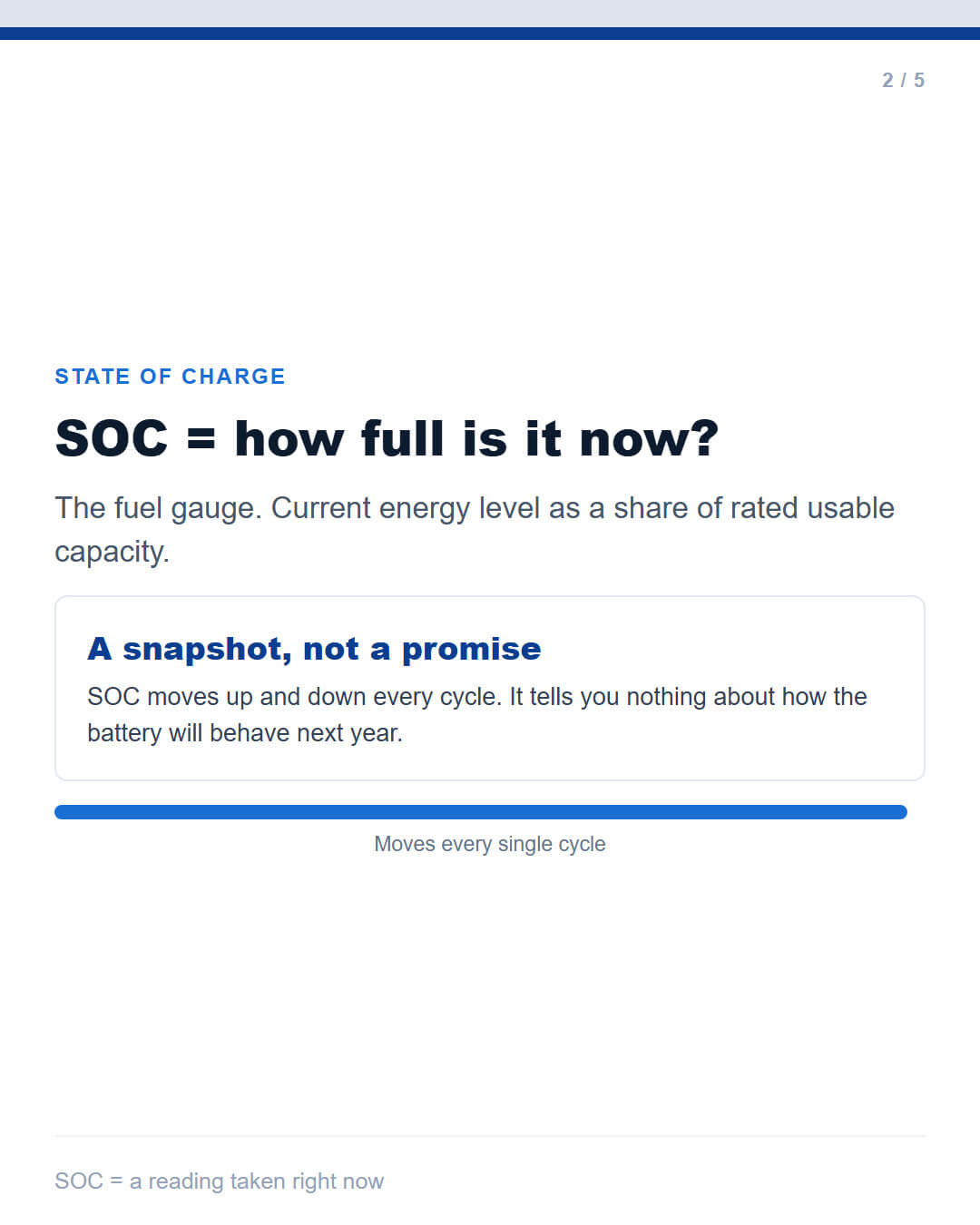
SOC tells you how full the battery is right now. SOH tells you how healthy it is compared with a new cell. DOD tells you how much of the usable capacity a given cycle actually consumed.
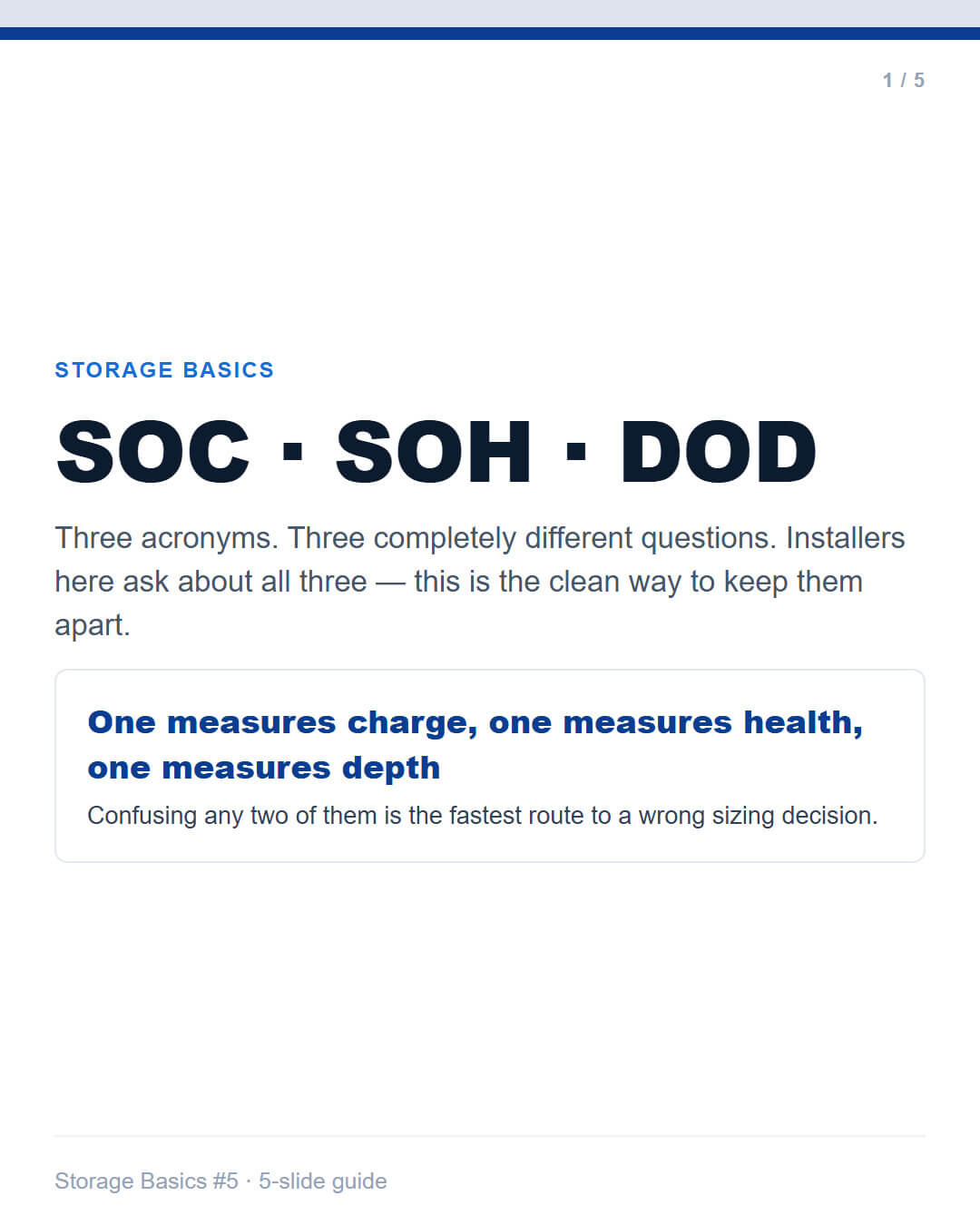
Confusing any two of them is one of the fastest ways to size a system wrongly — and in a backup application, "wrongly" usually means promising a client a service window the site cannot deliver.
The short version
|
SOC |
SOH |
DOD |
|
|
Question it answers |
How full is it now? |
How healthy is it? |
How deep did this cycle go? |
|
Reference point |
Rated usable capacity |
A brand-new cell |
The usable window |
|
Behaviour over time |
Moves up and down every cycle |
Only declines |
Resets each cycle |
|
Typical use |
Operational decisions |
Economic life, warranty |
Cycle-life design |
The one-line summary worth remembering: SOC is a reading, SOH is a trend, DOD is a count.
SOC — the fuel gauge
State of Charge reports the current energy level as a share of rated usable capacity.
|
SOC = Q remaining ÷ Q available × 100% |
It is a snapshot. It is refreshed continuously, and it changes every time the system charges or discharges. On its own it says nothing at all about how the battery will behave next year.
What SOC does not tell you is how much energy you can actually deliver to a load. Three things sit between the reading and the reality:
The usable window. Most systems operate inside a band — commonly 10%–90% — to protect the cells. That is 20% of nameplate you never touch.
Temperature. Usable capacity falls away in high ambient heat. In Philippine conditions, thermal management is not a nice-to-have.
Estimation error. SOC is inferred from voltage, current and temperature. There is always some error, and it drifts as the battery ages.
We cover that gap in more detail in our guide to what SOC actually tells you.
SOH — the health report
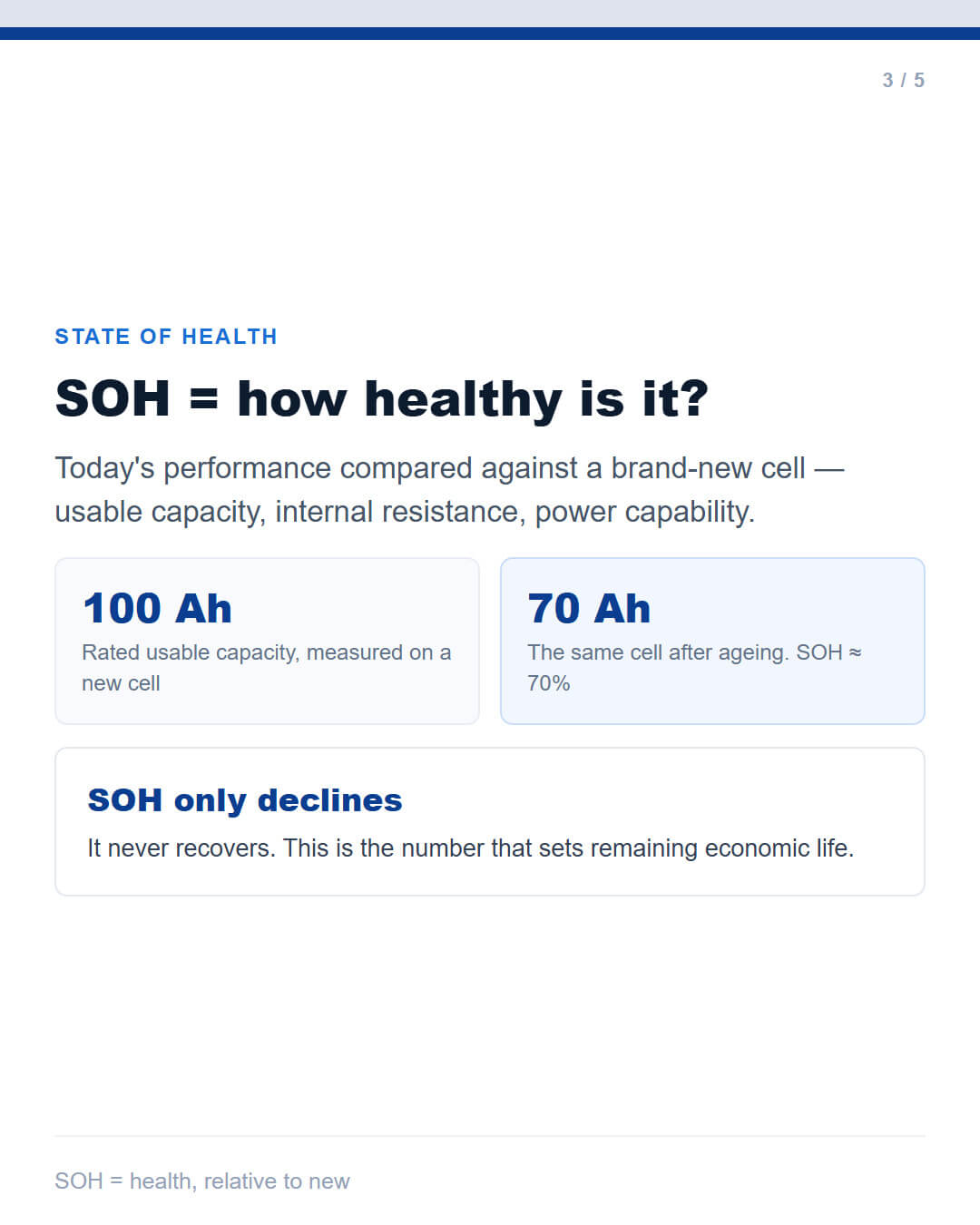
State of Health compares today's performance against a new cell. It is normally expressed through usable capacity, internal resistance and power capability.
| New cell |
After ageing |
|
| Usable capacity |
100 Ah |
70 Ah |
| Internal resistance |
10 mΩ |
25 mΩ |
| Indicative SOH |
100% |
~70% |
The critical property of SOH is direction: it only declines. It is not a charge level, it does not recover after a full charge, and it is the number that governs remaining economic life — which makes it the number your client's finance team actually cares about.
DOD — the cycle-depth counter
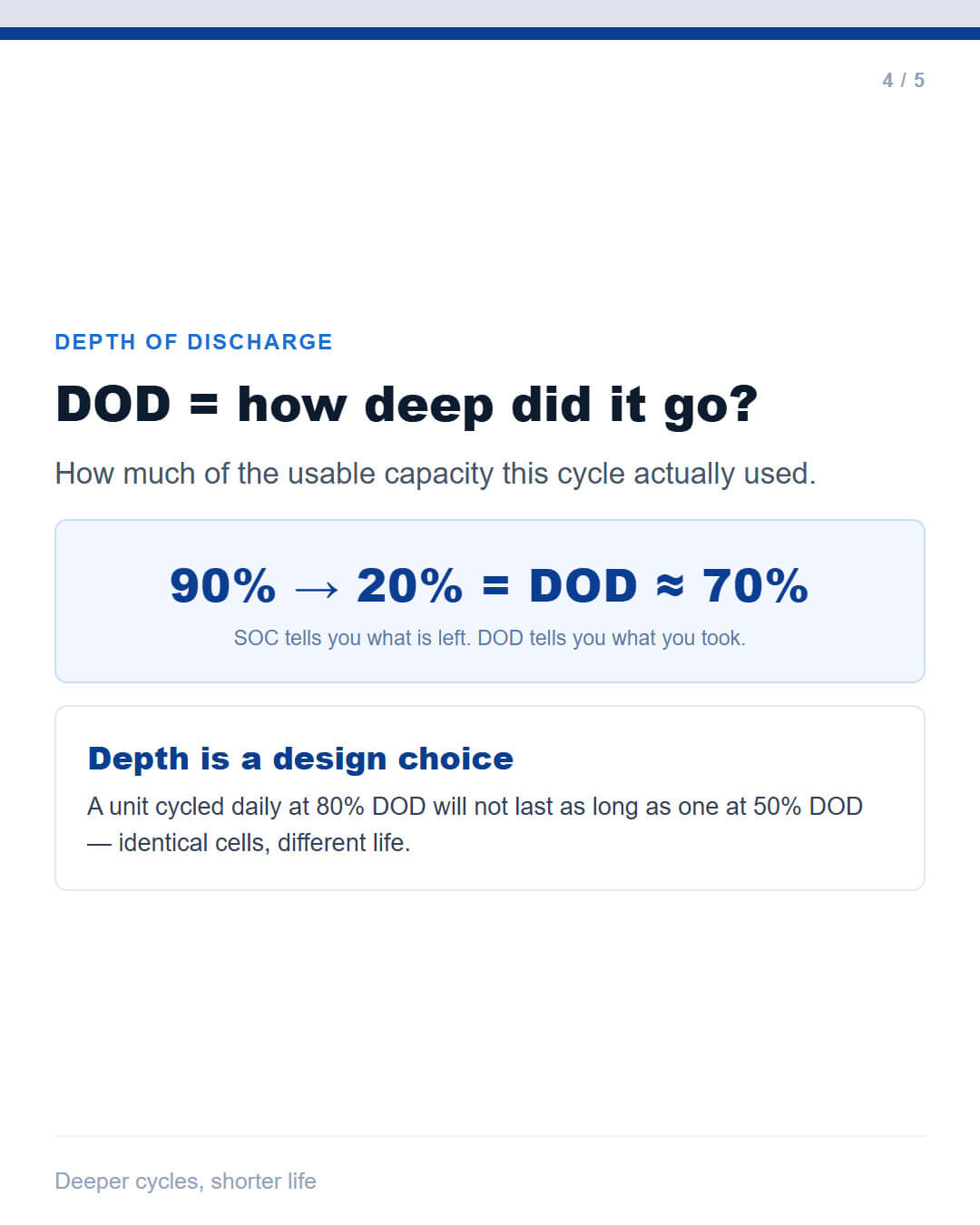
Depth of Discharge measures how much of the usable window a cycle consumed.
If a cycle starts at SOC 90% and ends at SOC 20%, the DOD for that cycle is approximately 70%. SOC and DOD are two views of the same event: one counts what remains, the other counts what you took.
Why it matters: depth is a design decision, not an accident. Deeper cycling ages a battery faster. A unit cycled daily at 80% DOD will not last as long as an identical unit cycled at 50% DOD. The cells are the same; the life is not.
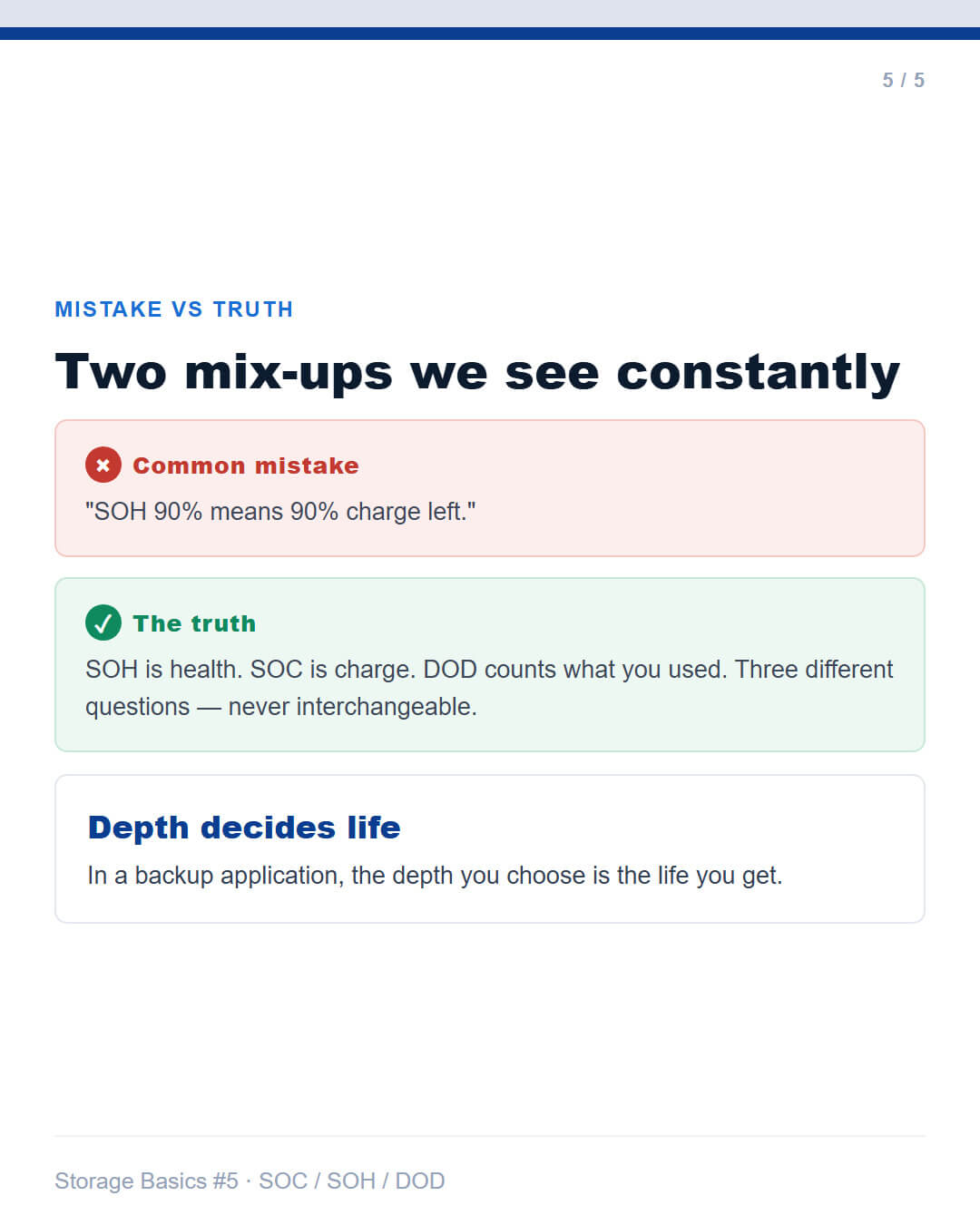
The two mix-ups we see most often
|
Mistake 1: "SOH 90% means 90% charge left." |
SOH is health. SOC is charge. A battery at 90% SOH may be sitting at 30% SOC, or at 100% SOC — the two figures are unrelated.
| Mistake 2: "DOD and SOC are the same thing." |
They describe the same cycle from opposite ends. SOC tells you what is left; DOD tells you what you used. Quoting one when a tender asks for the other is a specification error, not a rounding difference.
How to use all three in a proposal
Quote SOC when describing the operating window you intend to run — for example a 10%–90% band.
Quote DOD when describing the cycle you will actually perform, because that is what drives cycle life.
Quote SOH when describing what the client should expect at year five, seven and ten — and what the end-of-life criterion is.
A proposal that gives all three is a proposal that can be compared to another. A proposal that gives only SOC usually cannot.
Frequently asked questions
Does SOH ever increase? No. SOH is measured against a new cell and declines with use. Some BMS routines recalibrate the reported estimate, which can shift the figure slightly, but the underlying capacity fade is one-directional.
Is 100% DOD harmful? It is stressful. Deep cycling accelerates capacity fade compared with shallower cycling, which is one of the reasons storage systems typically operate inside a restricted SOC band rather than using the full nameplate.
Can two systems with the same SOC have different deliverable energy? Yes. Different usable windows, different temperatures and different SOH all change the deliverable energy even when the SOC reading is identical.
How long does a battery last at 80% DOD versus 50% DOD? It depends on the cell and the operating temperature, which is exactly why cycle-life figures should always be quoted with their test conditions. The direction, however, is consistent: shallower cycling extends life.
In Filipino (Tagalog)
SOC, SOH at DOD — tatlong magkaibang tanong:
Ang SOC ay kung gaano pa karami ang natitira — isang snapshot. Ang SOH ay kung malusog pa ang baterya kumpara sa bago. Ang DOD ay kung gaano kalalim ang nagamit sa isang cycle.
Halimbawa: mula SOC 90% hanggang SOC 20% ay DOD na humigit-kumulang 70%.
Tandaan: ang mas malalim na DOD ay mas mabilis magpababa ng buhay ng baterya. Ang pipiliin mong depth ay ang buhay na makukuha mo.
Related guides in this series
MW vs MWh: why storage power and capacity are two different things
The C-rate trap: why 0.5C is not 50% of rated power
What SOC actually tells you — and what it does not
Five questions to ask before you compare two storage quotes
All figures in this article are illustrative examples used to explain the underlying principles. They do not represent the specifications of any particular product. For current terms, availability and technical documentation, please contact us.
Storage Basics is an educational series from VANYO's overseas team, written for installers, EPCs and system integrators working in the Philippine market.
 Round-Trip Efficiency (RTE): Why It Is a System Number, Not a Cell Number

 Address: Wanyang Gold and Silver Building 6, Circular Economy Park, Sili Town, Jiyuan City, Henan Province, China