
 Home
Home
2025 Residential Energy Storage Trends: From Technology Pioneers to Home Autonomy
The residential energy landscape has reached a historic turning point in 2025. What was once an experimental add-on has evolved into the central hub of the modern smart home. As the global market scales toward $15 billion, the industry is moving beyond simple hardware.
Drawing insights from the strategies of industry giants and emerging innovations, here are the five trends defining residential energy storage systems this year.
Top 5 Trends Defining Residential Energy Storage Systems in 2025
1. The "Solar + Storage" Integration Standard
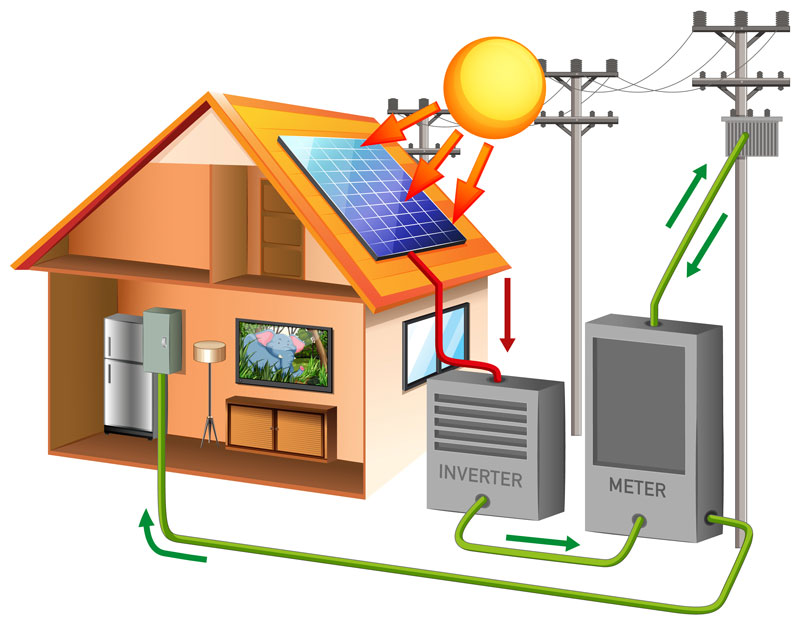
In 2025, the industry has shifted away from standalone solar. Following the lead of pioneers like Tesla (with the Powerwall 3) and Enphase, the market now views a battery as a non-negotiable component. This shift is driven by the global decline in feed-in tariffs, making energy self-consumption the only viable path to long-term savings. Homeowners are now seeking integrated residential energy storage systems that offer seamless transition during grid outages.
2. LFP: The Universal Safety Benchmark
The debate over battery chemistry is over. In 2025, Lithium Iron Phosphate (LFP) has become the global standard, favored by major manufacturers like BYD and adopted by high-end integrators worldwide.
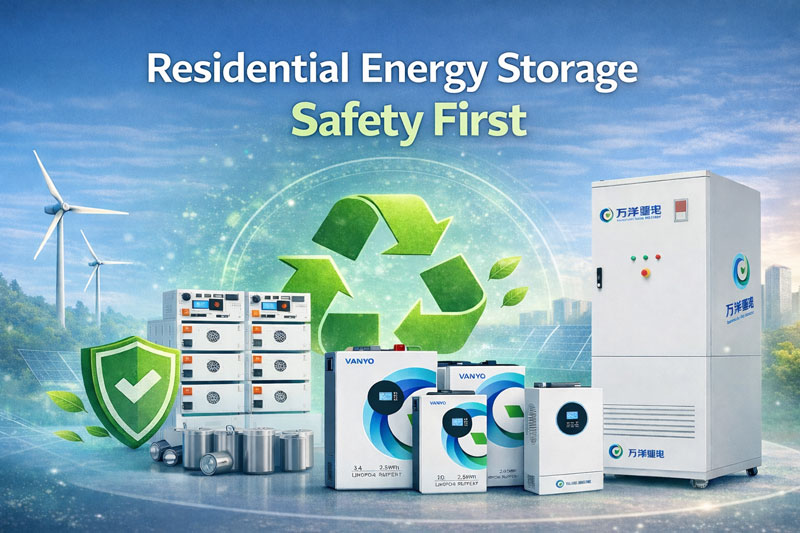
Vanyo's Perspective: While the industry benchmarks 6,000 to 8,000 cycles, the latest residential energy storage systems are optimizing LFP cell management to ensure decades of stable operation, prioritizing thermal safety in dense residential environments.
3. AI-Driven Smart Energy Management (EMS)
The most significant trend of 2025 is the "intelligence leap." Leading systems are no longer passive reservoirs; they are smart processors. Much like the advanced software ecosystems developed by Sonnen, new AI-driven platforms now predict solar production via weather APIs and automate Peak Shaving. This ensures that your residential energy storage systems charge when rates are lowest and discharge when utility costs peak.
4. Participation in Virtual Power Plants (VPP)
2025 marks the year that home batteries became revenue generators. Across the US, Europe, and Australia, VPP programs are aggregating thousands of individual residential energy storage systems to stabilize the local grid. By exporting excess power during peak demand—a model proven by companies like AutoGrid and Tesla—homeowners can now offset their initial investment faster than ever before.
5. Modular Design & High-Density Scalability
Space is a premium for modern homeowners. Inspired by the sleek, modular aesthetics popularized by Samsung SDI and LG Energy Solution, the 2025 generation of batteries focuses on "Plug-and-Play" simplicity.
Flexible Growth: Today's residential energy storage systems allow for incremental capacity increases. You can start with a 5kWh module for essential backup and expand as you add an Electric Vehicle (EV) or heat pump to your home.
Why Vanyo Energy for 2025?
While the industry is led by household names, the true value for 2025 lies in finding a balance between high-end performance and modular flexibility. By adopting these global trends—from LFP safety to AI intelligence—Vanyo Energy provides residential energy storage systems that empower homeowners to achieve total energy independence.
 Residential Energy Storage Supplier Europe
 Dec 15,2025

 Address: Wanyang Gold and Silver Building 6, Circular Economy Park, Sili Town, Jiyuan City, Henan Province, China